

394
Chemical Oceanography, 4th Edition
(3 nM) were found in the Bolivar Canal. These concentrations were associated with chlorophyll levels in excess of 13 μg L –1 and nearly complete depletion of nitrate and decreases
of pCO 2 of as much as 200 μatm (see Figure 9.24; Sakamoto et al., 1998).
Chlorophyll concentrations in the downstream plume were typically near 0.7 μg L –1 or
three times higher than in the upstream water mass. High fluorescence signals were regularly associated with frontal features characterized by lower temperatures, higher salinities, and higher nitrate and pCO 2 concentrations (see Figure 9.23). The highest fluorescence
signals always occurred at the contact between these upwelled water masses and the surrounding water.
Concentrations of chlorophyll and primary productivity rates increased by three to four
in the downstream plume. Chlorophyll- specific rates of primary production showed a
smaller change. This is not surprising as enclosed enrichment experiments have consistently shown that iron- deficient cells will preferentially synthesize chlorophyll, resulting
in a decrease of the cellular carbon:chlorophyll ratio.
Increased grazing pressure must have exerted some control on the rate of biomass
increase. However, it does not seem to be a likely mechanism for preventing phytoplankton from completely consuming the available major nutrients in the waters downstream
of the Galapagos Islands. Complete utilization of the available nitrate was observed only
in the Bolivar Canal station. Other investigators have also seen significant depletion of
major nutrients at stations over other regions of the Galapagos Platform. Grazing can be
a significant limitation on nutrient consumption only if there is a large reduction in grazing pressure in waters over the Galapagos Platform and in bottle experiments. Although
reduced grazing in bottle experiments is likely, there is no reason to expect an equivalent
reduction in grazing pressure over shelf regions. While vertically migrating zooplankton
might be excluded over a continental shelf, microheterotrophs should be unaffected over
shelf regions.
This suggests that nutrient consumption and phytoplankton growth are limited in the
patch and downstream of the Galapagos Islands because of a loss term that occurs in open
1 N
1 S
2 S
0
7
6
5
4
3
2
1
94 W
93 W
92 W
91 W
90 W
89 W
10
9
11
13
14
15
8
1 6
17
18
19
12
20
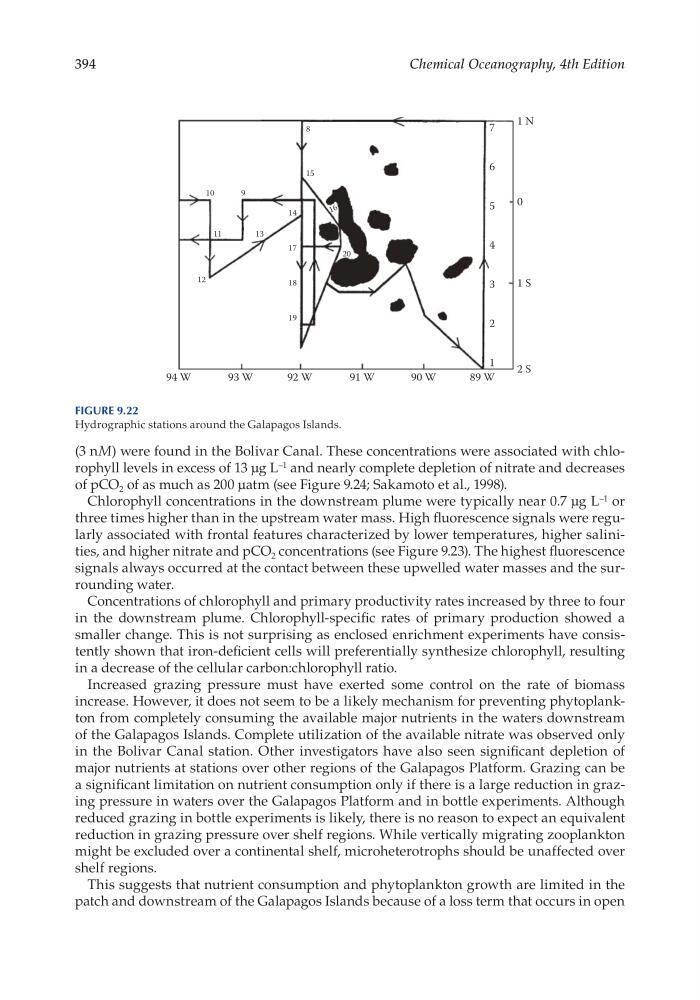
Figure 9.22
Hydrographic stations around the Galapagos Islands.
Chemical Oceanography, 4th Edition
(3 nM) were found in the Bolivar Canal. These concentrations were associated with chlorophyll levels in excess of 13 μg L –1 and nearly complete depletion of nitrate and decreases
of pCO 2 of as much as 200 μatm (see Figure 9.24; Sakamoto et al., 1998).
Chlorophyll concentrations in the downstream plume were typically near 0.7 μg L –1 or
three times higher than in the upstream water mass. High fluorescence signals were regularly associated with frontal features characterized by lower temperatures, higher salinities, and higher nitrate and pCO 2 concentrations (see Figure 9.23). The highest fluorescence
signals always occurred at the contact between these upwelled water masses and the surrounding water.
Concentrations of chlorophyll and primary productivity rates increased by three to four
in the downstream plume. Chlorophyll- specific rates of primary production showed a
smaller change. This is not surprising as enclosed enrichment experiments have consistently shown that iron- deficient cells will preferentially synthesize chlorophyll, resulting
in a decrease of the cellular carbon:chlorophyll ratio.
Increased grazing pressure must have exerted some control on the rate of biomass
increase. However, it does not seem to be a likely mechanism for preventing phytoplankton from completely consuming the available major nutrients in the waters downstream
of the Galapagos Islands. Complete utilization of the available nitrate was observed only
in the Bolivar Canal station. Other investigators have also seen significant depletion of
major nutrients at stations over other regions of the Galapagos Platform. Grazing can be
a significant limitation on nutrient consumption only if there is a large reduction in grazing pressure in waters over the Galapagos Platform and in bottle experiments. Although
reduced grazing in bottle experiments is likely, there is no reason to expect an equivalent
reduction in grazing pressure over shelf regions. While vertically migrating zooplankton
might be excluded over a continental shelf, microheterotrophs should be unaffected over
shelf regions.
This suggests that nutrient consumption and phytoplankton growth are limited in the
patch and downstream of the Galapagos Islands because of a loss term that occurs in open
1 N
1 S
2 S
0
7
6
5
4
3
2
1
94 W
93 W
92 W
91 W
90 W
89 W
10
9
11
13
14
15
8
1 6
17
18
19
12
20
Figure 9.22
Hydrographic stations around the Galapagos Islands.