

377
Primary Production in the Oceans
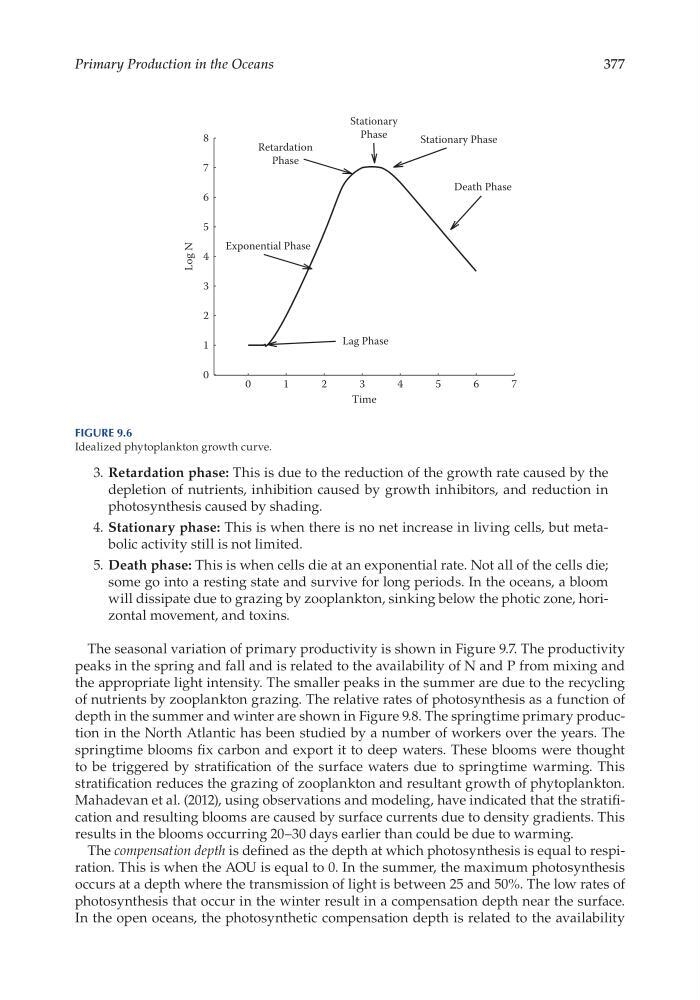
3. Retardation phase: This is due to the reduction of the growth rate caused by the
depletion of nutrients, inhibition caused by growth inhibitors, and reduction in
photosynthesis caused by shading.
4. Stationary phase: This is when there is no net increase in living cells, but metabolic activity still is not limited.
5. Death phase: This is when cells die at an exponential rate. Not all of the cells die;
some go into a resting state and survive for long periods. In the oceans, a bloom
will dissipate due to grazing by zooplankton, sinking below the photic zone, horizontal movement, and toxins.
The seasonal variation of primary productivity is shown in Figure 9.7. The productivity
peaks in the spring and fall and is related to the availability of N and P from mixing and
the appropriate light intensity. The smaller peaks in the summer are due to the recycling
of nutrients by zooplankton grazing. The relative rates of photosynthesis as a function of
depth in the summer and winter are shown in Figure 9.8. The springtime primary production in the North Atlantic has been studied by a number of workers over the years. The
springtime blooms fix carbon and export it to deep waters. These blooms were thought
to be triggered by stratification of the surface waters due to springtime warming. This
stratification reduces the grazing of zooplankton and resultant growth of phytoplankton.
Mahadevan et al. (2012), using observations and modeling, have indicated that the stratification and resulting blooms are caused by surface currents due to density gradients. This
results in the blooms occurring 20–30 days earlier than could be due to warming.
The compensation depth is defined as the depth at which photosynthesis is equal to respiration. This is when the AOU is equal to 0. In the summer, the maximum photosynthesis
occurs at a depth where the transmission of light is between 25 and 50%. The low rates of
photosynthesis that occur in the winter result in a compensation depth near the surface.
In the open oceans, the photosynthetic compensation depth is related to the availability
Time
0
1
2
3
4
5
6
7
Log N
0
1
2
3
4
5
6
7
8
Death Phase
Exponential Phase
Lag Phase
Stationary
Phase
Retardation
Phase
Stationary Phase
Figure 9.6
Idealized phytoplankton growth curve.
Primary Production in the Oceans
3. Retardation phase: This is due to the reduction of the growth rate caused by the
depletion of nutrients, inhibition caused by growth inhibitors, and reduction in
photosynthesis caused by shading.
4. Stationary phase: This is when there is no net increase in living cells, but metabolic activity still is not limited.
5. Death phase: This is when cells die at an exponential rate. Not all of the cells die;
some go into a resting state and survive for long periods. In the oceans, a bloom
will dissipate due to grazing by zooplankton, sinking below the photic zone, horizontal movement, and toxins.
The seasonal variation of primary productivity is shown in Figure 9.7. The productivity
peaks in the spring and fall and is related to the availability of N and P from mixing and
the appropriate light intensity. The smaller peaks in the summer are due to the recycling
of nutrients by zooplankton grazing. The relative rates of photosynthesis as a function of
depth in the summer and winter are shown in Figure 9.8. The springtime primary production in the North Atlantic has been studied by a number of workers over the years. The
springtime blooms fix carbon and export it to deep waters. These blooms were thought
to be triggered by stratification of the surface waters due to springtime warming. This
stratification reduces the grazing of zooplankton and resultant growth of phytoplankton.
Mahadevan et al. (2012), using observations and modeling, have indicated that the stratification and resulting blooms are caused by surface currents due to density gradients. This
results in the blooms occurring 20–30 days earlier than could be due to warming.
The compensation depth is defined as the depth at which photosynthesis is equal to respiration. This is when the AOU is equal to 0. In the summer, the maximum photosynthesis
occurs at a depth where the transmission of light is between 25 and 50%. The low rates of
photosynthesis that occur in the winter result in a compensation depth near the surface.
In the open oceans, the photosynthetic compensation depth is related to the availability
Time
0
1
2
3
4
5
6
7
Log N
0
1
2
3
4
5
6
7
8
Death Phase
Exponential Phase
Lag Phase
Stationary
Phase
Retardation
Phase
Stationary Phase
Figure 9.6
Idealized phytoplankton growth curve.