

300
Chemical Oceanography, 4th Edition
The first direct measurements to examine the rates of dissolution of CaCO 3 (s) in the
oceans were made by Peterson (1966). He suspended calcite spheres in the Pacific on deepsea moorings for 250 days. His results are shown in Figure 7.39. At a depth of about 4000 m,
the solution rate dramatically increased. This depth of rapid increase in the rate of dissolution is called the lysocline. Honjo (1975) suspended a number of CaCO 3 solids for 79 days
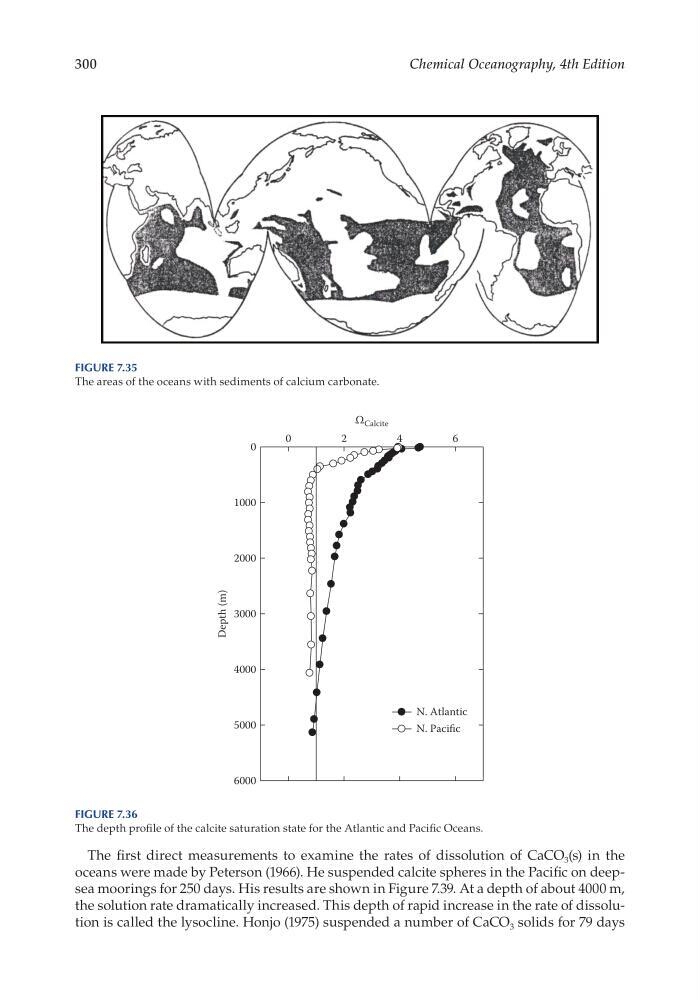
Figure 7.35
The areas of the oceans with sediments of calcium carbonate.
Ω Calcite
0
2
4
6
Depth (m)
0
1000
2000
3000
4000
5000
6000
N. Atlantic
N. Pacific
Figure 7.36
The depth profile of the calcite saturation state for the Atlantic and Pacific Oceans.
Chemical Oceanography, 4th Edition
The first direct measurements to examine the rates of dissolution of CaCO 3 (s) in the
oceans were made by Peterson (1966). He suspended calcite spheres in the Pacific on deepsea moorings for 250 days. His results are shown in Figure 7.39. At a depth of about 4000 m,
the solution rate dramatically increased. This depth of rapid increase in the rate of dissolution is called the lysocline. Honjo (1975) suspended a number of CaCO 3 solids for 79 days
Figure 7.35
The areas of the oceans with sediments of calcium carbonate.
Ω Calcite
0
2
4
6
Depth (m)
0
1000
2000
3000
4000
5000
6000
N. Atlantic
N. Pacific
Figure 7.36
The depth profile of the calcite saturation state for the Atlantic and Pacific Oceans.