

298
Chemical Oceanography, 4th Edition
Approximate saturation levels in North Atlantic and North Pacific waters are as follows:
North Atlantic
North Pacific
Calcite
4300 m
750 m
Aragonite
1500 m
500 m
The greater solubility of these minerals in deep waters is related to the effect of pressure on the solubility of CaCO 3 (s). Since two divalent ions are formed during the dissolution, the volume change is large and negative because of electrostriction. The Pacific deep
waters become undersaturated at shallower depths because of the lower pH or higher CO 2
formed by the oxidation of plant material. This decreases the concentration of CO 3
2– caused
by the shift in the equilibrium:
CO 3
2– + H + → HCO 3
–
(7.128)
The differences in Ω in the two oceans become smaller in the deep oceans because
of the effect of pressure controlling solubility. Although much of the deep oceans is
undersaturated with respect to CaCO 3 (s), large amounts of calcite are present in ocean
sediments. Geologists call the layer where CaCO 3 (s) is above 5% of the sediments the
calcium carbonate compensation depth (CCD). As shown in Figure 7.38, the CaCO 3 compensation depth in the Atlantic is about 2 km below the saturation depth. These results
indicate that the solubility of CaCO 3 (s) in seawater is not controlled by equilibrium but
by kinetic constraints.
NTCO 2 (µmol kg
–1 )
1900
2000
2100
2200
2300
2400
NTA (µmol kg
–1
)
2250
2300
2350
2400
2450
2500
Temperate
Surface Waters
Antarctic
Surface Water
Antarctic
Deep Waters
North Atlantic
Deep Water (2.5°C)
North Indian
and Pacific
Bottom Waters
Surface
Waters
Deep
Waters
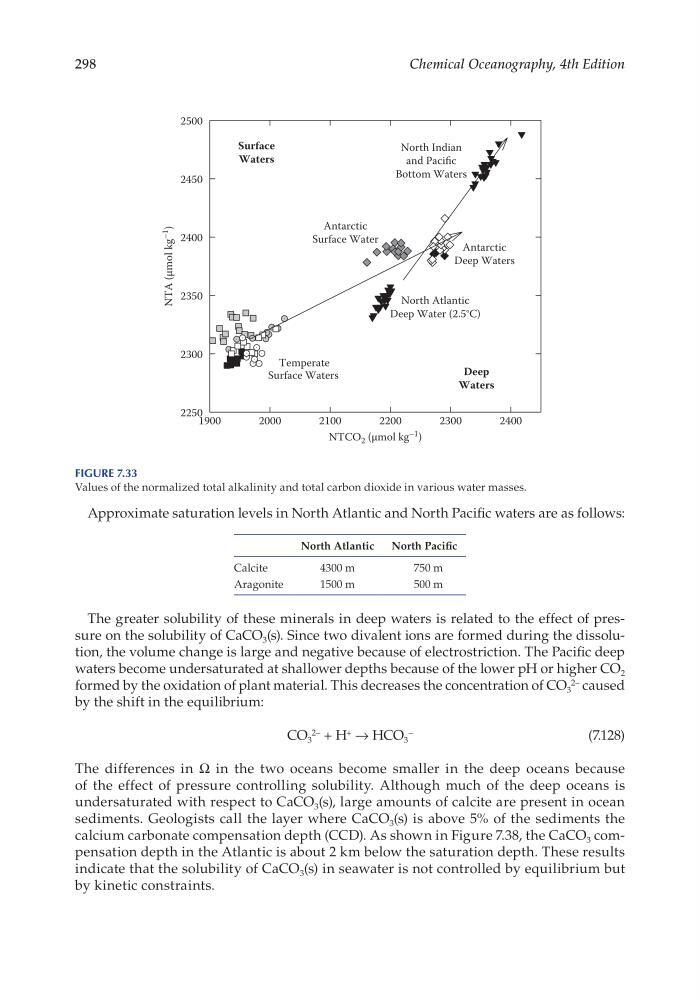
Figure 7.33
Values of the normalized total alkalinity and total carbon dioxide in various water masses.
Chemical Oceanography, 4th Edition
Approximate saturation levels in North Atlantic and North Pacific waters are as follows:
North Atlantic
North Pacific
Calcite
4300 m
750 m
Aragonite
1500 m
500 m
The greater solubility of these minerals in deep waters is related to the effect of pressure on the solubility of CaCO 3 (s). Since two divalent ions are formed during the dissolution, the volume change is large and negative because of electrostriction. The Pacific deep
waters become undersaturated at shallower depths because of the lower pH or higher CO 2
formed by the oxidation of plant material. This decreases the concentration of CO 3
2– caused
by the shift in the equilibrium:
CO 3
2– + H + → HCO 3
–
(7.128)
The differences in Ω in the two oceans become smaller in the deep oceans because
of the effect of pressure controlling solubility. Although much of the deep oceans is
undersaturated with respect to CaCO 3 (s), large amounts of calcite are present in ocean
sediments. Geologists call the layer where CaCO 3 (s) is above 5% of the sediments the
calcium carbonate compensation depth (CCD). As shown in Figure 7.38, the CaCO 3 compensation depth in the Atlantic is about 2 km below the saturation depth. These results
indicate that the solubility of CaCO 3 (s) in seawater is not controlled by equilibrium but
by kinetic constraints.
NTCO 2 (µmol kg
–1 )
1900
2000
2100
2200
2300
2400
NTA (µmol kg
–1
)
2250
2300
2350
2400
2450
2500
Temperate
Surface Waters
Antarctic
Surface Water
Antarctic
Deep Waters
North Atlantic
Deep Water (2.5°C)
North Indian
and Pacific
Bottom Waters
Surface
Waters
Deep
Waters
Figure 7.33
Values of the normalized total alkalinity and total carbon dioxide in various water masses.