

296
Chemical Oceanography, 4th Edition
The saturation state of seawater with respect to CaCO 3 is determined from
Ω = [Ca 2+ ][CO 3
2– ]/Ksp*
(7.126)
where [Ca 2+ ][CO 3
2– ] is the ion product of the concentration of Ca 2+ and CO 3
2– and Ksp* is the
solubility product at the in situ conditions of S, t, and P. Since Ca 2+ is a major constituent of
seawater (within 1%), its concentration (mol kg –1 ) can be estimated from
[Ca 2+ ] = 2.934 × 10 –4 S
(7.127)
The solubility product for calcite formed by foramanifera and aragonite formed by pteropods can be determined from Equation 7.72 to Equation 7.80. The values of [CO 3
2– ] can be
determined from the measured carbonate parameters (pH and TA or TA and TCO 2 ).
Profiles of Ω for calcite and aragonite for Atlantic and Pacific waters are shown in
Figure 7.36 and Figure 7.37, respectively. The surface values of Ω for calcite are near 5.0 and
decrease below 1.0 in deep water. The surface value of Ω for aragonite is 3.0. Aragonite is
1.5 times more soluble than calcite at a given S, t, and P. The waters of the Pacific become
undersaturated (Ω < 1.0) at shallower depths than those of the Atlantic.
Latitude
Latitude
–50 –40 –30 –20 –10 0 10 20 30 40 50 60 70
NTCO
2 (µmol kg
–1
)
NTCO
2 (µmol kg
–1
)
1920
1960
2000
2040
2080
2120
Pacific
–70 –60 –50 –40 –30 –20 –10
0
10 20 30
1950
2000
2050
2100
2150
2200
2250
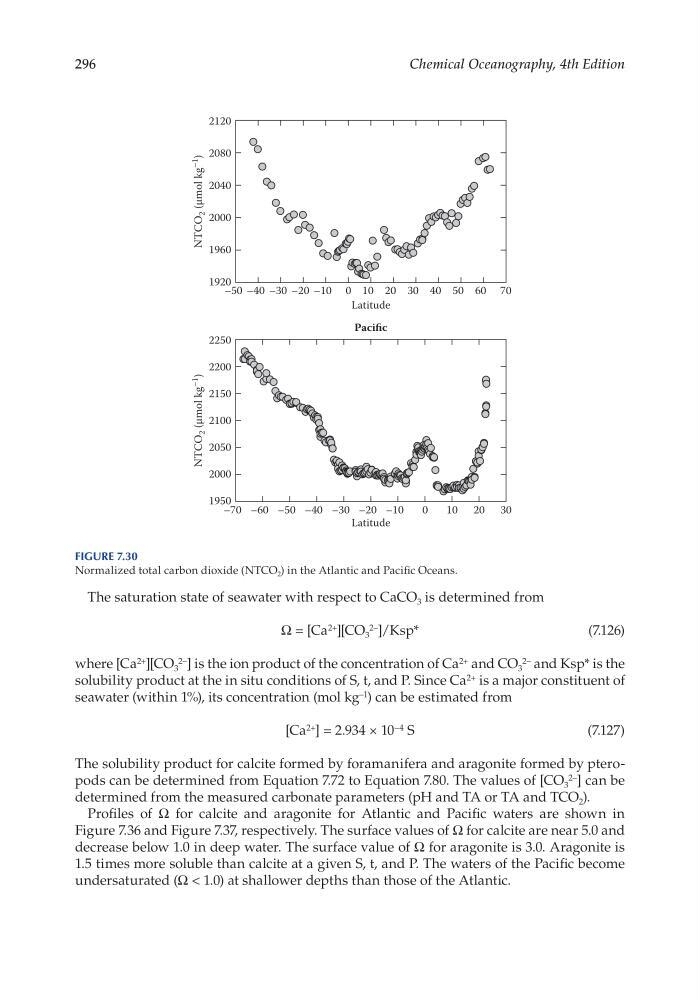
Figure 7.30
Normalized total carbon dioxide (NTCO 2 ) in the Atlantic and Pacific Oceans.
Chemical Oceanography, 4th Edition
The saturation state of seawater with respect to CaCO 3 is determined from
Ω = [Ca 2+ ][CO 3
2– ]/Ksp*
(7.126)
where [Ca 2+ ][CO 3
2– ] is the ion product of the concentration of Ca 2+ and CO 3
2– and Ksp* is the
solubility product at the in situ conditions of S, t, and P. Since Ca 2+ is a major constituent of
seawater (within 1%), its concentration (mol kg –1 ) can be estimated from
[Ca 2+ ] = 2.934 × 10 –4 S
(7.127)
The solubility product for calcite formed by foramanifera and aragonite formed by pteropods can be determined from Equation 7.72 to Equation 7.80. The values of [CO 3
2– ] can be
determined from the measured carbonate parameters (pH and TA or TA and TCO 2 ).
Profiles of Ω for calcite and aragonite for Atlantic and Pacific waters are shown in
Figure 7.36 and Figure 7.37, respectively. The surface values of Ω for calcite are near 5.0 and
decrease below 1.0 in deep water. The surface value of Ω for aragonite is 3.0. Aragonite is
1.5 times more soluble than calcite at a given S, t, and P. The waters of the Pacific become
undersaturated (Ω < 1.0) at shallower depths than those of the Atlantic.
Latitude
Latitude
–50 –40 –30 –20 –10 0 10 20 30 40 50 60 70
NTCO
2 (µmol kg
–1
)
NTCO
2 (µmol kg
–1
)
1920
1960
2000
2040
2080
2120
Pacific
–70 –60 –50 –40 –30 –20 –10
0
10 20 30
1950
2000
2050
2100
2150
2200
2250
Figure 7.30
Normalized total carbon dioxide (NTCO 2 ) in the Atlantic and Pacific Oceans.