

269
The Carbonate System
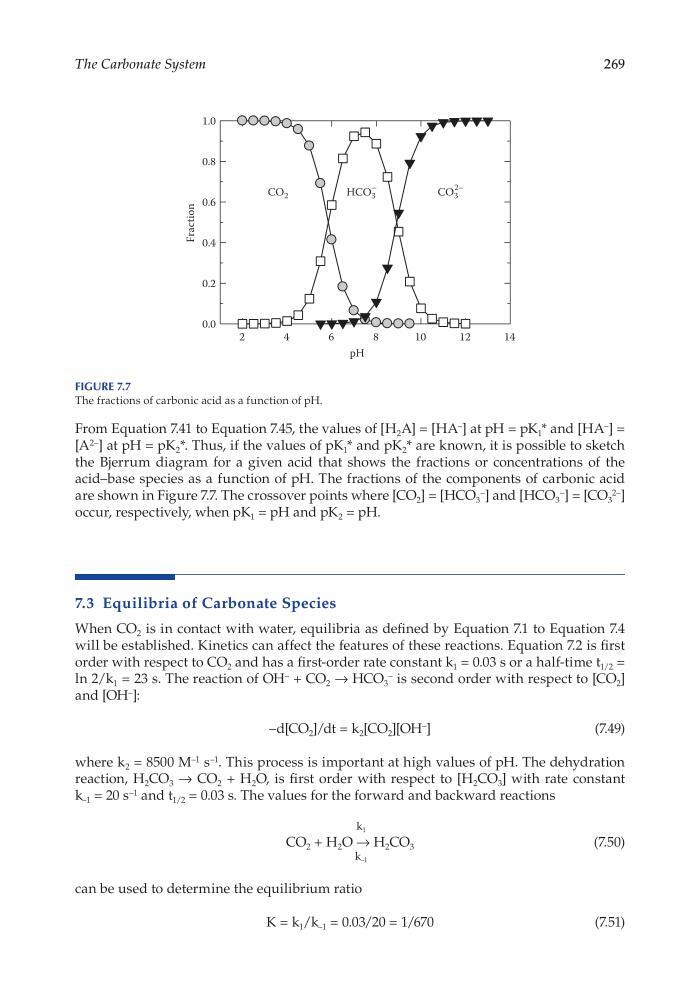
From Equation 7.41 to Equation 7.45, the values of [H 2 A] = [HA – ] at pH = pK 1 * and [HA – ] =
[A 2– ] at pH = pK 2 *. Thus, if the values of pK 1 * and pK 2 * are known, it is possible to sketch
the Bjerrum diagram for a given acid that shows the fractions or concentrations of the
acid–base species as a function of pH. The fractions of the components of carbonic acid
are shown in Figure 7.7. The crossover points where [CO 2 ] = [HCO 3
– ] and [HCO 3
– ] = [CO 3
2– ]
occur, respectively, when pK 1 = pH and pK 2 = pH.
7.3
Equilibria of Carbonate Species
When CO 2 is in contact with water, equilibria as defined by Equation 7.1 to Equation 7.4
will be established. Kinetics can affect the features of these reactions. Equation 7.2 is first
order with respect to CO 2 and has a first- order rate constant k 1 = 0.03 s or a half- time t 1/2 =
ln 2/k 1 = 23 s. The reaction of OH – + CO 2 → HCO 3
– is second order with respect to [CO 2 ]
and [OH – ]:
–d[CO 2 ]/dt = k 2 [CO 2 ][OH – ]
(7.49)
where k 2 = 8500 M –1 s –1 . This process is important at high values of pH. The dehydration
reaction, H 2 CO 3 → CO 2 + H 2 O, is first order with respect to [H 2 CO 3 ] with rate constant
k –1 = 20 s –1 and t 1/2 = 0.03 s. The values for the forward and backward reactions
k 1
CO 2 + H 2 O → H 2 CO 3
(7.50)
k –1
can be used to determine the equilibrium ratio
K = k 1 /k –1 = 0.03/20 = 1/670
(7.51)
pH
2
4
6
8
10
12
14
Fraction
0.0
0.2
0.4
0.6
0.8
1.0
CO 2
CO 3
2–
HCO 3
–
Figure 7.7
The fractions of carbonic acid as a function of pH.
The Carbonate System
From Equation 7.41 to Equation 7.45, the values of [H 2 A] = [HA – ] at pH = pK 1 * and [HA – ] =
[A 2– ] at pH = pK 2 *. Thus, if the values of pK 1 * and pK 2 * are known, it is possible to sketch
the Bjerrum diagram for a given acid that shows the fractions or concentrations of the
acid–base species as a function of pH. The fractions of the components of carbonic acid
are shown in Figure 7.7. The crossover points where [CO 2 ] = [HCO 3
– ] and [HCO 3
– ] = [CO 3
2– ]
occur, respectively, when pK 1 = pH and pK 2 = pH.
7.3
Equilibria of Carbonate Species
When CO 2 is in contact with water, equilibria as defined by Equation 7.1 to Equation 7.4
will be established. Kinetics can affect the features of these reactions. Equation 7.2 is first
order with respect to CO 2 and has a first- order rate constant k 1 = 0.03 s or a half- time t 1/2 =
ln 2/k 1 = 23 s. The reaction of OH – + CO 2 → HCO 3
– is second order with respect to [CO 2 ]
and [OH – ]:
–d[CO 2 ]/dt = k 2 [CO 2 ][OH – ]
(7.49)
where k 2 = 8500 M –1 s –1 . This process is important at high values of pH. The dehydration
reaction, H 2 CO 3 → CO 2 + H 2 O, is first order with respect to [H 2 CO 3 ] with rate constant
k –1 = 20 s –1 and t 1/2 = 0.03 s. The values for the forward and backward reactions
k 1
CO 2 + H 2 O → H 2 CO 3
(7.50)
k –1
can be used to determine the equilibrium ratio
K = k 1 /k –1 = 0.03/20 = 1/670
(7.51)
pH
2
4
6
8
10
12
14
Fraction
0.0
0.2
0.4
0.6
0.8
1.0
CO 2
CO 3
2–
HCO 3
–
Figure 7.7
The fractions of carbonic acid as a function of pH.