

260
Chemical Oceanography, 4th Edition
in the chapter, the increased adsorption of CO 2 by the oceans will result in a decrease
in the pH (ocean acidification). Approximate timescales for the mixing process can be
determined using radioactive tracers to gain some idea of the mixing times. To use these
estimates, it is necessary to have some idea of the total carbon in various reservoirs and
the global carbon cycle. The most recent estimates are shown in Figure 7.4. The inorganic
carbon estimates are reasonably accurate, but estimates for the carbon in the marine biosphere and humus are less precisely known. Most of the carbon in the oceans resides
below the thermocline. The amount of carbon stored in carbonate rocks and sediments is a
lot larger than the cycled CO 2 but is not important on short timescales (years).
pCO 2 (ATM)
Biological Pump
106 CO 2 + HNO 3 + H 3 PCO 4 = 122 H 2 O
(CH 2 O) 106 (NH 3 ) 16 H 3 PO 4 + 122 O 2
Surface Ocean
Phytoplankton
Zooplankton
Deep Ocean
POM
DOM
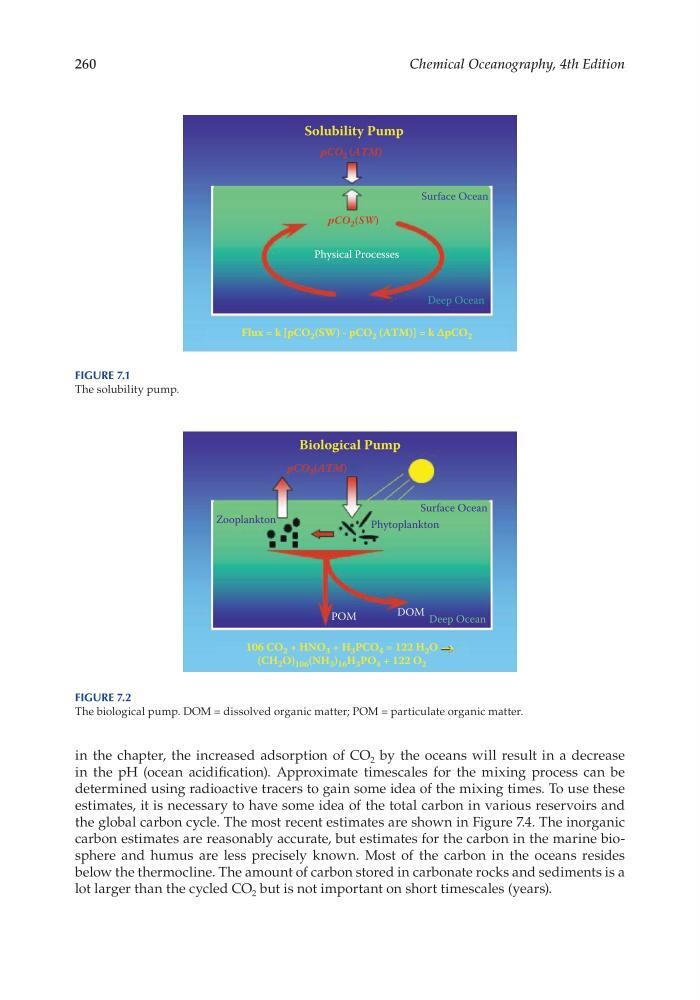
Figure 7.2
The biological pump. DOM = dissolved organic matter; POM = particulate organic matter.
pCO 2 (SW)
pCO 2 (ATM)
Solubility Pump
Flux = k [pCO 2 (SW) - pCO 2 (ATM)] = k ∆pCO 2
Surface Ocean
Deep Ocean
Physical Processes
Figure 7.1
The solubility pump.
Chemical Oceanography, 4th Edition
in the chapter, the increased adsorption of CO 2 by the oceans will result in a decrease
in the pH (ocean acidification). Approximate timescales for the mixing process can be
determined using radioactive tracers to gain some idea of the mixing times. To use these
estimates, it is necessary to have some idea of the total carbon in various reservoirs and
the global carbon cycle. The most recent estimates are shown in Figure 7.4. The inorganic
carbon estimates are reasonably accurate, but estimates for the carbon in the marine biosphere and humus are less precisely known. Most of the carbon in the oceans resides
below the thermocline. The amount of carbon stored in carbonate rocks and sediments is a
lot larger than the cycled CO 2 but is not important on short timescales (years).
pCO 2 (ATM)
Biological Pump
106 CO 2 + HNO 3 + H 3 PCO 4 = 122 H 2 O
(CH 2 O) 106 (NH 3 ) 16 H 3 PO 4 + 122 O 2
Surface Ocean
Phytoplankton
Zooplankton
Deep Ocean
POM
DOM
Figure 7.2
The biological pump. DOM = dissolved organic matter; POM = particulate organic matter.
pCO 2 (SW)
pCO 2 (ATM)
Solubility Pump
Flux = k [pCO 2 (SW) - pCO 2 (ATM)] = k ∆pCO 2
Surface Ocean
Deep Ocean
Physical Processes
Figure 7.1
The solubility pump.