

257
Dissolved Gases Other than CO 2
Masterton (1975) has shown that the salting out of gases in seawater can be accounted
for using
k = k a + k b
(6.55)
This equation is derived from the scale particle theory. k a results from the free energy
of cavity formation, and k b results from the free energy of interaction between the gas
molecule and the surrounding water molecules and ions. The first term is calculated from
the diameter of the gas and water molecules, the number of water molecules and ions per
milli liter, and the diameter of the ion. The k a term is always positive and leads to salting
out. It increases as the diameter of the gas molecule increases and becomes a smaller positive number as the temperature rises.
k b is related to the polarizability of the gas molecules and the ions, the total number of
electrons in the ion, and the dipole movement of water. k b is negative for all gases between
0 and 40°C and thus leads to salting in. The magnitude of k b decreases with increasing
temperature. A comparison of the measured and calculated values of k in NaCl and seawater is shown in Table 6.9. The agreement is quite good. A more thorough examination
of the use of the scale particle model to gases in seawater has been given by Millero (2000).
References and Further Reading
Benson, B.B., and Krause, D., Jr., The concentration and isotopic fractionation of oxygen dissolved in
fresh water and seawater in equilibrium with the atmosphere, Limnol. Oceanogr., 29, 620 (1984).
Benson, B.B., and Parker, P.D.M., Nitrogen/ argon and nitrogen isotope ratios in aerobic seawater,
Deep- Sea Res., 7, 237 (1961).
Broecker, W.S., and Peng, T.H., Tracers in the Sea, Eldigio Press, New York (1982).
Carpenter, J., The accuracy of the Winker method for the dissolved oxygen analysis, Limnol. Oceanogr.,
10, 141 (1965).
Craig, H.H., Abyssal carbon and radiocarbon in the Pacific, J. Geophys. Res., 74, 5491 (1969).
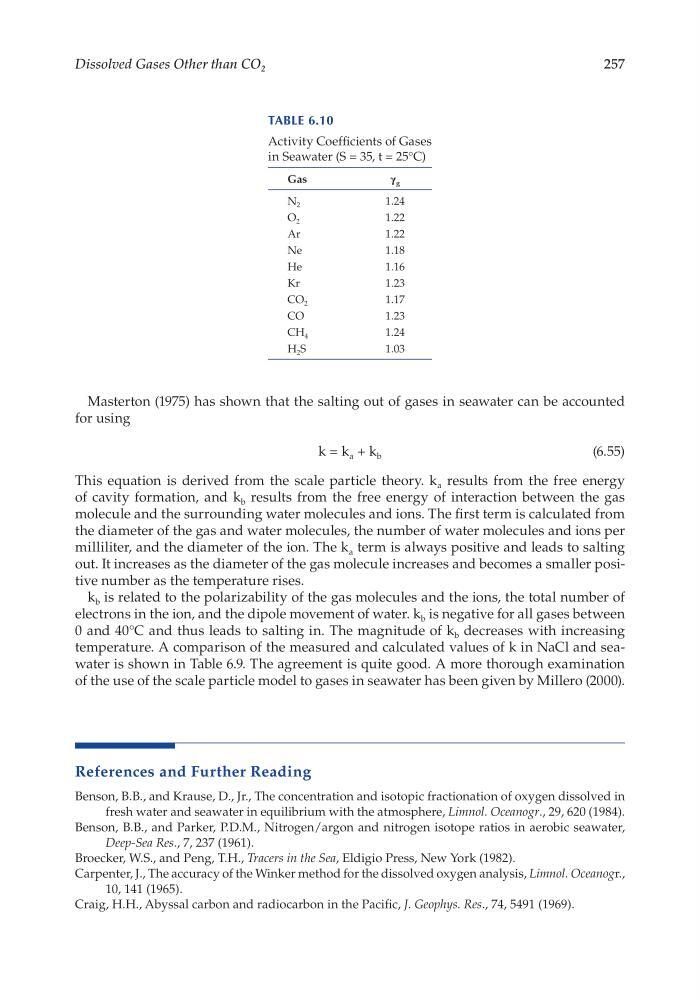
Table 6.10
Activity Coefficients of Gases
in Seawater (S = 35, t = 25°C)
Gas
γ g
N 2
1.24
O 2
1.22
Ar
1.22
Ne
1.18
He
1.16
Kr
1.23
CO 2
1.17
CO
1.23
CH 4
1.24
H 2 S
1.03
Dissolved Gases Other than CO 2
Masterton (1975) has shown that the salting out of gases in seawater can be accounted
for using
k = k a + k b
(6.55)
This equation is derived from the scale particle theory. k a results from the free energy
of cavity formation, and k b results from the free energy of interaction between the gas
molecule and the surrounding water molecules and ions. The first term is calculated from
the diameter of the gas and water molecules, the number of water molecules and ions per
milli liter, and the diameter of the ion. The k a term is always positive and leads to salting
out. It increases as the diameter of the gas molecule increases and becomes a smaller positive number as the temperature rises.
k b is related to the polarizability of the gas molecules and the ions, the total number of
electrons in the ion, and the dipole movement of water. k b is negative for all gases between
0 and 40°C and thus leads to salting in. The magnitude of k b decreases with increasing
temperature. A comparison of the measured and calculated values of k in NaCl and seawater is shown in Table 6.9. The agreement is quite good. A more thorough examination
of the use of the scale particle model to gases in seawater has been given by Millero (2000).
References and Further Reading
Benson, B.B., and Krause, D., Jr., The concentration and isotopic fractionation of oxygen dissolved in
fresh water and seawater in equilibrium with the atmosphere, Limnol. Oceanogr., 29, 620 (1984).
Benson, B.B., and Parker, P.D.M., Nitrogen/ argon and nitrogen isotope ratios in aerobic seawater,
Deep- Sea Res., 7, 237 (1961).
Broecker, W.S., and Peng, T.H., Tracers in the Sea, Eldigio Press, New York (1982).
Carpenter, J., The accuracy of the Winker method for the dissolved oxygen analysis, Limnol. Oceanogr.,
10, 141 (1965).
Craig, H.H., Abyssal carbon and radiocarbon in the Pacific, J. Geophys. Res., 74, 5491 (1969).
Table 6.10
Activity Coefficients of Gases
in Seawater (S = 35, t = 25°C)
Gas
γ g
N 2
1.24
O 2
1.22
Ar
1.22
Ne
1.18
He
1.16
Kr
1.23
CO 2
1.17
CO
1.23
CH 4
1.24
H 2 S
1.03