

255
Dissolved Gases Other than CO 2
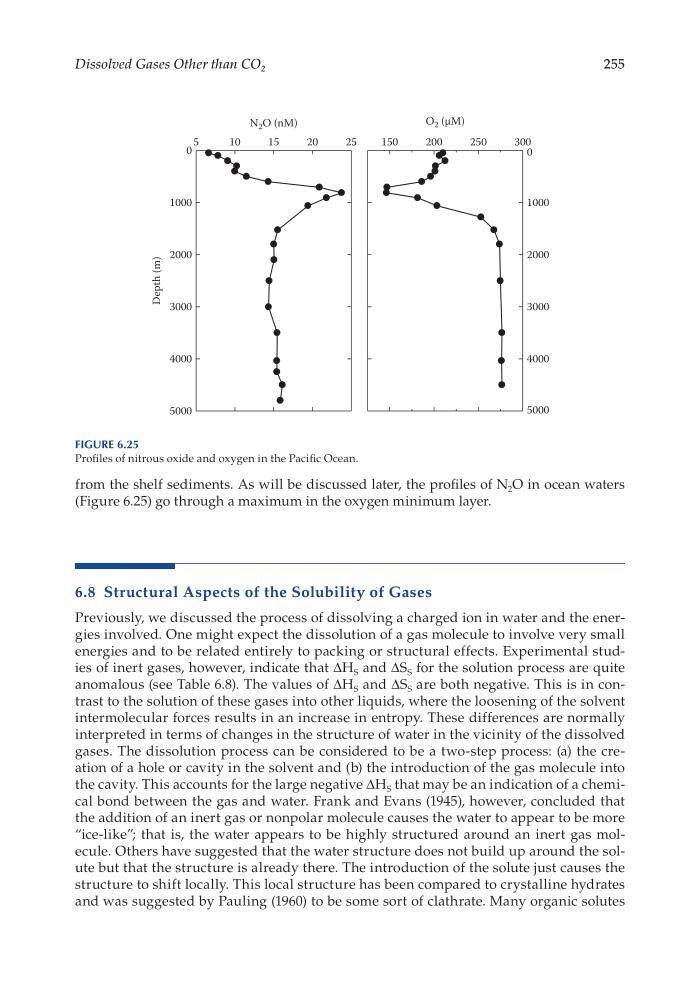
from the shelf sediments. As will be discussed later, the profiles of N 2 O in ocean waters
(Figure 6.25) go through a maximum in the oxygen minimum layer.
6.8 Structural Aspects of the Solubility of Gases
Previously, we discussed the process of dissolving a charged ion in water and the energies involved. One might expect the dissolution of a gas molecule to involve very small
energies and to be related entirely to packing or structural effects. Experimental studies of inert gases, however, indicate that ΔH S and ΔS S for the solution process are quite
anomalous (see Table 6.8). The values of ΔH S and ΔS S are both negative. This is in contrast to the solution of these gases into other liquids, where the loosening of the solvent
intermolecular forces results in an increase in entropy. These differences are normally
interpreted in terms of changes in the structure of water in the vicinity of the dissolved
gases. The dissolution process can be considered to be a two- step process: (a) the creation of a hole or cavity in the solvent and (b) the introduction of the gas molecule into
the cavity. This accounts for the large negative ΔH S that may be an indication of a chemical bond between the gas and water. Frank and Evans (1945), however, concluded that
the addition of an inert gas or nonpolar molecule causes the water to appear to be more
“ice- like”; that is, the water appears to be highly structured around an inert gas molecule. Others have suggested that the water structure does not build up around the solute but that the structure is already there. The introduction of the solute just causes the
structure to shift locally. This local structure has been compared to crystalline hydrates
and was suggested by Pauling (1960) to be some sort of clathrate. Many organic solutes
N 2 O (nM)
5
10
15
20
25
Depth (m)
0
1000
2000
3000
4000
5000
O 2 (µM)
150
200
250
300
0
1000
2000
3000
4000
5000
Figure 6.25
Profiles of nitrous oxide and oxygen in the Pacific Ocean.
Dissolved Gases Other than CO 2
from the shelf sediments. As will be discussed later, the profiles of N 2 O in ocean waters
(Figure 6.25) go through a maximum in the oxygen minimum layer.
6.8 Structural Aspects of the Solubility of Gases
Previously, we discussed the process of dissolving a charged ion in water and the energies involved. One might expect the dissolution of a gas molecule to involve very small
energies and to be related entirely to packing or structural effects. Experimental studies of inert gases, however, indicate that ΔH S and ΔS S for the solution process are quite
anomalous (see Table 6.8). The values of ΔH S and ΔS S are both negative. This is in contrast to the solution of these gases into other liquids, where the loosening of the solvent
intermolecular forces results in an increase in entropy. These differences are normally
interpreted in terms of changes in the structure of water in the vicinity of the dissolved
gases. The dissolution process can be considered to be a two- step process: (a) the creation of a hole or cavity in the solvent and (b) the introduction of the gas molecule into
the cavity. This accounts for the large negative ΔH S that may be an indication of a chemical bond between the gas and water. Frank and Evans (1945), however, concluded that
the addition of an inert gas or nonpolar molecule causes the water to appear to be more
“ice- like”; that is, the water appears to be highly structured around an inert gas molecule. Others have suggested that the water structure does not build up around the solute but that the structure is already there. The introduction of the solute just causes the
structure to shift locally. This local structure has been compared to crystalline hydrates
and was suggested by Pauling (1960) to be some sort of clathrate. Many organic solutes
N 2 O (nM)
5
10
15
20
25
Depth (m)
0
1000
2000
3000
4000
5000
O 2 (µM)
150
200
250
300
0
1000
2000
3000
4000
5000
Figure 6.25
Profiles of nitrous oxide and oxygen in the Pacific Ocean.