

244
Chemical Oceanography, 4th Edition
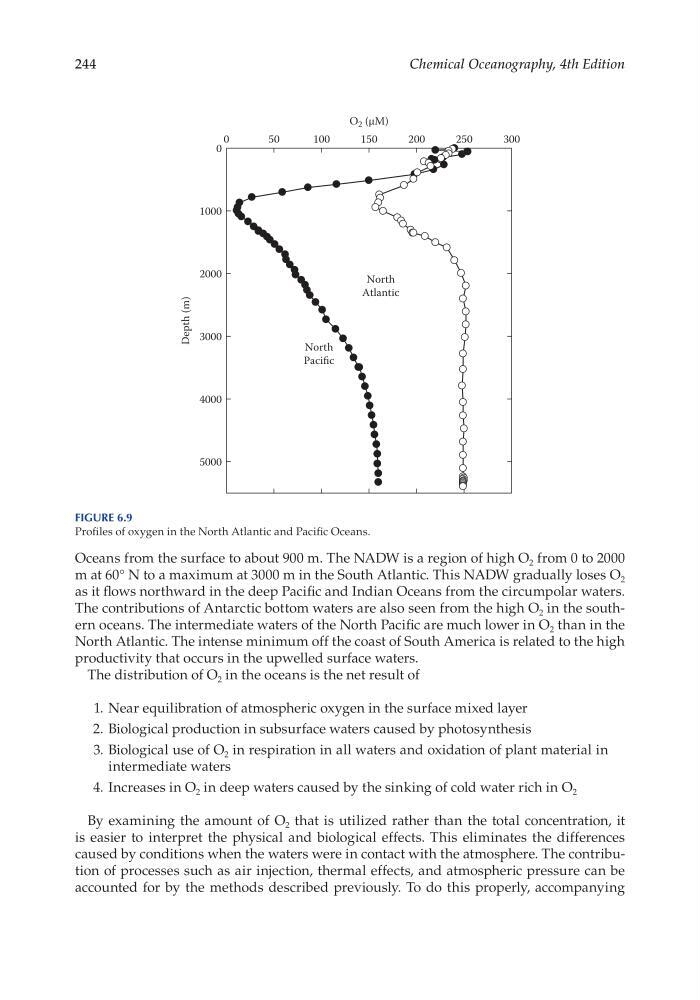
Oceans from the surface to about 900 m. The NADW is a region of high O 2 from 0 to 2000
m at 60° N to a maximum at 3000 m in the South Atlantic. This NADW gradually loses O 2
as it flows northward in the deep Pacific and Indian Oceans from the circumpolar waters.
The contributions of Antarctic bottom waters are also seen from the high O 2 in the southern oceans. The intermediate waters of the North Pacific are much lower in O 2 than in the
North Atlantic. The intense minimum off the coast of South America is related to the high
productivity that occurs in the upwelled surface waters.
The distribution of O 2 in the oceans is the net result of
1. Near equilibration of atmospheric oxygen in the surface mixed layer
2. Biological production in subsurface waters caused by photosynthesis
3. Biological use of O 2 in respiration in all waters and oxidation of plant material in
intermediate waters
4. Increases in O 2 in deep waters caused by the sinking of cold water rich in O 2
By examining the amount of O 2 that is utilized rather than the total concentration, it
is easier to interpret the physical and biological effects. This eliminates the differences
caused by conditions when the waters were in contact with the atmosphere. The contribution of processes such as air injection, thermal effects, and atmospheric pressure can be
accounted for by the methods described previously. To do this properly, accompanying
O 2 (µM)
0
50
100
150
200
250
300
Depth (m)
0
1000
2000
3000
4000
5000
North
Pacific
North
Atlantic
Figure 6.9
Profiles of oxygen in the North Atlantic and Pacific Oceans.
Chemical Oceanography, 4th Edition
Oceans from the surface to about 900 m. The NADW is a region of high O 2 from 0 to 2000
m at 60° N to a maximum at 3000 m in the South Atlantic. This NADW gradually loses O 2
as it flows northward in the deep Pacific and Indian Oceans from the circumpolar waters.
The contributions of Antarctic bottom waters are also seen from the high O 2 in the southern oceans. The intermediate waters of the North Pacific are much lower in O 2 than in the
North Atlantic. The intense minimum off the coast of South America is related to the high
productivity that occurs in the upwelled surface waters.
The distribution of O 2 in the oceans is the net result of
1. Near equilibration of atmospheric oxygen in the surface mixed layer
2. Biological production in subsurface waters caused by photosynthesis
3. Biological use of O 2 in respiration in all waters and oxidation of plant material in
intermediate waters
4. Increases in O 2 in deep waters caused by the sinking of cold water rich in O 2
By examining the amount of O 2 that is utilized rather than the total concentration, it
is easier to interpret the physical and biological effects. This eliminates the differences
caused by conditions when the waters were in contact with the atmosphere. The contribution of processes such as air injection, thermal effects, and atmospheric pressure can be
accounted for by the methods described previously. To do this properly, accompanying
O 2 (µM)
0
50
100
150
200
250
300
Depth (m)
0
1000
2000
3000
4000
5000
North
Pacific
North
Atlantic
Figure 6.9
Profiles of oxygen in the North Atlantic and Pacific Oceans.