

236
Chemical Oceanography, 4th Edition
and the Henry’s law constant for the gas. For most gases the resistance of one phase dominates and controls the total resistance.
For gases that can react chemically with water (CO 2 and SO 2 ), the transport is more
complex. This is due to the existence of not only a gas gradient but also a gradient in
the chemical species formed (HCO 3
– and HSO 3
– ). To account for the increase in the flux
caused by chemical reactions, workers have defined a term α. This gives
1/k l = 1/k l α + 1/Hk g = C g / k l αH – C l / k l α
(6.33)
For unreactive gases, α = 1.0, while for a gas like SO 2 α ≈ 2000. For gases like H 2 O, HCl, SO 2 ,
and HNO 3 , which partition strongly into water (low H) or react rapidly, the R g >> R l . For
gases like O 2 , N 2 , CO 2 , inert gases, SF 6 , and freons, which have high values of H and are
nonreactive, R l >> R g . The α for CO 2 , for example, is about 1.02 to 1.03. Thus, for most gases
the R l or k l term will dominate.
Values of k l at the air–sea interface have been estimated by a number of workers.
Broecker and Peng (1982), using 14 C data, found a value of k W = 20 cm h –1 with a probable
error of 20%, or 5 cm h –1 . A number of workers have used O 2 measurements to estimate k W .
They found k W = 5 to 15 cm h –1 in the summer and k W = 40 to 50 cm h –1 in the winter. The
higher values are probably related to the higher wind speeds in the winter. Broecker and
Peng (1982) have also used the concentrations of radon 222 Rn near the interface to estimate
values of k W . These results give k W = 12 to 15 cm h –1 , which corresponds to k W = 15 cm h –1
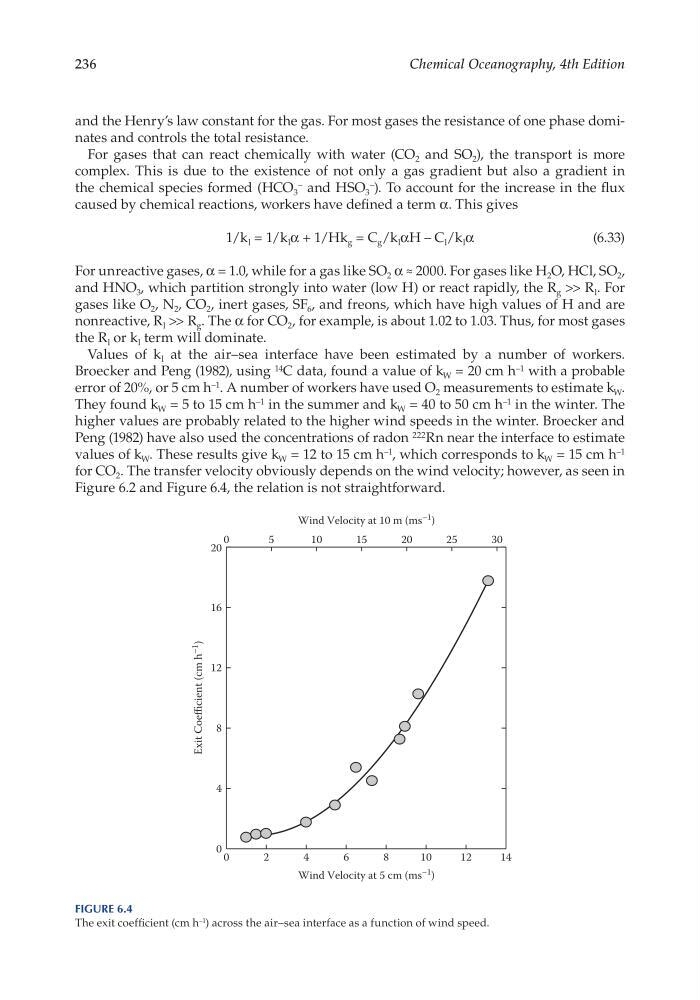
for CO 2 . The transfer velocity obviously depends on the wind velocity; however, as seen in
Figure 6.2 and Figure 6.4, the relation is not straightforward.
0
2
4
6
8
10
12
14
Exit Coefficient (cm h
–1
)
0
4
8
12
16
20
Wind Velocity at 10 m (ms
–1 )
0
5
10
15
20
25
30
Wind Velocity at 5 cm (ms –1 )
Figure 6.4
The exit coefficient (cm h –1 ) across the air–sea interface as a function of wind speed.
Chemical Oceanography, 4th Edition
and the Henry’s law constant for the gas. For most gases the resistance of one phase dominates and controls the total resistance.
For gases that can react chemically with water (CO 2 and SO 2 ), the transport is more
complex. This is due to the existence of not only a gas gradient but also a gradient in
the chemical species formed (HCO 3
– and HSO 3
– ). To account for the increase in the flux
caused by chemical reactions, workers have defined a term α. This gives
1/k l = 1/k l α + 1/Hk g = C g / k l αH – C l / k l α
(6.33)
For unreactive gases, α = 1.0, while for a gas like SO 2 α ≈ 2000. For gases like H 2 O, HCl, SO 2 ,
and HNO 3 , which partition strongly into water (low H) or react rapidly, the R g >> R l . For
gases like O 2 , N 2 , CO 2 , inert gases, SF 6 , and freons, which have high values of H and are
nonreactive, R l >> R g . The α for CO 2 , for example, is about 1.02 to 1.03. Thus, for most gases
the R l or k l term will dominate.
Values of k l at the air–sea interface have been estimated by a number of workers.
Broecker and Peng (1982), using 14 C data, found a value of k W = 20 cm h –1 with a probable
error of 20%, or 5 cm h –1 . A number of workers have used O 2 measurements to estimate k W .
They found k W = 5 to 15 cm h –1 in the summer and k W = 40 to 50 cm h –1 in the winter. The
higher values are probably related to the higher wind speeds in the winter. Broecker and
Peng (1982) have also used the concentrations of radon 222 Rn near the interface to estimate
values of k W . These results give k W = 12 to 15 cm h –1 , which corresponds to k W = 15 cm h –1
for CO 2 . The transfer velocity obviously depends on the wind velocity; however, as seen in
Figure 6.2 and Figure 6.4, the relation is not straightforward.
0
2
4
6
8
10
12
14
Exit Coefficient (cm h
–1
)
0
4
8
12
16
20
Wind Velocity at 10 m (ms
–1 )
0
5
10
15
20
25
30
Wind Velocity at 5 cm (ms –1 )
Figure 6.4
The exit coefficient (cm h –1 ) across the air–sea interface as a function of wind speed.