

228
Chemical Oceanography, 4th Edition
where n i is the number of moles of gas i (the number of molecules is equal to n i N, where
Avogadro’s number N = 6.024 × 10 23 molecules per mol), R = 0.082057 (dm 3 atm mol –1 K –1 ),
and T is the absolute temperature (T = t°C + 273.15).
The composition of the gases in dry air, expressed as the mole fraction, is
X i = n i / n T = P i / P T
(6.3)
where n T = ∑n i . The mole fractions of the major gases in the atmosphere were given in
Table 5.1. The values of X i are equal to the partial pressures P i for ideal gases when the
total pressure P T = 1 atm. The nonideal behavior of a gas can be estimated from the Van
der Waals equation of state:
(P i + n i
2 a/ V2)(V – n i b) = n i RT
(6.4)
where a is related to intermolecular attraction, and b is related to the finite volume and
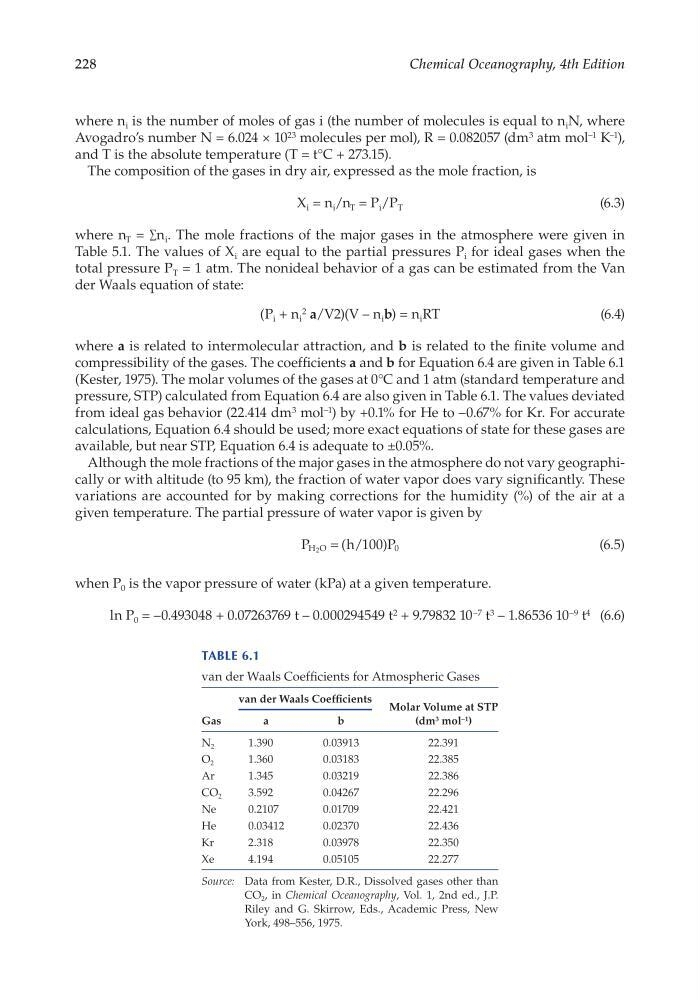
compressibility of the gases. The coefficients a and b for Equation 6.4 are given in Table 6.1
(Kester, 1975). The molar volumes of the gases at 0°C and 1 atm (standard temperature and
pressure, STP) calculated from Equation 6.4 are also given in Table 6.1. The values deviated
from ideal gas behavior (22.414 dm 3 mol –1 ) by +0.1% for He to –0.67% for Kr. For accurate
calculations, Equation 6.4 should be used; more exact equations of state for these gases are
available, but near STP, Equation 6.4 is adequate to ±0.05%.
Although the mole fractions of the major gases in the atmosphere do not vary geographically or with altitude (to 95 km), the fraction of water vapor does vary significantly. These
variations are accounted for by making corrections for the humidity (%) of the air at a
given temperature. The partial pressure of water vapor is given by
P
h
P
H O
2
100 0
= (
)
/
(6.5)
when P 0 is the vapor pressure of water (kPa) at a given temperature.
ln P 0 = –0.493048 + 0.07263769 t – 0.000294549 t 2 + 9.79832 10 −7 t 3 – 1.86536 10 –9 t 4 (6.6)
Table 6.1
van der Waals Coefficients for Atmospheric Gases
Gas
van der Waals Coefficients
Molar Volume at STP
(dm 3 mol –1 )
a
b
N 2
1.390
0.03913
22.391
O 2
1.360
0.03183
22.385
Ar
1.345
0.03219
22.386
CO 2
3.592
0.04267
22.296
Ne
0.2107
0.01709
22.421
He
0.03412
0.02370
22.436
Kr
2.318
0.03978
22.350
Xe
4.194
0.05105
22.277
Source: Data from Kester, D.R., Dissolved gases other than
CO 2 , in Chemical Oceanography, Vol. 1, 2nd ed., J.P.
Riley and G. Skirrow, Eds., Academic Press, New
York, 498–556, 1975.
Chemical Oceanography, 4th Edition
where n i is the number of moles of gas i (the number of molecules is equal to n i N, where
Avogadro’s number N = 6.024 × 10 23 molecules per mol), R = 0.082057 (dm 3 atm mol –1 K –1 ),
and T is the absolute temperature (T = t°C + 273.15).
The composition of the gases in dry air, expressed as the mole fraction, is
X i = n i / n T = P i / P T
(6.3)
where n T = ∑n i . The mole fractions of the major gases in the atmosphere were given in
Table 5.1. The values of X i are equal to the partial pressures P i for ideal gases when the
total pressure P T = 1 atm. The nonideal behavior of a gas can be estimated from the Van
der Waals equation of state:
(P i + n i
2 a/ V2)(V – n i b) = n i RT
(6.4)
where a is related to intermolecular attraction, and b is related to the finite volume and
compressibility of the gases. The coefficients a and b for Equation 6.4 are given in Table 6.1
(Kester, 1975). The molar volumes of the gases at 0°C and 1 atm (standard temperature and
pressure, STP) calculated from Equation 6.4 are also given in Table 6.1. The values deviated
from ideal gas behavior (22.414 dm 3 mol –1 ) by +0.1% for He to –0.67% for Kr. For accurate
calculations, Equation 6.4 should be used; more exact equations of state for these gases are
available, but near STP, Equation 6.4 is adequate to ±0.05%.
Although the mole fractions of the major gases in the atmosphere do not vary geographically or with altitude (to 95 km), the fraction of water vapor does vary significantly. These
variations are accounted for by making corrections for the humidity (%) of the air at a
given temperature. The partial pressure of water vapor is given by
P
h
P
H O
2
100 0
= (
)
/
(6.5)
when P 0 is the vapor pressure of water (kPa) at a given temperature.
ln P 0 = –0.493048 + 0.07263769 t – 0.000294549 t 2 + 9.79832 10 −7 t 3 – 1.86536 10 –9 t 4 (6.6)
Table 6.1
van der Waals Coefficients for Atmospheric Gases
Gas
van der Waals Coefficients
Molar Volume at STP
(dm 3 mol –1 )
a
b
N 2
1.390
0.03913
22.391
O 2
1.360
0.03183
22.385
Ar
1.345
0.03219
22.386
CO 2
3.592
0.04267
22.296
Ne
0.2107
0.01709
22.421
He
0.03412
0.02370
22.436
Kr
2.318
0.03978
22.350
Xe
4.194
0.05105
22.277
Source: Data from Kester, D.R., Dissolved gases other than
CO 2 , in Chemical Oceanography, Vol. 1, 2nd ed., J.P.
Riley and G. Skirrow, Eds., Academic Press, New
York, 498–556, 1975.