

224
Chemical Oceanography, 4th Edition
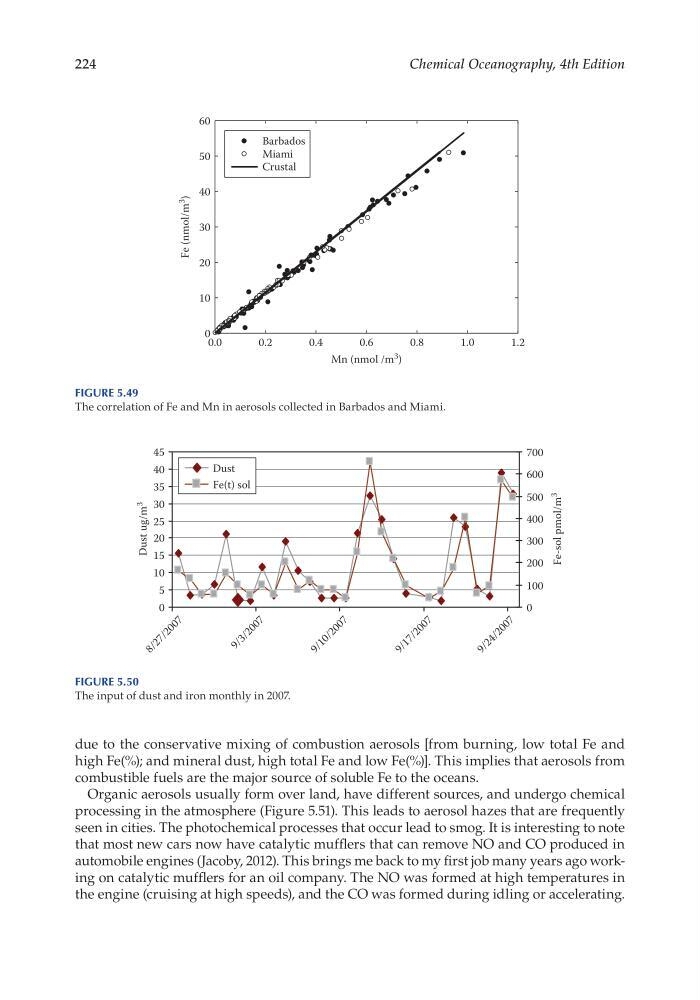
due to the conservative mixing of combustion aerosols [from burning, low total Fe and
high Fe(%); and mineral dust, high total Fe and low Fe(%)]. This implies that aerosols from
combustible fuels are the major source of soluble Fe to the oceans.
Organic aerosols usually form over land, have different sources, and undergo chemical
processing in the atmosphere (Figure 5.51). This leads to aerosol hazes that are frequently
seen in cities. The photochemical processes that occur lead to smog. It is interesting to note
that most new cars now have catalytic mufflers that can remove NO and CO produced in
automobile engines (Jacoby, 2012). This brings me back to my first job many years ago working on catalytic mufflers for an oil company. The NO was formed at high temperatures in
the engine (cruising at high speeds), and the CO was formed during idling or accelerating.
Mn (nmol /m
3 )
0.0
0.2
0.4
0.6
0.8
1.0
1.2
Fe (nmol/m
3
)
0
10
20
30
40
50
60
Barbados
Miami
Crustal
Figure 5.49
The correlation of Fe and Mn in aerosols collected in Barbados and Miami.
0
8 / 2 7 / 2 0 0 7
9 / 3 / 2 0 0 7
9 / 1 0 / 2 0 0 7
9 / 1 7 / 2 0 0 7
9 / 2 4 / 2 0 0 7
5
10
15
20
25
30
35
40
45
Dust ug/m
3
0
100
200
300
400
500
600
700
Fe-sol pmol/m
3
Dust
Fe(t) sol
Figure 5.50
The input of dust and iron monthly in 2007.
Chemical Oceanography, 4th Edition
due to the conservative mixing of combustion aerosols [from burning, low total Fe and
high Fe(%); and mineral dust, high total Fe and low Fe(%)]. This implies that aerosols from
combustible fuels are the major source of soluble Fe to the oceans.
Organic aerosols usually form over land, have different sources, and undergo chemical
processing in the atmosphere (Figure 5.51). This leads to aerosol hazes that are frequently
seen in cities. The photochemical processes that occur lead to smog. It is interesting to note
that most new cars now have catalytic mufflers that can remove NO and CO produced in
automobile engines (Jacoby, 2012). This brings me back to my first job many years ago working on catalytic mufflers for an oil company. The NO was formed at high temperatures in
the engine (cruising at high speeds), and the CO was formed during idling or accelerating.
Mn (nmol /m
3 )
0.0
0.2
0.4
0.6
0.8
1.0
1.2
Fe (nmol/m
3
)
0
10
20
30
40
50
60
Barbados
Miami
Crustal
Figure 5.49
The correlation of Fe and Mn in aerosols collected in Barbados and Miami.
0
8 / 2 7 / 2 0 0 7
9 / 3 / 2 0 0 7
9 / 1 0 / 2 0 0 7
9 / 1 7 / 2 0 0 7
9 / 2 4 / 2 0 0 7
5
10
15
20
25
30
35
40
45
Dust ug/m
3
0
100
200
300
400
500
600
700
Fe-sol pmol/m
3
Dust
Fe(t) sol
Figure 5.50
The input of dust and iron monthly in 2007.