

213
Atmospheric Chemistry
The loss of ozone in Antarctica in the springtime has been attributed to the formation of
ClO (see Figure 5.41). The large effects in the springtime have been attributed to a dynamic
uplifting of the lower stratosphere as well as catalytic cycles involving Cl. One potential
cycle is
ClO + ClO → Cl 2 O 2
(5.42)
Cl 2 O 2 + M → Cl 2 + O 2 + M
(5.43)
Cl 2 + hυ → 2Cl·
(5.44)
2Cl· + 2O 3 → 2ClO + 2O 2
(5.45)
Year
295
300
305
310
315
110
120
130
Carbon Tetrachloride (ppt)
80
100
120
140
CFC-12 (ppt)
240
280
320
360
400
140
160
180
200
220
240
CFC-11 (ppt)
Methylchloroform (ppt)
Nitrous Oxide (ppb)
1978
1979
1980
1981
1982
1983
1984
1985
1978
1979
1980
1981
1982
1983
1984
1985
1978
1979
1980
1981
1982
1983
1984
1985
1978
1979
1980
1981
1982
1983
1984
1985
1978
1979
1980
1981
1982
1983
1984
1985
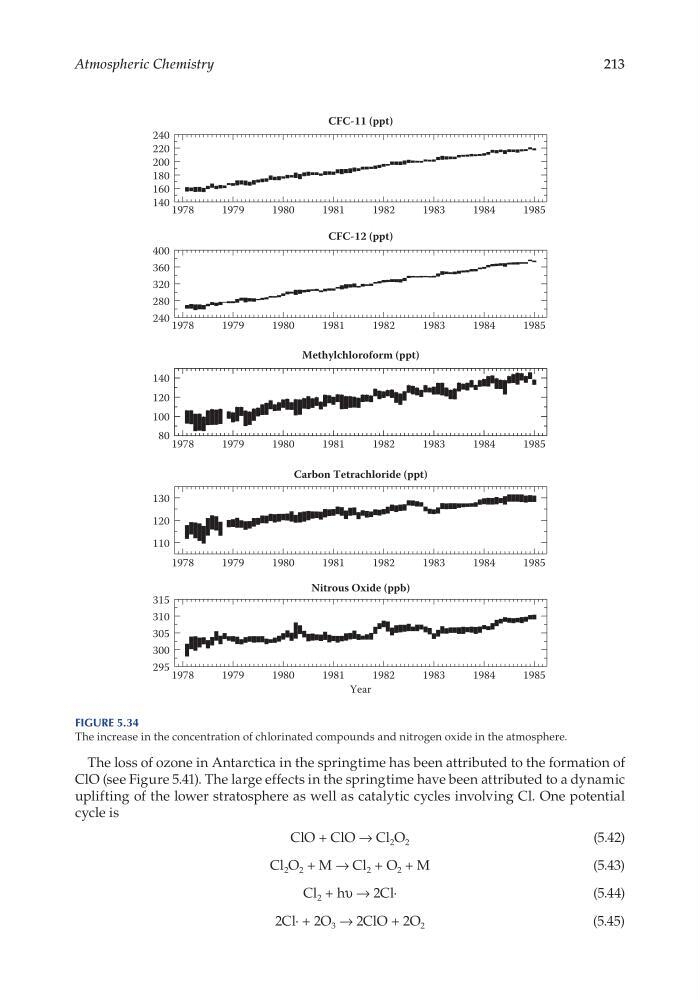
Figure 5.34
The increase in the concentration of chlorinated compounds and nitrogen oxide in the atmosphere.
Atmospheric Chemistry
The loss of ozone in Antarctica in the springtime has been attributed to the formation of
ClO (see Figure 5.41). The large effects in the springtime have been attributed to a dynamic
uplifting of the lower stratosphere as well as catalytic cycles involving Cl. One potential
cycle is
ClO + ClO → Cl 2 O 2
(5.42)
Cl 2 O 2 + M → Cl 2 + O 2 + M
(5.43)
Cl 2 + hυ → 2Cl·
(5.44)
2Cl· + 2O 3 → 2ClO + 2O 2
(5.45)
Year
295
300
305
310
315
110
120
130
Carbon Tetrachloride (ppt)
80
100
120
140
CFC-12 (ppt)
240
280
320
360
400
140
160
180
200
220
240
CFC-11 (ppt)
Methylchloroform (ppt)
Nitrous Oxide (ppb)
1978
1979
1980
1981
1982
1983
1984
1985
1978
1979
1980
1981
1982
1983
1984
1985
1978
1979
1980
1981
1982
1983
1984
1985
1978
1979
1980
1981
1982
1983
1984
1985
1978
1979
1980
1981
1982
1983
1984
1985
Figure 5.34
The increase in the concentration of chlorinated compounds and nitrogen oxide in the atmosphere.