

200
Chemical Oceanography, 4th Edition
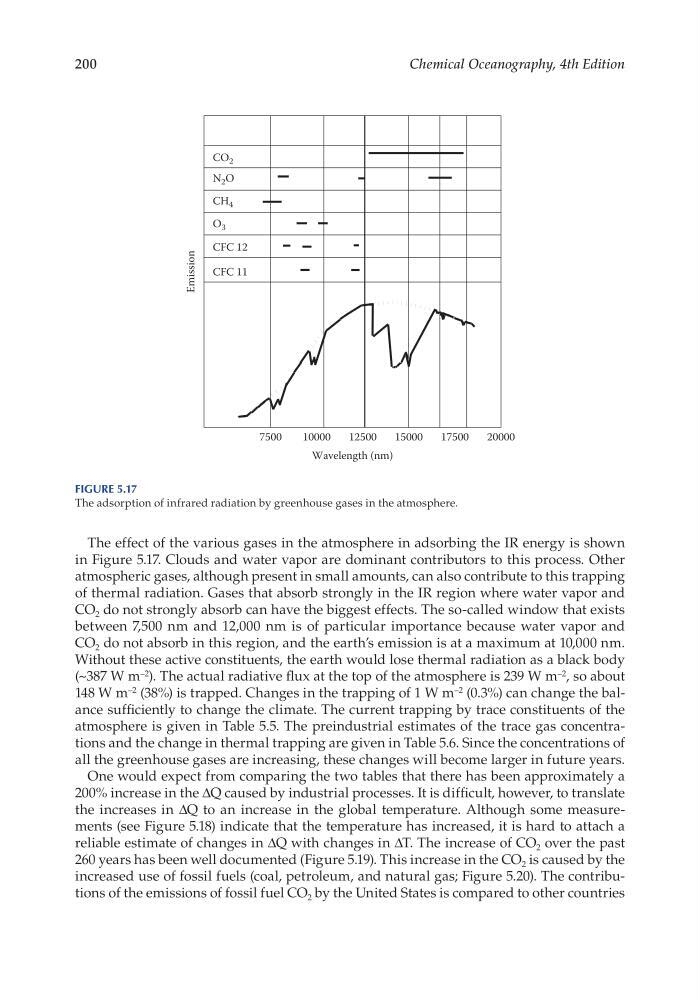
The effect of the various gases in the atmosphere in adsorbing the IR energy is shown
in Figure 5.17. Clouds and water vapor are dominant contributors to this process. Other
atmospheric gases, although present in small amounts, can also contribute to this trapping
of thermal radiation. Gases that absorb strongly in the IR region where water vapor and
CO 2 do not strongly absorb can have the biggest effects. The so- called window that exists
between 7,500 nm and 12,000 nm is of particular importance because water vapor and
CO 2 do not absorb in this region, and the earth’s emission is at a maximum at 10,000 nm.
Without these active constituents, the earth would lose thermal radiation as a black body
(~387 W m –2 ). The actual radiative flux at the top of the atmosphere is 239 W m –2 , so about
148 W m –2 (38%) is trapped. Changes in the trapping of 1 W m –2 (0.3%) can change the balance sufficiently to change the climate. The current trapping by trace constituents of the
atmosphere is given in Table 5.5. The preindustrial estimates of the trace gas concentrations and the change in thermal trapping are given in Table 5.6. Since the concentrations of
all the greenhouse gases are increasing, these changes will become larger in future years.
One would expect from comparing the two tables that there has been approximately a
200% increase in the ΔQ caused by industrial processes. It is difficult, however, to translate
the increases in ΔQ to an increase in the global temperature. Although some measurements (see Figure 5.18) indicate that the temperature has increased, it is hard to attach a
reliable estimate of changes in ΔQ with changes in ΔT. The increase of CO 2 over the past
260 years has been well documented (Figure 5.19). This increase in the CO 2 is caused by the
increased use of fossil fuels (coal, petroleum, and natural gas; Figure 5.20). The contributions of the emissions of fossil fuel CO 2 by the United States is compared to other countries
Wavelength (nm)
Emission
CFC 11
CFC 12
O 3
CH 4
N 2 O
CO 2
7500
20000
17500
15000
12500
10000
Figure 5.17
The adsorption of infrared radiation by greenhouse gases in the atmosphere.
Chemical Oceanography, 4th Edition
The effect of the various gases in the atmosphere in adsorbing the IR energy is shown
in Figure 5.17. Clouds and water vapor are dominant contributors to this process. Other
atmospheric gases, although present in small amounts, can also contribute to this trapping
of thermal radiation. Gases that absorb strongly in the IR region where water vapor and
CO 2 do not strongly absorb can have the biggest effects. The so- called window that exists
between 7,500 nm and 12,000 nm is of particular importance because water vapor and
CO 2 do not absorb in this region, and the earth’s emission is at a maximum at 10,000 nm.
Without these active constituents, the earth would lose thermal radiation as a black body
(~387 W m –2 ). The actual radiative flux at the top of the atmosphere is 239 W m –2 , so about
148 W m –2 (38%) is trapped. Changes in the trapping of 1 W m –2 (0.3%) can change the balance sufficiently to change the climate. The current trapping by trace constituents of the
atmosphere is given in Table 5.5. The preindustrial estimates of the trace gas concentrations and the change in thermal trapping are given in Table 5.6. Since the concentrations of
all the greenhouse gases are increasing, these changes will become larger in future years.
One would expect from comparing the two tables that there has been approximately a
200% increase in the ΔQ caused by industrial processes. It is difficult, however, to translate
the increases in ΔQ to an increase in the global temperature. Although some measurements (see Figure 5.18) indicate that the temperature has increased, it is hard to attach a
reliable estimate of changes in ΔQ with changes in ΔT. The increase of CO 2 over the past
260 years has been well documented (Figure 5.19). This increase in the CO 2 is caused by the
increased use of fossil fuels (coal, petroleum, and natural gas; Figure 5.20). The contributions of the emissions of fossil fuel CO 2 by the United States is compared to other countries
Wavelength (nm)
Emission
CFC 11
CFC 12
O 3
CH 4
N 2 O
CO 2
7500
20000
17500
15000
12500
10000
Figure 5.17
The adsorption of infrared radiation by greenhouse gases in the atmosphere.