

198
Chemical Oceanography, 4th Edition
values of pH above 5.5. This can cause starvation of predatory fish. Acidic streams have
frequently had fish kills caused by pulses of acidic waters during the spring snow melt.
The lower pH of lakes and streams can also cause aluminum to be released from the sediments. Ionic aluminum, Al 3+ , appears to be toxic, while the hydrolyzed forms are nontoxic
(Al[OH] 2+ , Al[OH] 2+ , etc.). Recent studies have shown that exchange reactions of H + with
sediments may lessen the effect of acid rain on a lake. The recovery of a lake may be fast
if the basic components of the soil are not lost. It is unlikely, however, that the original pH
will be reached for years, and widespread stocking will be necessary to bring back game
fish and the resultant food chains.
5.3 Greenhouse Gases
The likelihood that CO 2 increases will cause global climate changes is now well accepted.
Less is known, however, of the effects of other trace gases on the climate. Gases such as
CH 4 , O 3 , N 2 O, and CFCs such as CCl 3 F (CFC-11) and CCl 2 F 2 (CFC-12) can contribute to the
increasing temperature of the troposphere. Solar radiation is absorbed by the atmosphere,
providing energy for many processes. The UV energy coming to the top of the atmosphere is shown in Figure 5.15. The IR energy back- irradiated to the atmosphere is a function of the temperature of the earth (285 K or 12°C). The amount of solar energy that affects
the earth is shown in Figure 5.16. For the global climate to be balanced, the absorbed radiation must be equal to the outgoing radiation. The trapping of some of the thermal radiation
by particles and molecules increases the surface temperature by 10 to 15°C compared to
what it would be without these molecules. This process of absorption of (IR) energy radiated from the earth is called the greenhouse effect.
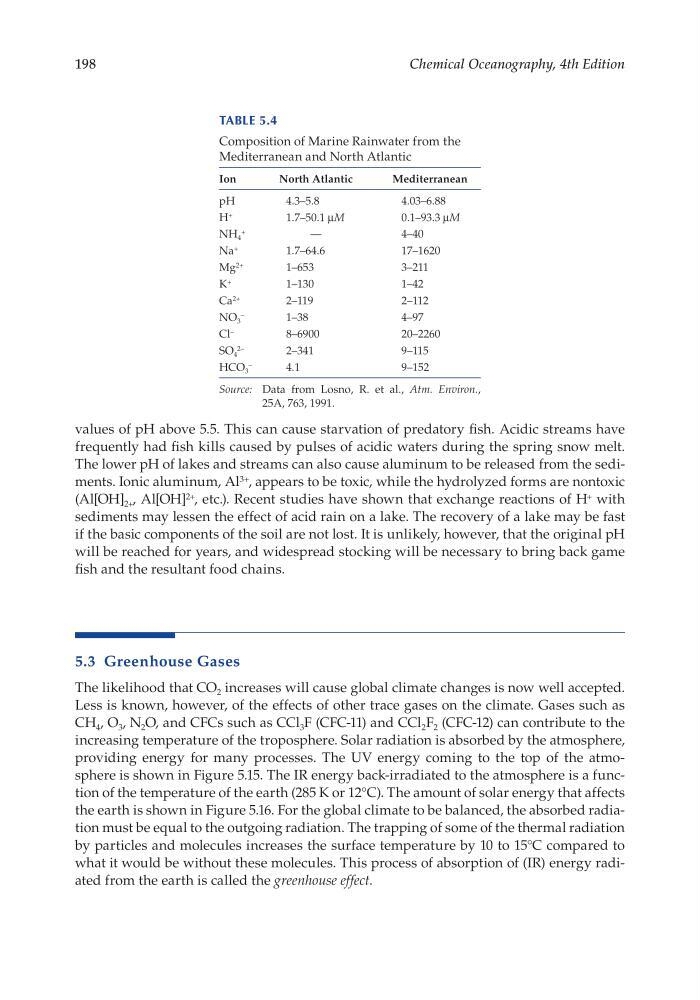
Table 5.4
Composition of Marine Rainwater from the
Mediterranean and North Atlantic
Ion
North Atlantic
Mediterranean
pH
4.3–5.8
4.03–6.88
H +
1.7–50.1 μM
0.1–93.3 μM
NH 4
+
—
4–40
Na +
1.7–64.6
17–1620
Mg 2+
1–653
3–211
K +
1–130
1–42
Ca 2+
2–119
2–112
NO 3
–
1–38
4–97
Cl –
8–6900
20–2260
SO 4
2–
2–341
9–115
HCO 3
–
4.1
9–152
Source: Data from Losno, R. et al., Atm. Environ.,
25A, 763, 1991.
Chemical Oceanography, 4th Edition
values of pH above 5.5. This can cause starvation of predatory fish. Acidic streams have
frequently had fish kills caused by pulses of acidic waters during the spring snow melt.
The lower pH of lakes and streams can also cause aluminum to be released from the sediments. Ionic aluminum, Al 3+ , appears to be toxic, while the hydrolyzed forms are nontoxic
(Al[OH] 2+ , Al[OH] 2+ , etc.). Recent studies have shown that exchange reactions of H + with
sediments may lessen the effect of acid rain on a lake. The recovery of a lake may be fast
if the basic components of the soil are not lost. It is unlikely, however, that the original pH
will be reached for years, and widespread stocking will be necessary to bring back game
fish and the resultant food chains.
5.3 Greenhouse Gases
The likelihood that CO 2 increases will cause global climate changes is now well accepted.
Less is known, however, of the effects of other trace gases on the climate. Gases such as
CH 4 , O 3 , N 2 O, and CFCs such as CCl 3 F (CFC-11) and CCl 2 F 2 (CFC-12) can contribute to the
increasing temperature of the troposphere. Solar radiation is absorbed by the atmosphere,
providing energy for many processes. The UV energy coming to the top of the atmosphere is shown in Figure 5.15. The IR energy back- irradiated to the atmosphere is a function of the temperature of the earth (285 K or 12°C). The amount of solar energy that affects
the earth is shown in Figure 5.16. For the global climate to be balanced, the absorbed radiation must be equal to the outgoing radiation. The trapping of some of the thermal radiation
by particles and molecules increases the surface temperature by 10 to 15°C compared to
what it would be without these molecules. This process of absorption of (IR) energy radiated from the earth is called the greenhouse effect.
Table 5.4
Composition of Marine Rainwater from the
Mediterranean and North Atlantic
Ion
North Atlantic
Mediterranean
pH
4.3–5.8
4.03–6.88
H +
1.7–50.1 μM
0.1–93.3 μM
NH 4
+
—
4–40
Na +
1.7–64.6
17–1620
Mg 2+
1–653
3–211
K +
1–130
1–42
Ca 2+
2–119
2–112
NO 3
–
1–38
4–97
Cl –
8–6900
20–2260
SO 4
2–
2–341
9–115
HCO 3
–
4.1
9–152
Source: Data from Losno, R. et al., Atm. Environ.,
25A, 763, 1991.