

196
Chemical Oceanography, 4th Edition
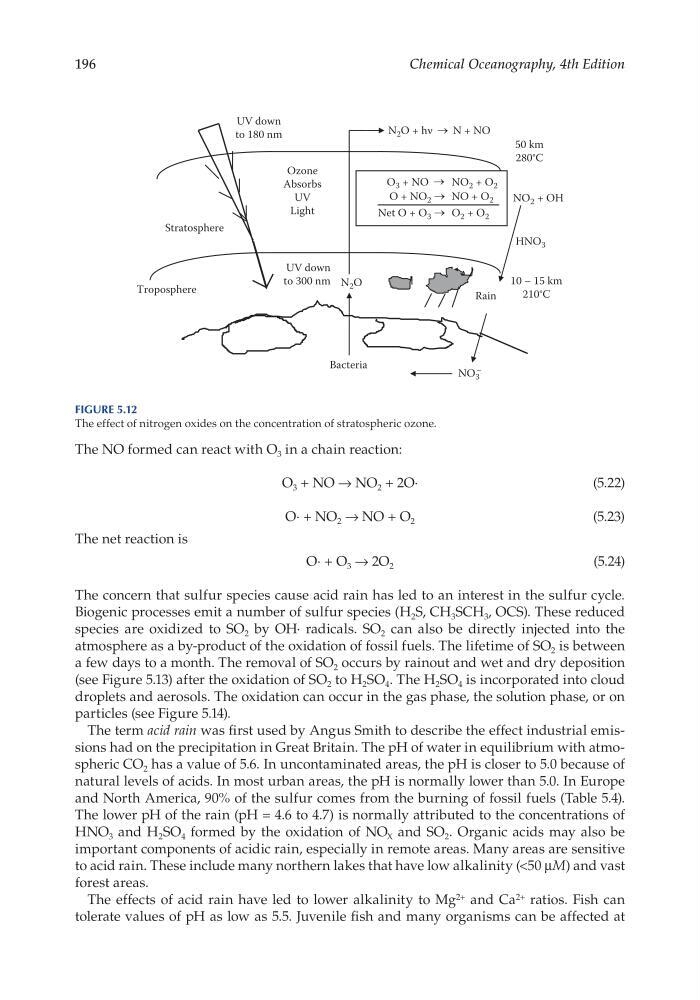
The NO formed can react with O 3 in a chain reaction:
O 3 + NO → NO 2 + 2O·
(5.22)
O· + NO 2 → NO + O 2
(5.23)
The net reaction is
O· + O 3 → 2O 2
(5.24)
The concern that sulfur species cause acid rain has led to an interest in the sulfur cycle.
Biogenic processes emit a number of sulfur species (H 2 S, CH 3 SCH 3 , OCS). These reduced
species are oxidized to SO 2 by OH· radicals. SO 2 can also be directly injected into the
atmosphere as a by- product of the oxidation of fossil fuels. The lifetime of SO 2 is between
a few days to a month. The removal of SO 2 occurs by rainout and wet and dry deposition
(see Figure 5.13) after the oxidation of SO 2 to H 2 SO 4 . The H 2 SO 4 is incorporated into cloud
droplets and aerosols. The oxidation can occur in the gas phase, the solution phase, or on
particles (see Figure 5.14).
The term acid rain was first used by Angus Smith to describe the effect industrial emissions had on the precipitation in Great Britain. The pH of water in equilibrium with atmospheric CO 2 has a value of 5.6. In uncontaminated areas, the pH is closer to 5.0 because of
natural levels of acids. In most urban areas, the pH is normally lower than 5.0. In Europe
and North America, 90% of the sulfur comes from the burning of fossil fuels (Table 5.4).
The lower pH of the rain (pH = 4.6 to 4.7) is normally attributed to the concentrations of
HNO 3 and H 2 SO 4 formed by the oxidation of NO X and SO 2 . Organic acids may also be
important components of acidic rain, especially in remote areas. Many areas are sensitive
to acid rain. These include many northern lakes that have low alkalinity (<50 μM) and vast
forest areas.
The effects of acid rain have led to lower alkalinity to Mg 2+ and Ca 2+ ratios. Fish can
tolerate values of pH as low as 5.5. Juvenile fish and many organisms can be affected at
UV down
to 180 nm
N 2 O + hν
N + NO
50 km
280°C
Ozone
Absorbs
UV
Light
O 3 + NO
NO 2 + O 2
O + NO 2
NO + O 2
NO 2 + OH
Net O + O 3
O 2 + O 2
Stratosphere
HNO 3
UV down
to 300 nm N 2 O
NO 3
–
10 – 15 km
210°C
Troposphere
Rain
Bacteria
Figure 5.12
The effect of nitrogen oxides on the concentration of stratospheric ozone.
Chemical Oceanography, 4th Edition
The NO formed can react with O 3 in a chain reaction:
O 3 + NO → NO 2 + 2O·
(5.22)
O· + NO 2 → NO + O 2
(5.23)
The net reaction is
O· + O 3 → 2O 2
(5.24)
The concern that sulfur species cause acid rain has led to an interest in the sulfur cycle.
Biogenic processes emit a number of sulfur species (H 2 S, CH 3 SCH 3 , OCS). These reduced
species are oxidized to SO 2 by OH· radicals. SO 2 can also be directly injected into the
atmosphere as a by- product of the oxidation of fossil fuels. The lifetime of SO 2 is between
a few days to a month. The removal of SO 2 occurs by rainout and wet and dry deposition
(see Figure 5.13) after the oxidation of SO 2 to H 2 SO 4 . The H 2 SO 4 is incorporated into cloud
droplets and aerosols. The oxidation can occur in the gas phase, the solution phase, or on
particles (see Figure 5.14).
The term acid rain was first used by Angus Smith to describe the effect industrial emissions had on the precipitation in Great Britain. The pH of water in equilibrium with atmospheric CO 2 has a value of 5.6. In uncontaminated areas, the pH is closer to 5.0 because of
natural levels of acids. In most urban areas, the pH is normally lower than 5.0. In Europe
and North America, 90% of the sulfur comes from the burning of fossil fuels (Table 5.4).
The lower pH of the rain (pH = 4.6 to 4.7) is normally attributed to the concentrations of
HNO 3 and H 2 SO 4 formed by the oxidation of NO X and SO 2 . Organic acids may also be
important components of acidic rain, especially in remote areas. Many areas are sensitive
to acid rain. These include many northern lakes that have low alkalinity (<50 μM) and vast
forest areas.
The effects of acid rain have led to lower alkalinity to Mg 2+ and Ca 2+ ratios. Fish can
tolerate values of pH as low as 5.5. Juvenile fish and many organisms can be affected at
UV down
to 180 nm
N 2 O + hν
N + NO
50 km
280°C
Ozone
Absorbs
UV
Light
O 3 + NO
NO 2 + O 2
O + NO 2
NO + O 2
NO 2 + OH
Net O + O 3
O 2 + O 2
Stratosphere
HNO 3
UV down
to 300 nm N 2 O
NO 3
–
10 – 15 km
210°C
Troposphere
Rain
Bacteria
Figure 5.12
The effect of nitrogen oxides on the concentration of stratospheric ozone.