

193
Atmospheric Chemistry
O· + O 2 + M → O 3 + M
(5.20)
where M = N 2 or O 2 . The burning of fossil fuels (e.g., in automobiles) produces large
amounts of CO and NO. The CO comes from incomplete combustion of hydrocarbons, and
the NO is formed from N 2 and O 2 at high temperatures. As a result of the use of catalytic
converters on cars and trucks, the output of these gases will be lessened (Jacoby, 2012).
Although CO causes the OH· levels to decrease, NO can enhance the OH· levels, especially
in remote areas. The nitrogen oxides are rapidly removed from the atmosphere as HNO 3 ,
which is soluble in rainwater. It also can be attached to aerosols and particles and removed
as dry deposition. The HNO 3 in rainwater is one of the components of acid rain. Although
the importance of HNO 3 as a component of acid rain has been known to affect the pH of
rain, recent work (see Figure 5.11) indicates that atmospheric sources of nitrate may also
contribute to the eutrophication of the Chesapeake Bay.
The N 2 O in the atmosphere can also reduce the stratospheric ozone (see Figure 5.12).
Bacterially produced N 2 O can break down at high altitudes by the absorption of light:
N 2 O + hυ → N + NO
(5.21)
Latitude
–60
–40
–20
0
20
40
60
1.5
1.6
1.7
1.8
1.9
2.0
Latitude
–60
–40
–20
0
20
40
60
0
50
100
150
200
ITCZ
ITCZ
CH
4 Concentration (ppm)
CO Concentration (ppb)
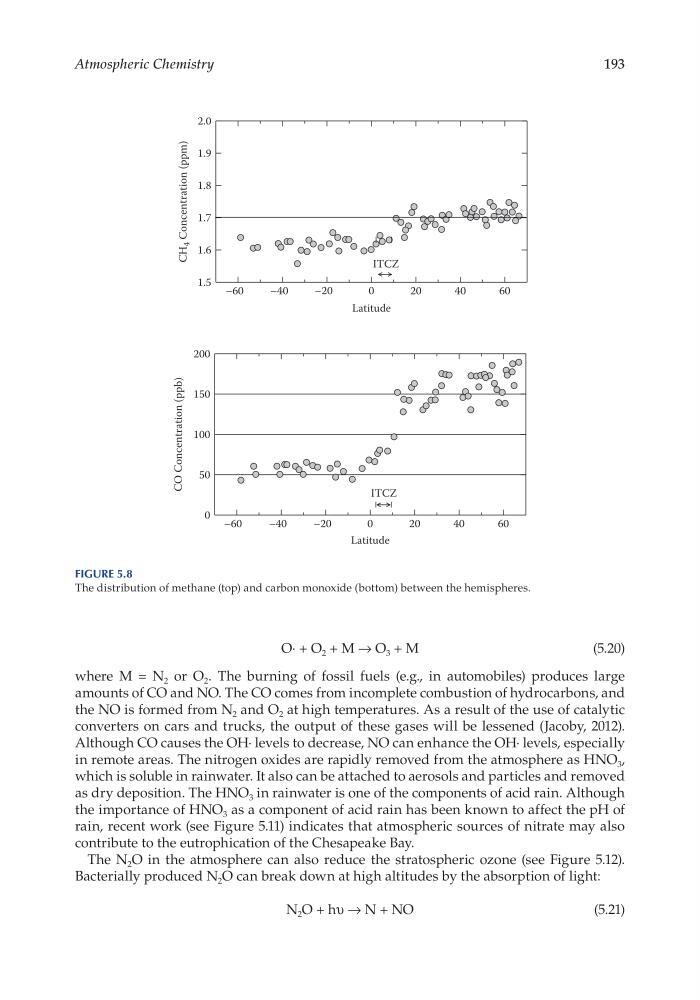
Figure 5.8
The distribution of methane (top) and carbon monoxide (bottom) between the hemispheres.
Atmospheric Chemistry
O· + O 2 + M → O 3 + M
(5.20)
where M = N 2 or O 2 . The burning of fossil fuels (e.g., in automobiles) produces large
amounts of CO and NO. The CO comes from incomplete combustion of hydrocarbons, and
the NO is formed from N 2 and O 2 at high temperatures. As a result of the use of catalytic
converters on cars and trucks, the output of these gases will be lessened (Jacoby, 2012).
Although CO causes the OH· levels to decrease, NO can enhance the OH· levels, especially
in remote areas. The nitrogen oxides are rapidly removed from the atmosphere as HNO 3 ,
which is soluble in rainwater. It also can be attached to aerosols and particles and removed
as dry deposition. The HNO 3 in rainwater is one of the components of acid rain. Although
the importance of HNO 3 as a component of acid rain has been known to affect the pH of
rain, recent work (see Figure 5.11) indicates that atmospheric sources of nitrate may also
contribute to the eutrophication of the Chesapeake Bay.
The N 2 O in the atmosphere can also reduce the stratospheric ozone (see Figure 5.12).
Bacterially produced N 2 O can break down at high altitudes by the absorption of light:
N 2 O + hυ → N + NO
(5.21)
Latitude
–60
–40
–20
0
20
40
60
1.5
1.6
1.7
1.8
1.9
2.0
Latitude
–60
–40
–20
0
20
40
60
0
50
100
150
200
ITCZ
ITCZ
CH
4 Concentration (ppm)
CO Concentration (ppb)
Figure 5.8
The distribution of methane (top) and carbon monoxide (bottom) between the hemispheres.