

166
Chemical Oceanography, 4th Edition
The various forms of Cu 2+ calculated from Equation 4.74 are given in Table 4.12 and
shown in Figure 4.33. At a pH of 8.1 and 25°C, the dominant forms are CuCO 3
o (74%)
and Cu(CO 3 ) 2
2– (14%). The speciation of divalent and trivalent metals over a wide range of
concentrations can be made using the equations of Millero and coworkers (Millero and
Hawke, 1992; Millero, 1992, 2001). Calculations as a function of temperature can be made
using the equation of Byrne, Kump, and Cantrell (1988).
4.5.2 Specific interaction Model
Although the ion- pairing model yields reliable estimates of activity coefficients in dilute
solutions (below 1 m), it is not as reliable at higher ionic strengths. This is largely because
it does not consider the interactions of ions of the same sign (plus–plus and minus–minus
interactions). Ionic solution theory suggests that activity coefficients in electrolyte mixtures should be of the form
lnγ = DH + ΣB ij m j + ΣC ijk m j m k
(4.75)
where DH is a Debye–Hückel term, B ij is a term related to binary interactions of all the
components (plus–minus, plus–plus, and minus–minus), and C ijk is related to ternary
HSO 4
–
H
+
HF
NaSO 4
–
Na
+
Mg
2+
MgHCO 3
+
MgSO 4
K
+
KSO 4
–
Ca
2+
CaSO 4
CaCO 3
CaHCO 3
+
SrSO 4
Sr
2+
SrHCO 3
+
SrCO 3
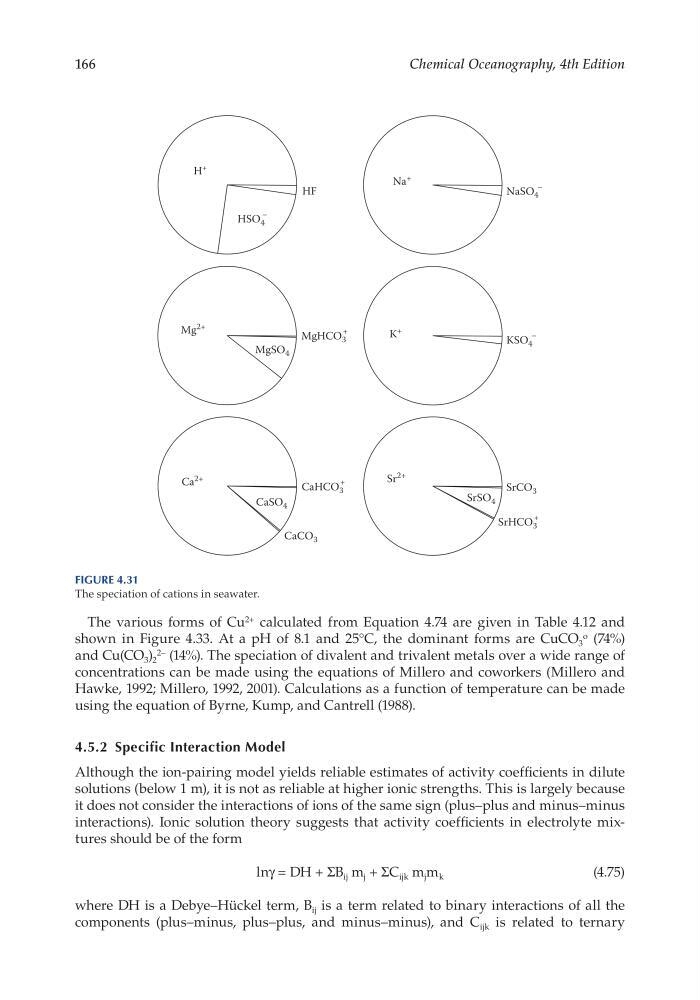
Figure 4.31
The speciation of cations in seawater.
Chemical Oceanography, 4th Edition
The various forms of Cu 2+ calculated from Equation 4.74 are given in Table 4.12 and
shown in Figure 4.33. At a pH of 8.1 and 25°C, the dominant forms are CuCO 3
o (74%)
and Cu(CO 3 ) 2
2– (14%). The speciation of divalent and trivalent metals over a wide range of
concentrations can be made using the equations of Millero and coworkers (Millero and
Hawke, 1992; Millero, 1992, 2001). Calculations as a function of temperature can be made
using the equation of Byrne, Kump, and Cantrell (1988).
4.5.2 Specific interaction Model
Although the ion- pairing model yields reliable estimates of activity coefficients in dilute
solutions (below 1 m), it is not as reliable at higher ionic strengths. This is largely because
it does not consider the interactions of ions of the same sign (plus–plus and minus–minus
interactions). Ionic solution theory suggests that activity coefficients in electrolyte mixtures should be of the form
lnγ = DH + ΣB ij m j + ΣC ijk m j m k
(4.75)
where DH is a Debye–Hückel term, B ij is a term related to binary interactions of all the
components (plus–minus, plus–plus, and minus–minus), and C ijk is related to ternary
HSO 4
–
H
+
HF
NaSO 4
–
Na
+
Mg
2+
MgHCO 3
+
MgSO 4
K
+
KSO 4
–
Ca
2+
CaSO 4
CaCO 3
CaHCO 3
+
SrSO 4
Sr
2+
SrHCO 3
+
SrCO 3
Figure 4.31
The speciation of cations in seawater.