

127
Minor Elements in Seawater
References and Further Reading
Barth, T.W., Theoretical Petrology, Wiley, New York (1952).
Biller, D.V., and Bruland, K.W., Analysis of Mn, Fe, Co, Ni, Su, Zn, Cd and Pb in seawater using the
Nobias- chelate PA1 resin and magnetic sector inductively coupled plasma mass spectrometer
(ICP_MS), Mar. Chem., 130, 12-20 (2012).
Bowen, H.H.M., Trace Elements in Biochemistry, Academic Press, London (1966).
Boyle, E.A., Cadmium and δ13C paleochemical ocean distributes during stage 2 glacial maximum,
Annu. Rev. Earth Planet Sci., 20, 245 (1992).
Brewer, P., Minor elements in sea water, Chapter 7, Chemical Oceanography, Vol. 1, 2nd ed., Riley, J.P.,
and Skirrow, G., Eds., Academic Press, New York, 416–496 (1975).
Bruland, K.W., Trace elements in sea–water, Chapter 45, Chemical Oceanography, Vol. 8, 2nd ed., Riley,
J.P., and Chester, R., Eds., Academic Press, New York, 157–220 (1983).
De Baar, H.J.W., Saager, P.M., Nolting, R.F., and Van der Meer, J., Cadmium versus phosphate in the
world ocean, Mar. Chem., 46, 261 (1994).
Fisher, N.S., On the reactivity of metals for marine phytoplankton, Limnol. Oceanogr., 31, 443 (1986).
Garrels, R.M., and Christ, C.L., Solutions, Mineral and Equilibria, Harper and Row, New York (1965).
Garrels, R.M., and Mackenzie, F.T., Evolution of Sedimentary Rocks. W. W. Norton & Co., New York,
539 (1971).
Goldberg, E., Minor elements in sea water, Chapter 5, Chemical Oceanography, Vol. 1, Riley, J.P., and
Skirrow, G., Eds., Academic Press, New York, 163–196 (1965).
Goldsmith, V.M., Fortsch. Mineral. Krist. Petrogr., 17, 112 (1967).
Horne, R., Marine Chemistry, Wiley- Interscience, New York, 568 (1969).
Löscher, B.M., van der Meer, J., de Baar, H.J.W., Saager, P.M., and de Jong, J.T.M., The global Cd/
phosphate relationship in deep ocean waters and the need for accuracy, Mar. Chem., 59, 87
(1997).
Mackenzie, F.T., Sedimentary cycling and the evolution of sea water, Chapter 5, Chemical Oceanography,
Vol. 1, 2nd ed., Riley, J.P., and Skirrow, G., Eds., Academic Press, New York, 309–364 (1975).
Meybeck, M., Global chemical weathering of surficial rocks estimate from river dissolved loads,
Am. J. Sci., 287, 401 (1987).
Nicholls, G.D., The geochemical history of the oceans, Chapter 20, Chemical Oceanography, Vol. 2,
Riley, J.P., and Skirrow, G., Eds., Academic Press, New York, 277–294 (1965).
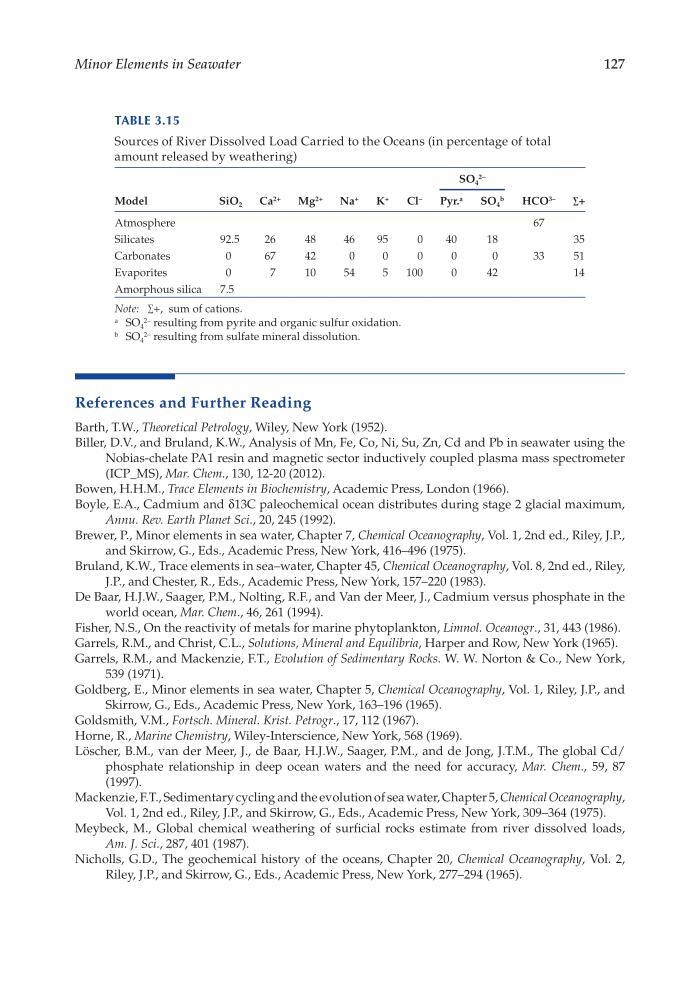
Table 3.15
Sources of River Dissolved Load Carried to the Oceans (in percentage of total
amount released by weathering)
Model
SiO 2
Ca 2+
Mg 2+
Na +
K +
Cl –
SO 4
2–
HCO 3–
∑+
Pyr. a
SO 4
b
Atmosphere
67
Silicates
92.5
26
48
46
95
0
40
18
35
Carbonates
0
67
42
0
0
0
0
0
33
51
Evaporites
0
7
10
54
5
100
0
42
14
Amorphous silica
7.5
Note: ∑+, sum of cations.
a SO 4
2– resulting from pyrite and organic sulfur oxidation.
b SO 4
2– resulting from sulfate mineral dissolution.
Minor Elements in Seawater
References and Further Reading
Barth, T.W., Theoretical Petrology, Wiley, New York (1952).
Biller, D.V., and Bruland, K.W., Analysis of Mn, Fe, Co, Ni, Su, Zn, Cd and Pb in seawater using the
Nobias- chelate PA1 resin and magnetic sector inductively coupled plasma mass spectrometer
(ICP_MS), Mar. Chem., 130, 12-20 (2012).
Bowen, H.H.M., Trace Elements in Biochemistry, Academic Press, London (1966).
Boyle, E.A., Cadmium and δ13C paleochemical ocean distributes during stage 2 glacial maximum,
Annu. Rev. Earth Planet Sci., 20, 245 (1992).
Brewer, P., Minor elements in sea water, Chapter 7, Chemical Oceanography, Vol. 1, 2nd ed., Riley, J.P.,
and Skirrow, G., Eds., Academic Press, New York, 416–496 (1975).
Bruland, K.W., Trace elements in sea–water, Chapter 45, Chemical Oceanography, Vol. 8, 2nd ed., Riley,
J.P., and Chester, R., Eds., Academic Press, New York, 157–220 (1983).
De Baar, H.J.W., Saager, P.M., Nolting, R.F., and Van der Meer, J., Cadmium versus phosphate in the
world ocean, Mar. Chem., 46, 261 (1994).
Fisher, N.S., On the reactivity of metals for marine phytoplankton, Limnol. Oceanogr., 31, 443 (1986).
Garrels, R.M., and Christ, C.L., Solutions, Mineral and Equilibria, Harper and Row, New York (1965).
Garrels, R.M., and Mackenzie, F.T., Evolution of Sedimentary Rocks. W. W. Norton & Co., New York,
539 (1971).
Goldberg, E., Minor elements in sea water, Chapter 5, Chemical Oceanography, Vol. 1, Riley, J.P., and
Skirrow, G., Eds., Academic Press, New York, 163–196 (1965).
Goldsmith, V.M., Fortsch. Mineral. Krist. Petrogr., 17, 112 (1967).
Horne, R., Marine Chemistry, Wiley- Interscience, New York, 568 (1969).
Löscher, B.M., van der Meer, J., de Baar, H.J.W., Saager, P.M., and de Jong, J.T.M., The global Cd/
phosphate relationship in deep ocean waters and the need for accuracy, Mar. Chem., 59, 87
(1997).
Mackenzie, F.T., Sedimentary cycling and the evolution of sea water, Chapter 5, Chemical Oceanography,
Vol. 1, 2nd ed., Riley, J.P., and Skirrow, G., Eds., Academic Press, New York, 309–364 (1975).
Meybeck, M., Global chemical weathering of surficial rocks estimate from river dissolved loads,
Am. J. Sci., 287, 401 (1987).
Nicholls, G.D., The geochemical history of the oceans, Chapter 20, Chemical Oceanography, Vol. 2,
Riley, J.P., and Skirrow, G., Eds., Academic Press, New York, 277–294 (1965).
Table 3.15
Sources of River Dissolved Load Carried to the Oceans (in percentage of total
amount released by weathering)
Model
SiO 2
Ca 2+
Mg 2+
Na +
K +
Cl –
SO 4
2–
HCO 3–
∑+
Pyr. a
SO 4
b
Atmosphere
67
Silicates
92.5
26
48
46
95
0
40
18
35
Carbonates
0
67
42
0
0
0
0
0
33
51
Evaporites
0
7
10
54
5
100
0
42
14
Amorphous silica
7.5
Note: ∑+, sum of cations.
a SO 4
2– resulting from pyrite and organic sulfur oxidation.
b SO 4
2– resulting from sulfate mineral dissolution.