

108
Chemical Oceanography, 4th Edition
6. Middepth maxima or minima in the suboxic layer (~1 km): A large suboxic layer
exists in some regions of the Pacific and Indian Oceans. Reduction and oxidation
processes in the water column or adjacent slope sediments can yield maxima of
the reduced forms (Fe 2+ , Mn 2+ , and Co 2+ , Figures 3.14, 3.15, and 3.16, respectively).
Minima may occur due to insoluble or scavenged metals by solid phases (Cr 3+ ).
7. Maxima and minima in anoxic waters: In areas of restricted circulation such as
the Black Sea, the Cariaco Trench, and fjords, the water can become anoxic (devoid
of O 2 ) with the production of H 2 S. Near the interface between the two waters, redox
processes can occur that cause maxima and minima from solubility changes of the
various species. Fe 2+ and Mn 2+ , for example, have maxima because of the increased
solubility of the reduced forms (see Figure 3.24 and Figure 3.25). These maxima
are due to oxidation and reduction of iron and manganese near the oxic–anoxic
interface. More is said about anoxic waters in Chapter 10.
Many of the metals studied have higher concentrations in the Pacific than in the
Atlantic (see Table 3.8). Exceptions are Pb 2+ and Al 3+ . The higher values in the deep
Pacific are attributed to the older water accumulating more metals from surface
waters. For Pb 2+ and Al 3+ , the higher surface input in the Atlantic leads to higher
values in the deep Atlantic waters. Since these metals are quickly scavenged from
seawater, they do not accumulate in the deep waters of the Pacific. The higher concentration of most metals on shelves (Table 3.9) indicates a land source (rivers or
sediments), while the higher concentration (Table 3.10) in the Atlantic central gyre
indicates an atmospheric input (from African dust).
Ag (pM)
0
10
20
30
40
50
Depth (m)
0
1000
2000
3000
4000
5000
6000
N. Pacific
N. Atlantic
SiO 2 (µM)
0
40
80
120
160
Depth (m)
0
1000
2000
3000
4000
5000
6000
N. Pacific
N. Atlantic
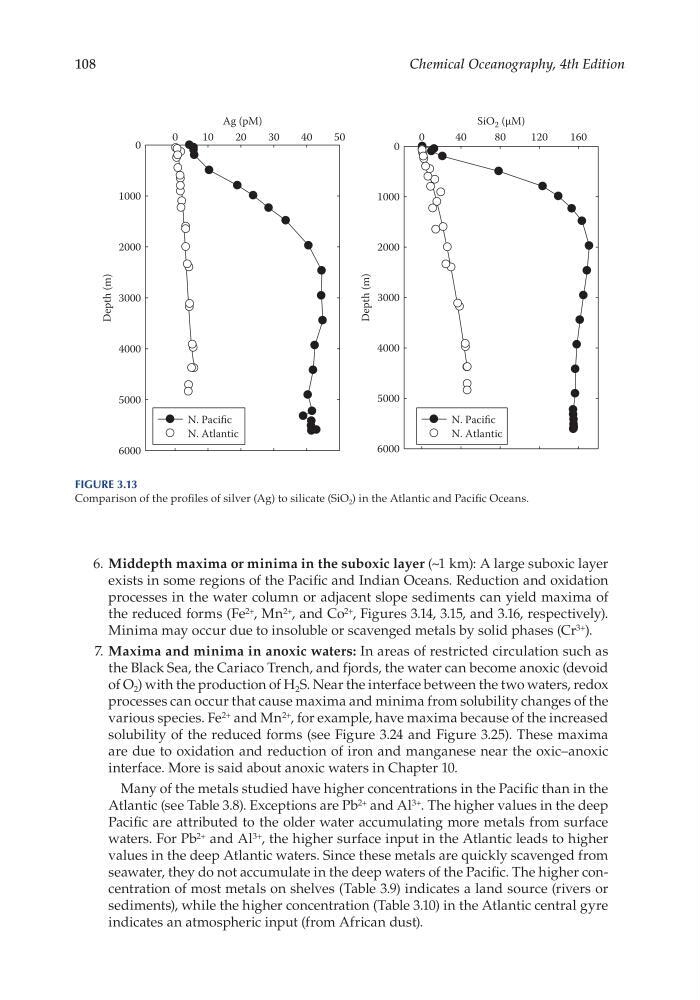
Figure 3.13
Comparison of the profiles of silver (Ag) to silicate (SiO 2 ) in the Atlantic and Pacific Oceans.
Chemical Oceanography, 4th Edition
6. Middepth maxima or minima in the suboxic layer (~1 km): A large suboxic layer
exists in some regions of the Pacific and Indian Oceans. Reduction and oxidation
processes in the water column or adjacent slope sediments can yield maxima of
the reduced forms (Fe 2+ , Mn 2+ , and Co 2+ , Figures 3.14, 3.15, and 3.16, respectively).
Minima may occur due to insoluble or scavenged metals by solid phases (Cr 3+ ).
7. Maxima and minima in anoxic waters: In areas of restricted circulation such as
the Black Sea, the Cariaco Trench, and fjords, the water can become anoxic (devoid
of O 2 ) with the production of H 2 S. Near the interface between the two waters, redox
processes can occur that cause maxima and minima from solubility changes of the
various species. Fe 2+ and Mn 2+ , for example, have maxima because of the increased
solubility of the reduced forms (see Figure 3.24 and Figure 3.25). These maxima
are due to oxidation and reduction of iron and manganese near the oxic–anoxic
interface. More is said about anoxic waters in Chapter 10.
Many of the metals studied have higher concentrations in the Pacific than in the
Atlantic (see Table 3.8). Exceptions are Pb 2+ and Al 3+ . The higher values in the deep
Pacific are attributed to the older water accumulating more metals from surface
waters. For Pb 2+ and Al 3+ , the higher surface input in the Atlantic leads to higher
values in the deep Atlantic waters. Since these metals are quickly scavenged from
seawater, they do not accumulate in the deep waters of the Pacific. The higher concentration of most metals on shelves (Table 3.9) indicates a land source (rivers or
sediments), while the higher concentration (Table 3.10) in the Atlantic central gyre
indicates an atmospheric input (from African dust).
Ag (pM)
0
10
20
30
40
50
Depth (m)
0
1000
2000
3000
4000
5000
6000
N. Pacific
N. Atlantic
SiO 2 (µM)
0
40
80
120
160
Depth (m)
0
1000
2000
3000
4000
5000
6000
N. Pacific
N. Atlantic
Figure 3.13
Comparison of the profiles of silver (Ag) to silicate (SiO 2 ) in the Atlantic and Pacific Oceans.