

however, there have been significant advances in
parameterizing the effect of eddy fluxes, largely
building on the concept of isopycnal layer mixing
proposed by Gent and McWilliams (1990; hereafter GM). The important step taken by GM was
to include dynamic effects of mesoscale eddies,
such as the flattening of fronts (Gent et al., 1995).
The use of this scheme has been found of considerable success in level-coordinate models of low and
intermediate resolution: improvements were noted
with respect to thermocline sharpness, confinement of deep convection regimes, and elimination of spurious diapycnic mixing in frontal zones
(e.g. Danabasoglu et al., 1994; England and Hirst,
1997).
Since a direct validation of eddy-mixing parameterizations is virtually impossible owing to the
sparsity of measured eddy-induced fluxes in the
ocean, eddy-resolving circulation models have been
of critical importance to test and guide refinements
of proposed schemes. A pioneering comparison of
simulated eddy fluxes with the GM closure was
performed by Rix and Willebrand (1996) based on
CME experiments, proving a general consistency
for the main thermocline of the subtropical
North Atlantic. A recent analysis of a near-global,
SECTION 2 OBSERVATIONS AND MODELS
72
(a)
(b)
(c)
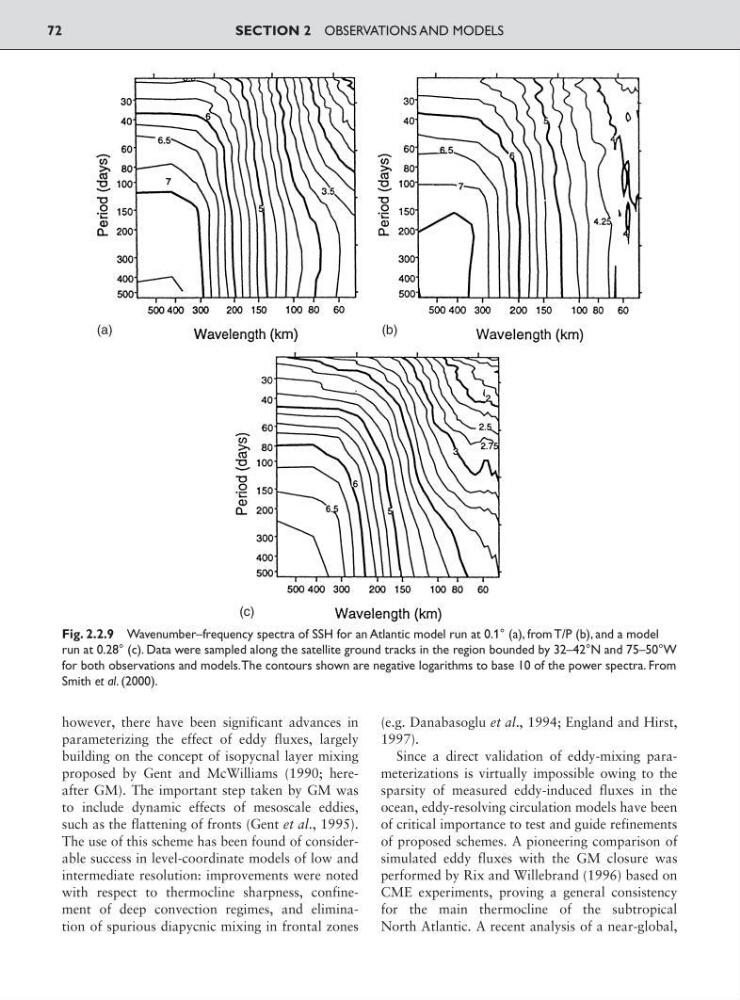
Fig. 2.2.9 Wavenumber–frequency spectra of SSH for an Atlantic model run at 0.1° (a), from T/P (b), and a model
run at 0.28° (c). Data were sampled along the satellite ground tracks in the region bounded by 32–42°N and 75–50°W
for both observations and models.The contours shown are negative logarithms to base 10 of the power spectra. From
Smith et al. (2000).
parameterizing the effect of eddy fluxes, largely
building on the concept of isopycnal layer mixing
proposed by Gent and McWilliams (1990; hereafter GM). The important step taken by GM was
to include dynamic effects of mesoscale eddies,
such as the flattening of fronts (Gent et al., 1995).
The use of this scheme has been found of considerable success in level-coordinate models of low and
intermediate resolution: improvements were noted
with respect to thermocline sharpness, confinement of deep convection regimes, and elimination of spurious diapycnic mixing in frontal zones
(e.g. Danabasoglu et al., 1994; England and Hirst,
1997).
Since a direct validation of eddy-mixing parameterizations is virtually impossible owing to the
sparsity of measured eddy-induced fluxes in the
ocean, eddy-resolving circulation models have been
of critical importance to test and guide refinements
of proposed schemes. A pioneering comparison of
simulated eddy fluxes with the GM closure was
performed by Rix and Willebrand (1996) based on
CME experiments, proving a general consistency
for the main thermocline of the subtropical
North Atlantic. A recent analysis of a near-global,
SECTION 2 OBSERVATIONS AND MODELS
72
(a)
(b)
(c)
Fig. 2.2.9 Wavenumber–frequency spectra of SSH for an Atlantic model run at 0.1° (a), from T/P (b), and a model
run at 0.28° (c). Data were sampled along the satellite ground tracks in the region bounded by 32–42°N and 75–50°W
for both observations and models.The contours shown are negative logarithms to base 10 of the power spectra. From
Smith et al. (2000).