

through Fram Strait (Meincke et al., 1992; Rudels,
1995).
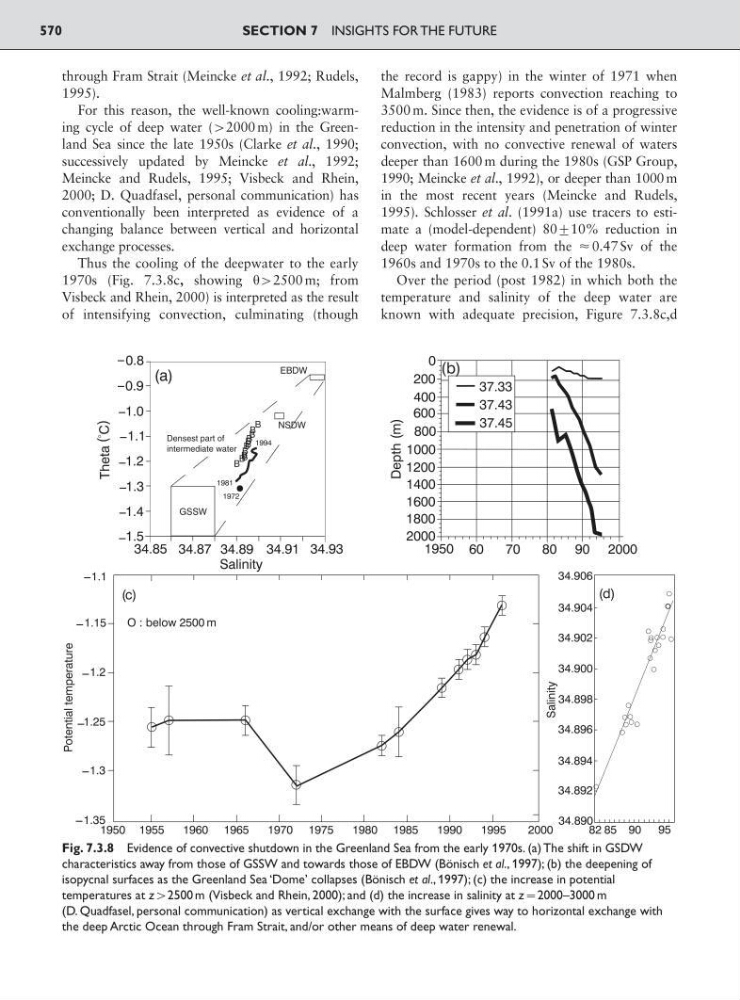
For this reason, the well-known cooling:warming cycle of deep water (92000 m) in the Greenland Sea since the late 1950s (Clarke et al., 1990;
successively updated by Meincke et al., 1992;
Meincke and Rudels, 1995; Visbeck and Rhein,
2000; D. Quadfasel, personal communication) has
conventionally been interpreted as evidence of a
changing balance between vertical and horizontal
exchange processes.
Thus the cooling of the deepwater to the early
1970s (Fig. 7.3.8c, showing 92500 m; from
Visbeck and Rhein, 2000) is interpreted as the result
of intensifying convection, culminating (though
the record is gappy) in the winter of 1971 when
Malmberg (1983) reports convection reaching to
3500 m. Since then, the evidence is of a progressive
reduction in the intensity and penetration of winter
convection, with no convective renewal of waters
deeper than 1600 m during the 1980s (GSP Group,
1990; Meincke et al., 1992), or deeper than 1000 m
in the most recent years (Meincke and Rudels,
1995). Schlosser et al. (1991a) use tracers to estimate a (model-dependent) 80<10% reduction in
deep water formation from the Ϸ 0.47 Sv of the
1960s and 1970s to the 0.1 Sv of the 1980s.
Over the period (post 1982) in which both the
temperature and salinity of the deep water are
known with adequate precision, Figure 7.3.8c,d
SECTION 7 INSIGHTS FOR THE FUTURE
570
Densest part of
intermediate water
Fig. 7.3.8 Evidence of convective shutdown in the Greenland Sea from the early 1970s. (a) The shift in GSDW
characteristics away from those of GSSW and towards those of EBDW (Bönisch et al., 1997); (b) the deepening of
isopycnal surfaces as the Greenland Sea ‘Dome’ collapses (Bönisch et al., 1997); (c) the increase in potential
temperatures at z92500 m (Visbeck and Rhein, 2000); and (d) the increase in salinity at z:2000–3000 m
(D. Quadfasel, personal communication) as vertical exchange with the surface gives way to horizontal exchange with
the deep Arctic Ocean through Fram Strait, and/or other means of deep water renewal.