

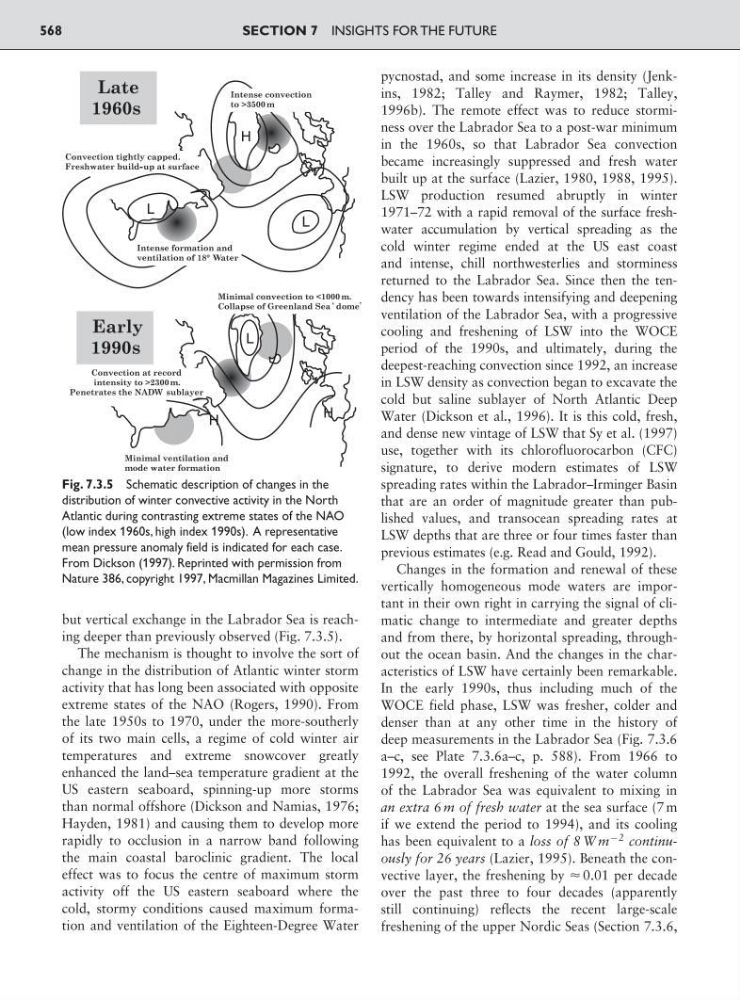
but vertical exchange in the Labrador Sea is reaching deeper than previously observed (Fig. 7.3.5).
The mechanism is thought to involve the sort of
change in the distribution of Atlantic winter storm
activity that has long been associated with opposite
extreme states of the NAO (Rogers, 1990). From
the late 1950s to 1970, under the more-southerly
of its two main cells, a regime of cold winter air
temperatures and extreme snowcover greatly
enhanced the land–sea temperature gradient at the
US eastern seaboard, spinning-up more storms
than normal offshore (Dickson and Namias, 1976;
Hayden, 1981) and causing them to develop more
rapidly to occlusion in a narrow band following
the main coastal baroclinic gradient. The local
effect was to focus the centre of maximum storm
activity off the US eastern seaboard where the
cold, stormy conditions caused maximum formation and ventilation of the Eighteen-Degree Water
pycnostad, and some increase in its density (Jenkins, 1982; Talley and Raymer, 1982; Talley,
1996b). The remote effect was to reduce storminess over the Labrador Sea to a post-war minimum
in the 1960s, so that Labrador Sea convection
became increasingly suppressed and fresh water
built up at the surface (Lazier, 1980, 1988, 1995).
LSW production resumed abruptly in winter
1971–72 with a rapid removal of the surface freshwater accumulation by vertical spreading as the
cold winter regime ended at the US east coast
and intense, chill northwesterlies and storminess
returned to the Labrador Sea. Since then the tendency has been towards intensifying and deepening
ventilation of the Labrador Sea, with a progressive
cooling and freshening of LSW into the WOCE
period of the 1990s, and ultimately, during the
deepest-reaching convection since 1992, an increase
in LSW density as convection began to excavate the
cold but saline sublayer of North Atlantic Deep
Water (Dickson et al., 1996). It is this cold, fresh,
and dense new vintage of LSW that Sy et al. (1997)
use, together with its chlorofluorocarbon (CFC)
signature, to derive modern estimates of LSW
spreading rates within the Labrador–Irminger Basin
that are an order of magnitude greater than published values, and transocean spreading rates at
LSW depths that are three or four times faster than
previous estimates (e.g. Read and Gould, 1992).
Changes in the formation and renewal of these
vertically homogeneous mode waters are important in their own right in carrying the signal of climatic change to intermediate and greater depths
and from there, by horizontal spreading, throughout the ocean basin. And the changes in the characteristics of LSW have certainly been remarkable.
In the early 1990s, thus including much of the
WOCE field phase, LSW was fresher, colder and
denser than at any other time in the history of
deep measurements in the Labrador Sea (Fig. 7.3.6
a–c, see Plate 7.3.6a–c, p. 588). From 1966 to
1992, the overall freshening of the water column
of the Labrador Sea was equivalent to mixing in
an extra 6 m of fresh water at the sea surface (7 m
if we extend the period to 1994), and its cooling
has been equivalent to a loss of 8 W m
92 continuously for 26 years (Lazier, 1995). Beneath the convective layer, the freshening by Ϸ 0.01 per decade
over the past three to four decades (apparently
still continuing) reflects the recent large-scale
freshening of the upper Nordic Seas (Section 7.3.6,
SECTION 7 INSIGHTS FOR THE FUTURE
568
‘
’
Fig. 7.3.5 Schematic description of changes in the
distribution of winter convective activity in the North
Atlantic during contrasting extreme states of the NAO
(low index 1960s, high index 1990s). A representative
mean pressure anomaly field is indicated for each case.
From Dickson (1997). Reprinted with permission from
Nature 386, copyright 1997, Macmillan Magazines Limited.