

that had sunk into the ocean interior and moved
towards the equator. Stommel (1979) examined the
connection between the ocean mixed layer and the
geostrophic flow below, and showed that the convergent Ekman layer pumped water down into the
deep geostrophic flow along isopycnal surfaces.
This analysis was extended by Woods (1985b),
who showed that, in addition to Ekman pumping,
subduction occurs where the maximum depth of
the winter mixed layer decreases in thickness in
the direction of motion (see also Price, Chapter
5.3; Nurser and Marshall, 1991; Pedlosky and
Robbins, 1991).
All of this research on ventilated thermoclines
has assumed a steady circulation in the deep and
surface ocean. Here we consider the effect of the
warming or freshening of surface waters on the
thermocline temperature and salinity structure.
Pure warming
Suppose the water in the mixed layer has been
warmed through increased heat flux from the
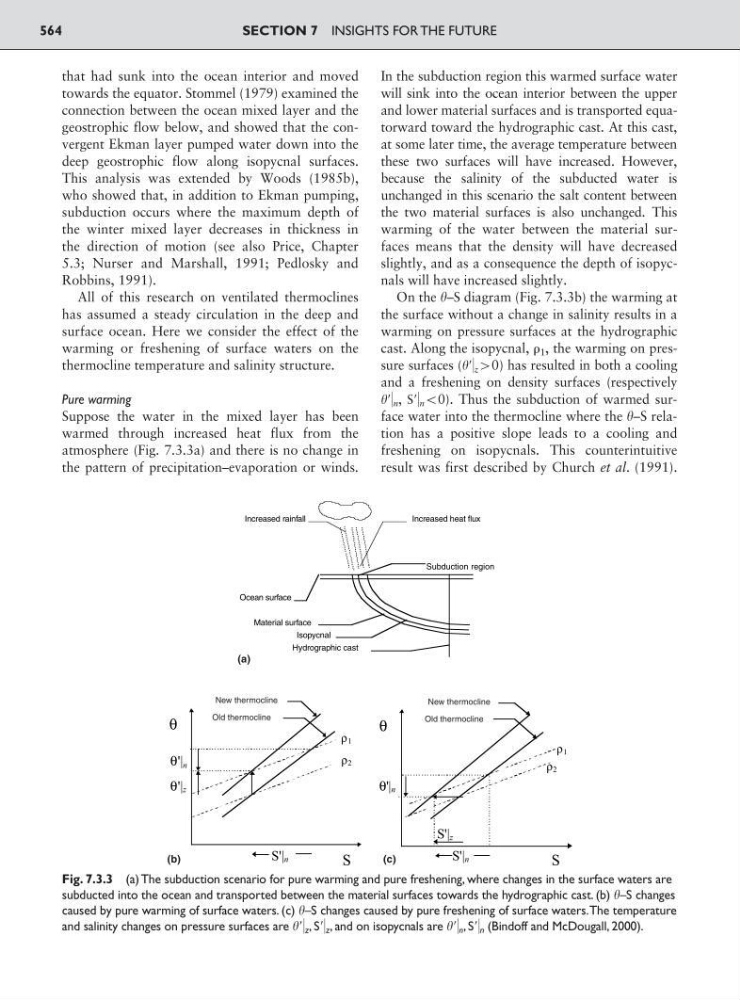
atmosphere (Fig. 7.3.3a) and there is no change in
the pattern of precipitation–evaporation or winds.
In the subduction region this warmed surface water
will sink into the ocean interior between the upper
and lower material surfaces and is transported equatorward toward the hydrographic cast. At this cast,
at some later time, the average temperature between
these two surfaces will have increased. However,
because the salinity of the subducted water is
unchanged in this scenario the salt content between
the two material surfaces is also unchanged. This
warming of the water between the material surfaces means that the density will have decreased
slightly, and as a consequence the depth of isopycnals will have increased slightly.
On the –S diagram (Fig. 7.3.3b) the warming at
the surface without a change in salinity results in a
warming on pressure surfaces at the hydrographic
cast. Along the isopycnal, 1 , the warming on pressure surfaces (ЈΗ z 90) has resulted in both a cooling
and a freshening on density surfaces (respectively
ЈΗ n , SЈΗ n :0). Thus the subduction of warmed surface water into the thermocline where the –S relation has a positive slope leads to a cooling and
freshening on isopycnals. This counterintuitive
result was first described by Church et al. (1991).
SECTION 7 INSIGHTS FOR THE FUTURE
564
Material surface
Isopycnal
Hydrographic cast
Ocean surface
Subduction region
Increased rainfall
Increased heat flux
S
θ
θ'| n
θ'| z
S'| n
ρ 2
ρ 1
S
θ
θ'| n
S'| n
ρ 2
ρ 1
S'| z
New thermocline
Old thermocline
New thermocline
Old thermocline
(a)
(b)
(c)
Fig. 7.3.3 (a) The subduction scenario for pure warming and pure freshening, where changes in the surface waters are
subducted into the ocean and transported between the material surfaces towards the hydrographic cast. (b) –S changes
caused by pure warming of surface waters. (c) –S changes caused by pure freshening of surface waters.The temperature
and salinity changes on pressure surfaces are ЈΗ z , SЈΗ z , and on isopycnals are ЈΗ n , SЈΗ n (Bindoff and McDougall, 2000).
towards the equator. Stommel (1979) examined the
connection between the ocean mixed layer and the
geostrophic flow below, and showed that the convergent Ekman layer pumped water down into the
deep geostrophic flow along isopycnal surfaces.
This analysis was extended by Woods (1985b),
who showed that, in addition to Ekman pumping,
subduction occurs where the maximum depth of
the winter mixed layer decreases in thickness in
the direction of motion (see also Price, Chapter
5.3; Nurser and Marshall, 1991; Pedlosky and
Robbins, 1991).
All of this research on ventilated thermoclines
has assumed a steady circulation in the deep and
surface ocean. Here we consider the effect of the
warming or freshening of surface waters on the
thermocline temperature and salinity structure.
Pure warming
Suppose the water in the mixed layer has been
warmed through increased heat flux from the
atmosphere (Fig. 7.3.3a) and there is no change in
the pattern of precipitation–evaporation or winds.
In the subduction region this warmed surface water
will sink into the ocean interior between the upper
and lower material surfaces and is transported equatorward toward the hydrographic cast. At this cast,
at some later time, the average temperature between
these two surfaces will have increased. However,
because the salinity of the subducted water is
unchanged in this scenario the salt content between
the two material surfaces is also unchanged. This
warming of the water between the material surfaces means that the density will have decreased
slightly, and as a consequence the depth of isopycnals will have increased slightly.
On the –S diagram (Fig. 7.3.3b) the warming at
the surface without a change in salinity results in a
warming on pressure surfaces at the hydrographic
cast. Along the isopycnal, 1 , the warming on pressure surfaces (ЈΗ z 90) has resulted in both a cooling
and a freshening on density surfaces (respectively
ЈΗ n , SЈΗ n :0). Thus the subduction of warmed surface water into the thermocline where the –S relation has a positive slope leads to a cooling and
freshening on isopycnals. This counterintuitive
result was first described by Church et al. (1991).
SECTION 7 INSIGHTS FOR THE FUTURE
564
Material surface
Isopycnal
Hydrographic cast
Ocean surface
Subduction region
Increased rainfall
Increased heat flux
S
θ
θ'| n
θ'| z
S'| n
ρ 2
ρ 1
S
θ
θ'| n
S'| n
ρ 2
ρ 1
S'| z
New thermocline
Old thermocline
New thermocline
Old thermocline
(a)
(b)
(c)
Fig. 7.3.3 (a) The subduction scenario for pure warming and pure freshening, where changes in the surface waters are
subducted into the ocean and transported between the material surfaces towards the hydrographic cast. (b) –S changes
caused by pure warming of surface waters. (c) –S changes caused by pure freshening of surface waters.The temperature
and salinity changes on pressure surfaces are ЈΗ z , SЈΗ z , and on isopycnals are ЈΗ n , SЈΗ n (Bindoff and McDougall, 2000).