

conservation, numerical ocean circulation models
provide a comprehensive means of analysing observations based on a more general physical principle.
Moreover, a truly optimal analysis of the ocean
will be achieved by utilizing all available measurements, including altimetry, hydrography, float and
drifter velocities, XBT temperature profiles, and
ultimately tracer and nutrient data. Ocean state
estimation, often referred to as data assimilation,
involves combining these diverse observations with
ocean models. We expect that such an approach
will lead to estimates of the time-evolving ocean
SECTION 7 INSIGHTS FOR THE FUTURE
536
-100
0
100
10m
u (cm s –1
)
u (cm s –1
)
u (cm s –1
)
u (cm s –1
)
TAO
Model
-50
0
50
100
150
45m
0
100
200
120m
84
85
86
87
88
89
90
91
92
93
94
95
96
97
98
-50
0
50
100
150
200m
Year
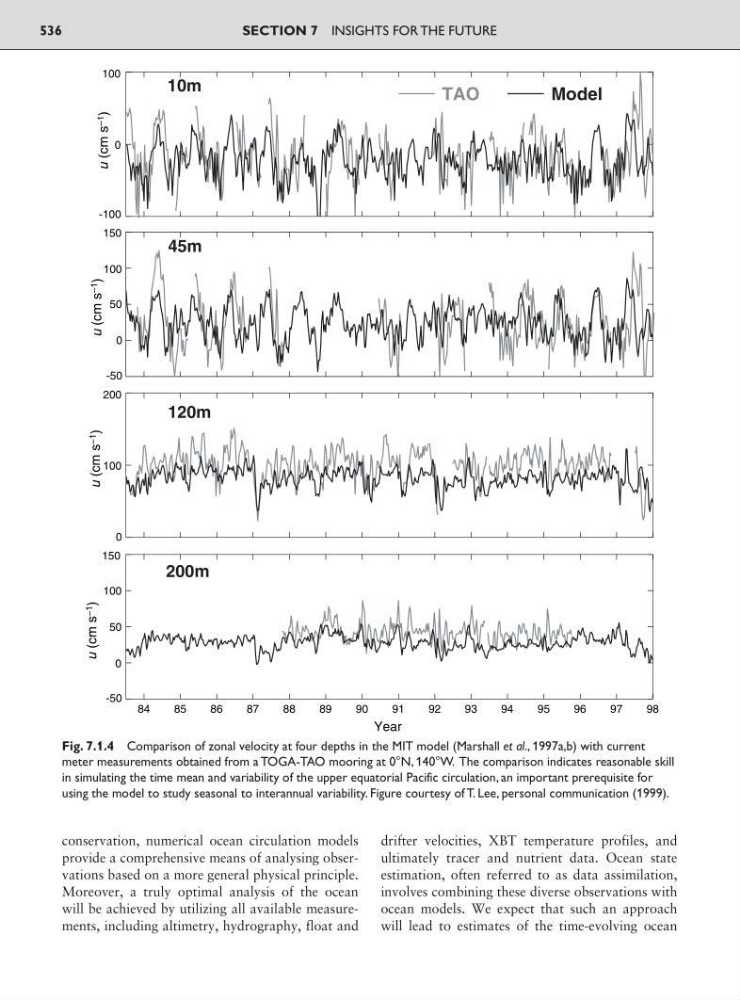
Fig. 7.1.4 Comparison of zonal velocity at four depths in the MIT model (Marshall et al., 1997a,b) with current
meter measurements obtained from a TOGA-TAO mooring at 0°N, 140°W. The comparison indicates reasonable skill
in simulating the time mean and variability of the upper equatorial Pacific circulation, an important prerequisite for
using the model to study seasonal to interannual variability. Figure courtesy of T. Lee, personal communication (1999).
provide a comprehensive means of analysing observations based on a more general physical principle.
Moreover, a truly optimal analysis of the ocean
will be achieved by utilizing all available measurements, including altimetry, hydrography, float and
drifter velocities, XBT temperature profiles, and
ultimately tracer and nutrient data. Ocean state
estimation, often referred to as data assimilation,
involves combining these diverse observations with
ocean models. We expect that such an approach
will lead to estimates of the time-evolving ocean
SECTION 7 INSIGHTS FOR THE FUTURE
536
-100
0
100
10m
u (cm s –1
)
u (cm s –1
)
u (cm s –1
)
u (cm s –1
)
TAO
Model
-50
0
50
100
150
45m
0
100
200
120m
84
85
86
87
88
89
90
91
92
93
94
95
96
97
98
-50
0
50
100
150
200m
Year
Fig. 7.1.4 Comparison of zonal velocity at four depths in the MIT model (Marshall et al., 1997a,b) with current
meter measurements obtained from a TOGA-TAO mooring at 0°N, 140°W. The comparison indicates reasonable skill
in simulating the time mean and variability of the upper equatorial Pacific circulation, an important prerequisite for
using the model to study seasonal to interannual variability. Figure courtesy of T. Lee, personal communication (1999).