

continually increased. Such a situation can occur
even in the absence of any changes in ocean circulation, ocean biology, heat flux, etc.
This possibility arises because the thermodynamic capacity of seawater to absorb further CO 2
decreases as more and more CO 2 is absorbed. This
behaviour is not shared by other anthropogenic
gases such as the CFCs. For non-reactive gases
(e.g. the CFCs), the amount (mass) of gas that can
be absorbed by the surface ocean in response to a
given perturbation of its atmospheric partial pressure is given by Henry’s Law. The relative air–sea
partitioning is therefore constant, irrespective of
the equilibrium partial pressure of the gas in the
air–ocean system. This is not the case for CO 2 , the
uptake of which is dependent on the buffer capacity of seawater. This buffer capacity is dependent
on the concentration of dissolved carbonate ion,
which tends to decrease as more and more CO 2 is
added to seawater. Hence the uptake capacity for
CO 2 is reduced at higher pCO 2 .
Consider a highly idealized model of the
Atlantic conveyor in which the upper limb of the
meridional overturning circulation (MOC) has had
sufficient time to reach equilibrium with respect to
contemporary atmospheric pCO 2 , prior to crossing the equator. Within the North Atlantic these
upper waters cool strongly so that CO 2 solubility
increases, tending to drive CO 2 uptake from the
atmosphere into the ocean. At some point the
upper waters become dense enough to sink out of
the surface layer and return southwards with the
lower limb of the MOC. We assume that an identical circulation and cooling occurred in both the
preindustrial and contemporary ocean and that, in
both cases, the upper limb of the MOC had sufficient time to pre-equilibrate with the contemporary atmospheric pCO 2 levels prior to entering the
North Atlantic. For the contemporary ocean, with
surface waters originating at elevated pCO 2 levels
(e.g. 370 atm), the CO 2 solubility within the
North Atlantic will increase as the surface water is
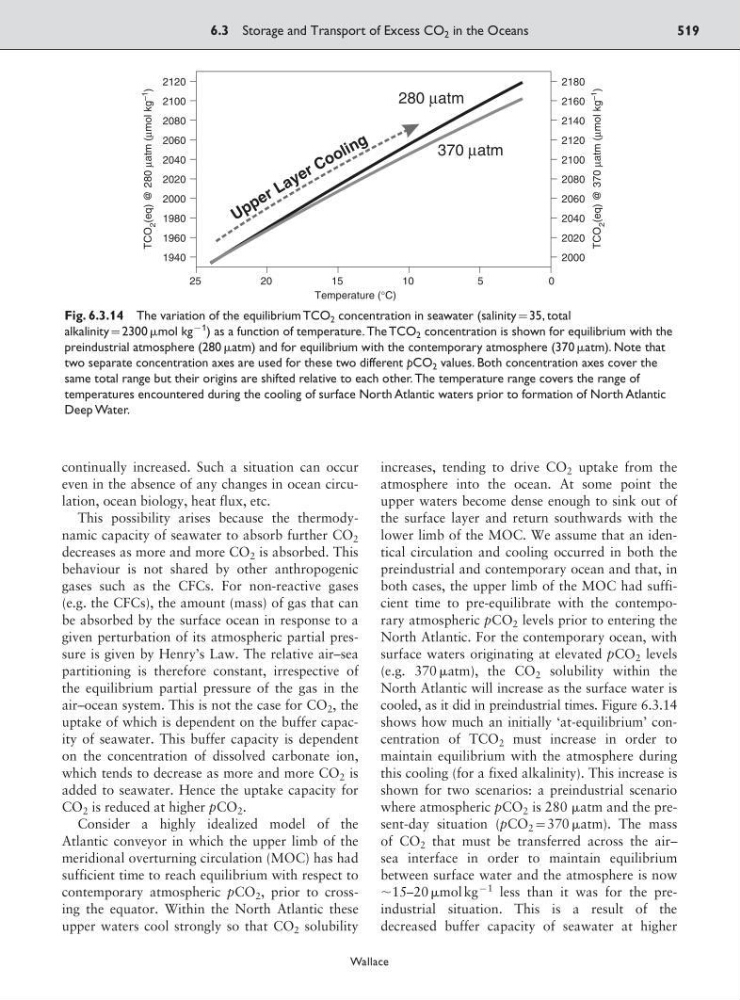
cooled, as it did in preindustrial times. Figure 6.3.14
shows how much an initially ‘at-equilibrium’ concentration of TCO 2 must increase in order to
maintain equilibrium with the atmosphere during
this cooling (for a fixed alkalinity). This increase is
shown for two scenarios: a preindustrial scenario
where atmospheric pCO 2 is 280 atm and the present-day situation (pCO 2 :370 atm). The mass
of CO 2 that must be transferred across the air–
sea interface in order to maintain equilibrium
between surface water and the atmosphere is now
ϳ15–20 mol kg
91 less than it was for the preindustrial situation. This is a result of the
decreased buffer capacity of seawater at higher
6.3 Storage and Transport of Excess CO 2 in the Oceans
519
Wallace
Temperature (°C)
0
5
10
15
20
25
1940
1960
1980
2000
2020
2040
2060
2080
2100
2120
2000
2020
2040
2060
2080
2100
2120
2140
2160
2180
280 μatm
370 μatm
U p p e r L a y e r C o o l i n g
TCO
2
(eq) @ 280
μatm (μmol kg
–1
)
TCO
2
(eq) @ 370
μatm (μmol kg
–1
)
Fig. 6.3.14 The variation of the equilibrium TCO 2 concentration in seawater (salinity:35, total
alkalinity:2300 mol kg
91 ) as a function of temperature. The TCO 2 concentration is shown for equilibrium with the
preindustrial atmosphere (280 atm) and for equilibrium with the contemporary atmosphere (370 atm). Note that
two separate concentration axes are used for these two different pCO 2 values. Both concentration axes cover the
same total range but their origins are shifted relative to each other. The temperature range covers the range of
temperatures encountered during the cooling of surface North Atlantic waters prior to formation of North Atlantic
Deep Water.
even in the absence of any changes in ocean circulation, ocean biology, heat flux, etc.
This possibility arises because the thermodynamic capacity of seawater to absorb further CO 2
decreases as more and more CO 2 is absorbed. This
behaviour is not shared by other anthropogenic
gases such as the CFCs. For non-reactive gases
(e.g. the CFCs), the amount (mass) of gas that can
be absorbed by the surface ocean in response to a
given perturbation of its atmospheric partial pressure is given by Henry’s Law. The relative air–sea
partitioning is therefore constant, irrespective of
the equilibrium partial pressure of the gas in the
air–ocean system. This is not the case for CO 2 , the
uptake of which is dependent on the buffer capacity of seawater. This buffer capacity is dependent
on the concentration of dissolved carbonate ion,
which tends to decrease as more and more CO 2 is
added to seawater. Hence the uptake capacity for
CO 2 is reduced at higher pCO 2 .
Consider a highly idealized model of the
Atlantic conveyor in which the upper limb of the
meridional overturning circulation (MOC) has had
sufficient time to reach equilibrium with respect to
contemporary atmospheric pCO 2 , prior to crossing the equator. Within the North Atlantic these
upper waters cool strongly so that CO 2 solubility
increases, tending to drive CO 2 uptake from the
atmosphere into the ocean. At some point the
upper waters become dense enough to sink out of
the surface layer and return southwards with the
lower limb of the MOC. We assume that an identical circulation and cooling occurred in both the
preindustrial and contemporary ocean and that, in
both cases, the upper limb of the MOC had sufficient time to pre-equilibrate with the contemporary atmospheric pCO 2 levels prior to entering the
North Atlantic. For the contemporary ocean, with
surface waters originating at elevated pCO 2 levels
(e.g. 370 atm), the CO 2 solubility within the
North Atlantic will increase as the surface water is
cooled, as it did in preindustrial times. Figure 6.3.14
shows how much an initially ‘at-equilibrium’ concentration of TCO 2 must increase in order to
maintain equilibrium with the atmosphere during
this cooling (for a fixed alkalinity). This increase is
shown for two scenarios: a preindustrial scenario
where atmospheric pCO 2 is 280 atm and the present-day situation (pCO 2 :370 atm). The mass
of CO 2 that must be transferred across the air–
sea interface in order to maintain equilibrium
between surface water and the atmosphere is now
ϳ15–20 mol kg
91 less than it was for the preindustrial situation. This is a result of the
decreased buffer capacity of seawater at higher
6.3 Storage and Transport of Excess CO 2 in the Oceans
519
Wallace
Temperature (°C)
0
5
10
15
20
25
1940
1960
1980
2000
2020
2040
2060
2080
2100
2120
2000
2020
2040
2060
2080
2100
2120
2140
2160
2180
280 μatm
370 μatm
U p p e r L a y e r C o o l i n g
TCO
2
(eq) @ 280
μatm (μmol kg
–1
)
TCO
2
(eq) @ 370
μatm (μmol kg
–1
)
Fig. 6.3.14 The variation of the equilibrium TCO 2 concentration in seawater (salinity:35, total
alkalinity:2300 mol kg
91 ) as a function of temperature. The TCO 2 concentration is shown for equilibrium with the
preindustrial atmosphere (280 atm) and for equilibrium with the contemporary atmosphere (370 atm). Note that
two separate concentration axes are used for these two different pCO 2 values. Both concentration axes cover the
same total range but their origins are shifted relative to each other. The temperature range covers the range of
temperatures encountered during the cooling of surface North Atlantic waters prior to formation of North Atlantic
Deep Water.