

To-date observation-based studies of ocean carbon transport have been conducted exclusively in
the Atlantic Ocean although analysis of Pacific
Ocean transports is now commencing (P. Robbins,
personal communication).
Atlantic carbon transport: methods
Brewer et al. (1989) were the first to estimate carbon transports in a manner similar to the analysis
of heat and freshwater transports by Bryden and
Hall (1980) and Roemmich and Wunsch (1985).
Their analysis was based on a limited data set collected in the Florida Straits and along 25°N.
Martel and Wunsch (1993a) subsequently calculated carbon transports using a circulation-modelbased inversion of North Atlantic data. Analyses
of interhemispheric transports published by
Broecker and Peng (1992) and Keeling and Peng
(1995), although frequently cited in the carbon
modelling literature, were simple ‘box-overturning’ calculations intended primarily to illustrate
the rough magnitude of interhemispheric carbon
transports. These earlier estimates are discussed in
detail by Holfort et al. (1998). Here we focus on
WOCE-era studies and and also contribute a general picture of the carbon transport in the Atlantic
Ocean. Stoll et al. (1996) and Holfort et al. (1998)
have published meridional transport calculations
using zonal WOCE sections from the northern
North Atlantic (AR7E at 58°N) and the mid-latitude South Atlantic (A8, A9 and A10, 10–30°S),
respectively. A study by Rosón et al. (2001) based
on data collected along A5 (24.5°N) using the
mass transport estimates of Lavín et al. (1998) is
also discussed.
All of these WOCE-era studies used zonal
sections of TCO 2 to calculate meridional carbon
transports. The net transport across the bounding
hydrographic sections was calculated with an
approach similar to that used to estimate the North–
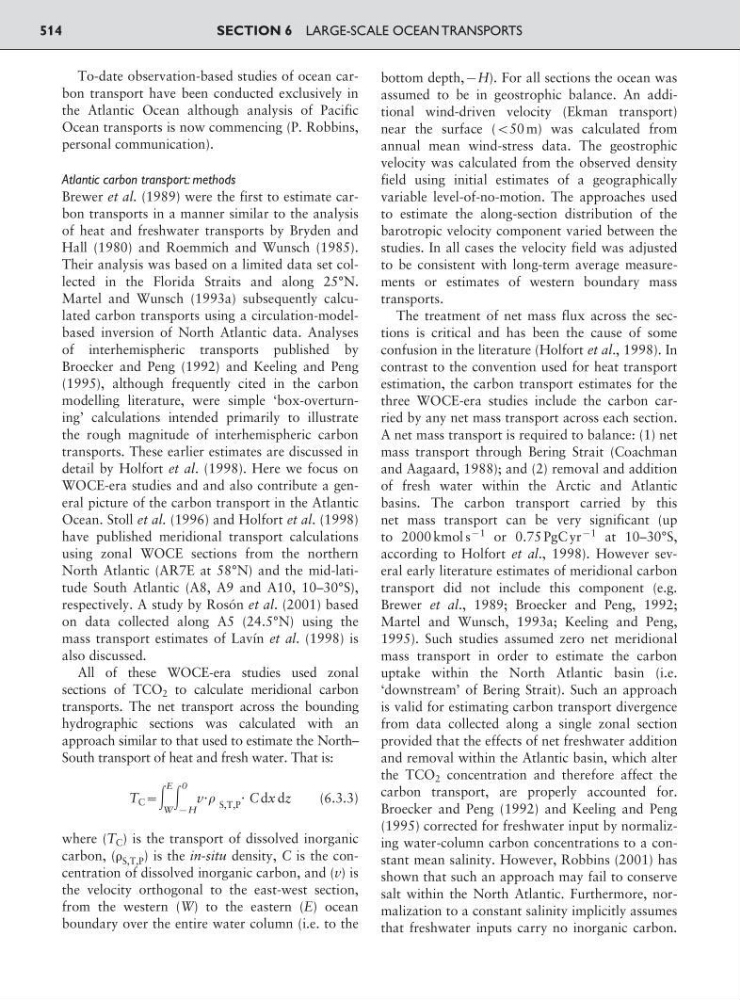
South transport of heat and fresh water. That is:
T C :͵
E
W
͵
0
9H
vи S,T,P и C dx dz
(6.3.3)
where (T C ) is the transport of dissolved inorganic
carbon, ( S,T,P ) is the in-situ density, C is the concentration of dissolved inorganic carbon, and (v) is
the velocity orthogonal to the east-west section,
from the western (W) to the eastern (E) ocean
boundary over the entire water column (i.e. to the
bottom depth,9H). For all sections the ocean was
assumed to be in geostrophic balance. An additional wind-driven velocity (Ekman transport)
near the surface (:50 m) was calculated from
annual mean wind-stress data. The geostrophic
velocity was calculated from the observed density
field using initial estimates of a geographically
variable level-of-no-motion. The approaches used
to estimate the along-section distribution of the
barotropic velocity component varied between the
studies. In all cases the velocity field was adjusted
to be consistent with long-term average measurements or estimates of western boundary mass
transports.
The treatment of net mass flux across the sections is critical and has been the cause of some
confusion in the literature (Holfort et al., 1998). In
contrast to the convention used for heat transport
estimation, the carbon transport estimates for the
three WOCE-era studies include the carbon carried by any net mass transport across each section.
A net mass transport is required to balance: (1) net
mass transport through Bering Strait (Coachman
and Aagaard, 1988); and (2) removal and addition
of fresh water within the Arctic and Atlantic
basins. The carbon transport carried by this
net mass transport can be very significant (up
to 2000 kmol s
91 or 0.75 PgC yr
91 at 10–30°S,
according to Holfort et al., 1998). However several early literature estimates of meridional carbon
transport did not include this component (e.g.
Brewer et al., 1989; Broecker and Peng, 1992;
Martel and Wunsch, 1993a; Keeling and Peng,
1995). Such studies assumed zero net meridional
mass transport in order to estimate the carbon
uptake within the North Atlantic basin (i.e.
‘downstream’ of Bering Strait). Such an approach
is valid for estimating carbon transport divergence
from data collected along a single zonal section
provided that the effects of net freshwater addition
and removal within the Atlantic basin, which alter
the TCO 2 concentration and therefore affect the
carbon transport, are properly accounted for.
Broecker and Peng (1992) and Keeling and Peng
(1995) corrected for freshwater input by normalizing water-column carbon concentrations to a constant mean salinity. However, Robbins (2001) has
shown that such an approach may fail to conserve
salt within the North Atlantic. Furthermore, normalization to a constant salinity implicitly assumes
that freshwater inputs carry no inorganic carbon.
SECTION 6 LARGE-SCALE OCEAN TRANSPORTS
514
the Atlantic Ocean although analysis of Pacific
Ocean transports is now commencing (P. Robbins,
personal communication).
Atlantic carbon transport: methods
Brewer et al. (1989) were the first to estimate carbon transports in a manner similar to the analysis
of heat and freshwater transports by Bryden and
Hall (1980) and Roemmich and Wunsch (1985).
Their analysis was based on a limited data set collected in the Florida Straits and along 25°N.
Martel and Wunsch (1993a) subsequently calculated carbon transports using a circulation-modelbased inversion of North Atlantic data. Analyses
of interhemispheric transports published by
Broecker and Peng (1992) and Keeling and Peng
(1995), although frequently cited in the carbon
modelling literature, were simple ‘box-overturning’ calculations intended primarily to illustrate
the rough magnitude of interhemispheric carbon
transports. These earlier estimates are discussed in
detail by Holfort et al. (1998). Here we focus on
WOCE-era studies and and also contribute a general picture of the carbon transport in the Atlantic
Ocean. Stoll et al. (1996) and Holfort et al. (1998)
have published meridional transport calculations
using zonal WOCE sections from the northern
North Atlantic (AR7E at 58°N) and the mid-latitude South Atlantic (A8, A9 and A10, 10–30°S),
respectively. A study by Rosón et al. (2001) based
on data collected along A5 (24.5°N) using the
mass transport estimates of Lavín et al. (1998) is
also discussed.
All of these WOCE-era studies used zonal
sections of TCO 2 to calculate meridional carbon
transports. The net transport across the bounding
hydrographic sections was calculated with an
approach similar to that used to estimate the North–
South transport of heat and fresh water. That is:
T C :͵
E
W
͵
0
9H
vи S,T,P и C dx dz
(6.3.3)
where (T C ) is the transport of dissolved inorganic
carbon, ( S,T,P ) is the in-situ density, C is the concentration of dissolved inorganic carbon, and (v) is
the velocity orthogonal to the east-west section,
from the western (W) to the eastern (E) ocean
boundary over the entire water column (i.e. to the
bottom depth,9H). For all sections the ocean was
assumed to be in geostrophic balance. An additional wind-driven velocity (Ekman transport)
near the surface (:50 m) was calculated from
annual mean wind-stress data. The geostrophic
velocity was calculated from the observed density
field using initial estimates of a geographically
variable level-of-no-motion. The approaches used
to estimate the along-section distribution of the
barotropic velocity component varied between the
studies. In all cases the velocity field was adjusted
to be consistent with long-term average measurements or estimates of western boundary mass
transports.
The treatment of net mass flux across the sections is critical and has been the cause of some
confusion in the literature (Holfort et al., 1998). In
contrast to the convention used for heat transport
estimation, the carbon transport estimates for the
three WOCE-era studies include the carbon carried by any net mass transport across each section.
A net mass transport is required to balance: (1) net
mass transport through Bering Strait (Coachman
and Aagaard, 1988); and (2) removal and addition
of fresh water within the Arctic and Atlantic
basins. The carbon transport carried by this
net mass transport can be very significant (up
to 2000 kmol s
91 or 0.75 PgC yr
91 at 10–30°S,
according to Holfort et al., 1998). However several early literature estimates of meridional carbon
transport did not include this component (e.g.
Brewer et al., 1989; Broecker and Peng, 1992;
Martel and Wunsch, 1993a; Keeling and Peng,
1995). Such studies assumed zero net meridional
mass transport in order to estimate the carbon
uptake within the North Atlantic basin (i.e.
‘downstream’ of Bering Strait). Such an approach
is valid for estimating carbon transport divergence
from data collected along a single zonal section
provided that the effects of net freshwater addition
and removal within the Atlantic basin, which alter
the TCO 2 concentration and therefore affect the
carbon transport, are properly accounted for.
Broecker and Peng (1992) and Keeling and Peng
(1995) corrected for freshwater input by normalizing water-column carbon concentrations to a constant mean salinity. However, Robbins (2001) has
shown that such an approach may fail to conserve
salt within the North Atlantic. Furthermore, normalization to a constant salinity implicitly assumes
that freshwater inputs carry no inorganic carbon.
SECTION 6 LARGE-SCALE OCEAN TRANSPORTS
514