

mode and intermediate waters from the Southern
Ocean to the southern subtropical gyres may be
the single most important mechanism for balancing the large net flux (0.61 Sv; see Table 6.2.2)
received by the oceans south of 30°S from the
atmosphere and through ice flows.
The ability of ocean general circulation models
to reproduce the estimated freshwater fluxes and
their mechanisms will be a stringent test of model
realism. In ocean-only models, surface flux forcing
will determine the net equilibrium transports
(unless the problematic relaxation boundary conditions are used), but internal model physics will
determine how this flux is achieved.
6.2.7 Global budgets
Direct oceanic freshwater transport estimates are
presently available in all basins at six latitudes
(Table 6.2.2), allowing the global meridional
freshwater transport to be examined. Since few of
the major rivers flow meridionally, the zonally
integrated meridional ocean transport of fresh water
is largely equal and opposite to transport in the
atmosphere (Wijffels et al., 1992). These estimates
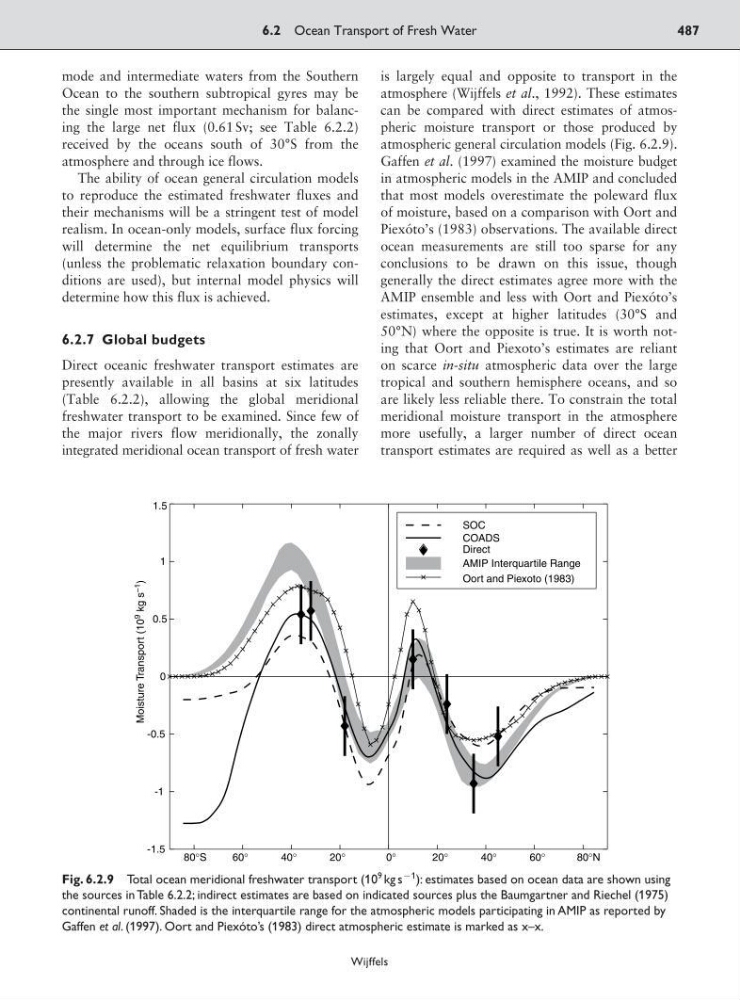
can be compared with direct estimates of atmospheric moisture transport or those produced by
atmospheric general circulation models (Fig. 6.2.9).
Gaffen et al. (1997) examined the moisture budget
in atmospheric models in the AMIP and concluded
that most models overestimate the poleward flux
of moisture, based on a comparison with Oort and
Piexóto’s (1983) observations. The available direct
ocean measurements are still too sparse for any
conclusions to be drawn on this issue, though
generally the direct estimates agree more with the
AMIP ensemble and less with Oort and Piexóto’s
estimates, except at higher latitudes (30°S and
50°N) where the opposite is true. It is worth noting that Oort and Piexoto’s estimates are reliant
on scarce in-situ atmospheric data over the large
tropical and southern hemisphere oceans, and so
are likely less reliable there. To constrain the total
meridional moisture transport in the atmosphere
more usefully, a larger number of direct ocean
transport estimates are required as well as a better
6.2 Ocean Transport of Fresh Water
487
Wijffels
80°S
60°
40°
20°
0°
20°
40°
60°
80°N
-1.5
-1
-0.5
0
0.5
1
1.5
Moisture Transport (10
9
kg s
–1
)
SOC
COADS
Direct
AMIP Interquartile Range
Oort and Piexoto (1983)
Fig. 6.2.9 Total ocean meridional freshwater transport (10
9 kg s
91 ): estimates based on ocean data are shown using
the sources in Table 6.2.2; indirect estimates are based on indicated sources plus the Baumgartner and Riechel (1975)
continental runoff. Shaded is the interquartile range for the atmospheric models participating in AMIP as reported by
Gaffen et al. (1997). Oort and Piexóto’s (1983) direct atmospheric estimate is marked as x–x.
Ocean to the southern subtropical gyres may be
the single most important mechanism for balancing the large net flux (0.61 Sv; see Table 6.2.2)
received by the oceans south of 30°S from the
atmosphere and through ice flows.
The ability of ocean general circulation models
to reproduce the estimated freshwater fluxes and
their mechanisms will be a stringent test of model
realism. In ocean-only models, surface flux forcing
will determine the net equilibrium transports
(unless the problematic relaxation boundary conditions are used), but internal model physics will
determine how this flux is achieved.
6.2.7 Global budgets
Direct oceanic freshwater transport estimates are
presently available in all basins at six latitudes
(Table 6.2.2), allowing the global meridional
freshwater transport to be examined. Since few of
the major rivers flow meridionally, the zonally
integrated meridional ocean transport of fresh water
is largely equal and opposite to transport in the
atmosphere (Wijffels et al., 1992). These estimates
can be compared with direct estimates of atmospheric moisture transport or those produced by
atmospheric general circulation models (Fig. 6.2.9).
Gaffen et al. (1997) examined the moisture budget
in atmospheric models in the AMIP and concluded
that most models overestimate the poleward flux
of moisture, based on a comparison with Oort and
Piexóto’s (1983) observations. The available direct
ocean measurements are still too sparse for any
conclusions to be drawn on this issue, though
generally the direct estimates agree more with the
AMIP ensemble and less with Oort and Piexóto’s
estimates, except at higher latitudes (30°S and
50°N) where the opposite is true. It is worth noting that Oort and Piexoto’s estimates are reliant
on scarce in-situ atmospheric data over the large
tropical and southern hemisphere oceans, and so
are likely less reliable there. To constrain the total
meridional moisture transport in the atmosphere
more usefully, a larger number of direct ocean
transport estimates are required as well as a better
6.2 Ocean Transport of Fresh Water
487
Wijffels
80°S
60°
40°
20°
0°
20°
40°
60°
80°N
-1.5
-1
-0.5
0
0.5
1
1.5
Moisture Transport (10
9
kg s
–1
)
SOC
COADS
Direct
AMIP Interquartile Range
Oort and Piexoto (1983)
Fig. 6.2.9 Total ocean meridional freshwater transport (10
9 kg s
91 ): estimates based on ocean data are shown using
the sources in Table 6.2.2; indirect estimates are based on indicated sources plus the Baumgartner and Riechel (1975)
continental runoff. Shaded is the interquartile range for the atmospheric models participating in AMIP as reported by
Gaffen et al. (1997). Oort and Piexóto’s (1983) direct atmospheric estimate is marked as x–x.