

those among observational estimates. For instance,
Gaffen et al. (1997) concluded that the majority of
atmospheric models participating in the Atmospheric Model Intercomparison Project (AMIP)
overestimate the poleward transport of moisture
compared with estimates based on direct observations. However, such direct observations are based
on mostly non-existent observations over the
oceans (which cover the majority of the planet’s
surface area) and have unknown accuracy (Oort
and Piexóto, 1983).
Ocean modelling efforts, however, suffer an
even greater disadvantage. Ocean models require
surface freshwater forcing. When forced with
‘observed’ freshwater fluxes the models can drift
off to unrealistic states (McWilliams, 1996), and it
has been difficult to distinguish the cause: inaccurate model physics versus errors in the forcing
field. To avoid this problem (and because freshwater forcing of surface bouyancy has been considered of secondary dynamical importance in
comparison to thermal forcing), the practice of
relaxing to an observed salinity field at the surface
(Haney condition for salinity) has become the convention. While a Haney condition for heat is plausible given both sensible and radiational cooling of
warm temperature anomalies by the atmosphere,
such a flux formulation for salinity has not been
physically justified.
In the realm of coupled climate modelling, the
component ocean and atmospheric models are
often first ‘spun-up’ separately before coupling. In
order to maintain a stable ‘realistic’ climate, flux
adjustments are introduced into the coupled system, which are essentially the difference between
the flux out of the atmosphere model spun-up over
the observed sea surface temperature field, and the
flux into the ocean model run under relaxation
forcing (Gordon and O’Farrell, 1997). This common expedient propagates freshwater flux errors
from the unrealistic ocean spin-up under surface
relaxation into the coupled system. Typical freshwater flux adjustments have magnitudes as large
as the natural fluxes themselves, and the resulting
6.2 Ocean Transport of Fresh Water
477
Wijffels
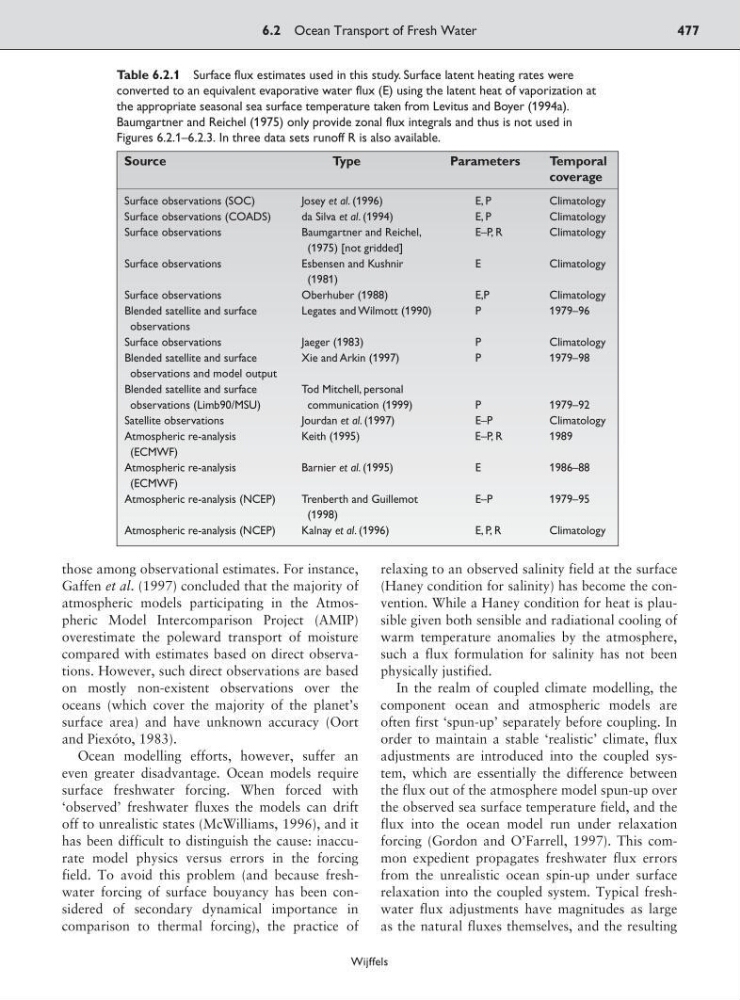
Table 6.2.1 Surface flux estimates used in this study. Surface latent heating rates were
converted to an equivalent evaporative water flux (E) using the latent heat of vaporization at
the appropriate seasonal sea surface temperature taken from Levitus and Boyer (1994a).
Baumgartner and Reichel (1975) only provide zonal flux integrals and thus is not used in
Figures 6.2.1–6.2.3. In three data sets runoff R is also available.
Source
Type
Parameters
Temporal
coverage
Surface observations (SOC)
Josey et al. (1996)
E, P
Climatology
Surface observations (COADS)
da Silva et al. (1994)
E, P
Climatology
Surface observations
Baumgartner and Reichel,
E–P, R
Climatology
(1975) [not gridded]
Surface observations
Esbensen and Kushnir
E
Climatology
(1981)
Surface observations
Oberhuber (1988)
E,P
Climatology
Blended satellite and surface
Legates and Wilmott (1990)
P
1979–96
observations
Surface observations
Jaeger (1983)
P
Climatology
Blended satellite and surface
Xie and Arkin (1997)
P
1979–98
observations and model output
Blended satellite and surface
Tod Mitchell, personal
observations (Limb90/MSU)
communication (1999)
P
1979–92
Satellite observations
Jourdan et al. (1997)
E–P
Climatology
Atmospheric re-analysis
Keith (1995)
E–P, R
1989
(ECMWF)
Atmospheric re-analysis
Barnier et al. (1995)
E
1986–88
(ECMWF)
Atmospheric re-analysis (NCEP)
Trenberth and Guillemot
E–P
1979–95
(1998)
Atmospheric re-analysis (NCEP)
Kalnay et al. (1996)
E, P, R
Climatology
Gaffen et al. (1997) concluded that the majority of
atmospheric models participating in the Atmospheric Model Intercomparison Project (AMIP)
overestimate the poleward transport of moisture
compared with estimates based on direct observations. However, such direct observations are based
on mostly non-existent observations over the
oceans (which cover the majority of the planet’s
surface area) and have unknown accuracy (Oort
and Piexóto, 1983).
Ocean modelling efforts, however, suffer an
even greater disadvantage. Ocean models require
surface freshwater forcing. When forced with
‘observed’ freshwater fluxes the models can drift
off to unrealistic states (McWilliams, 1996), and it
has been difficult to distinguish the cause: inaccurate model physics versus errors in the forcing
field. To avoid this problem (and because freshwater forcing of surface bouyancy has been considered of secondary dynamical importance in
comparison to thermal forcing), the practice of
relaxing to an observed salinity field at the surface
(Haney condition for salinity) has become the convention. While a Haney condition for heat is plausible given both sensible and radiational cooling of
warm temperature anomalies by the atmosphere,
such a flux formulation for salinity has not been
physically justified.
In the realm of coupled climate modelling, the
component ocean and atmospheric models are
often first ‘spun-up’ separately before coupling. In
order to maintain a stable ‘realistic’ climate, flux
adjustments are introduced into the coupled system, which are essentially the difference between
the flux out of the atmosphere model spun-up over
the observed sea surface temperature field, and the
flux into the ocean model run under relaxation
forcing (Gordon and O’Farrell, 1997). This common expedient propagates freshwater flux errors
from the unrealistic ocean spin-up under surface
relaxation into the coupled system. Typical freshwater flux adjustments have magnitudes as large
as the natural fluxes themselves, and the resulting
6.2 Ocean Transport of Fresh Water
477
Wijffels
Table 6.2.1 Surface flux estimates used in this study. Surface latent heating rates were
converted to an equivalent evaporative water flux (E) using the latent heat of vaporization at
the appropriate seasonal sea surface temperature taken from Levitus and Boyer (1994a).
Baumgartner and Reichel (1975) only provide zonal flux integrals and thus is not used in
Figures 6.2.1–6.2.3. In three data sets runoff R is also available.
Source
Type
Parameters
Temporal
coverage
Surface observations (SOC)
Josey et al. (1996)
E, P
Climatology
Surface observations (COADS)
da Silva et al. (1994)
E, P
Climatology
Surface observations
Baumgartner and Reichel,
E–P, R
Climatology
(1975) [not gridded]
Surface observations
Esbensen and Kushnir
E
Climatology
(1981)
Surface observations
Oberhuber (1988)
E,P
Climatology
Blended satellite and surface
Legates and Wilmott (1990)
P
1979–96
observations
Surface observations
Jaeger (1983)
P
Climatology
Blended satellite and surface
Xie and Arkin (1997)
P
1979–98
observations and model output
Blended satellite and surface
Tod Mitchell, personal
observations (Limb90/MSU)
communication (1999)
P
1979–92
Satellite observations
Jourdan et al. (1997)
E–P
Climatology
Atmospheric re-analysis
Keith (1995)
E–P, R
1989
(ECMWF)
Atmospheric re-analysis
Barnier et al. (1995)
E
1986–88
(ECMWF)
Atmospheric re-analysis (NCEP)
Trenberth and Guillemot
E–P
1979–95
(1998)
Atmospheric re-analysis (NCEP)
Kalnay et al. (1996)
E, P, R
Climatology