

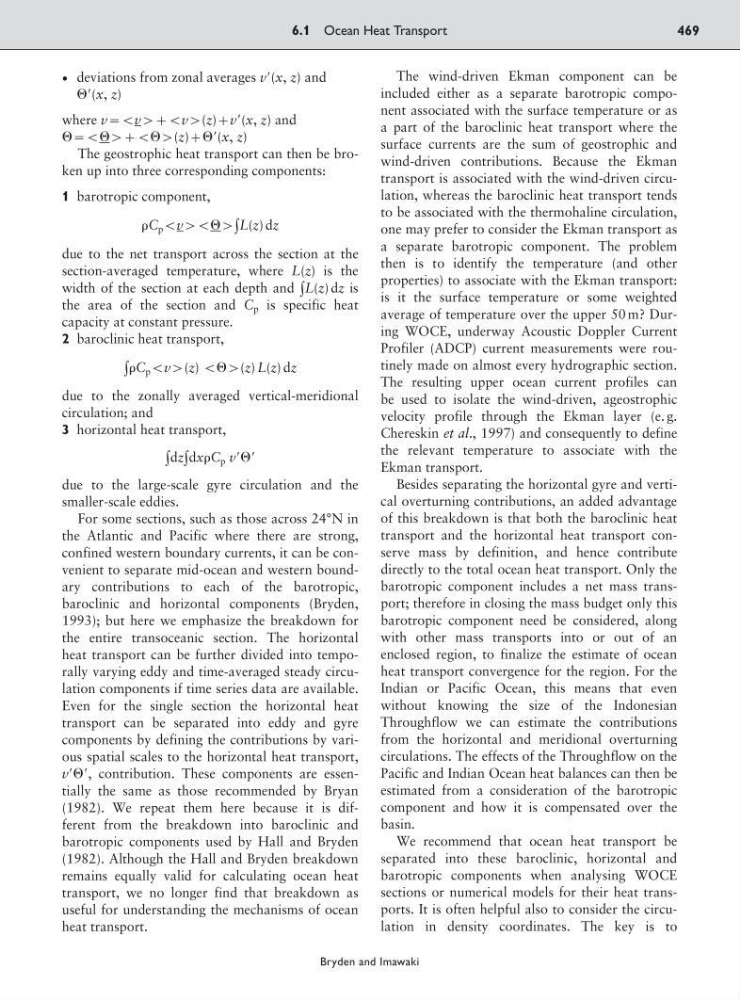
¥ deviations from zonal averages vЈ(x, z) and
⌰Ј(x, z)
where v::v9;:v9(z);vЈ(x, z) and
⌰::⌰9;:⌰9(z);⌰Ј(x, z)
The geostrophic heat transport can then be broken up into three corresponding components:
1 barotropic component,
C p :v9:⌰9L(z) dz
due to the net transport across the section at the
section-averaged temperature, where L(z) is the
width of the section at each depth and L(z) dz is
the area of the section and C p is specific heat
capacity at constant pressure.
2 baroclinic heat transport,
C p :v9(z) :⌰9(z) L(z) dz
due to the zonally averaged vertical-meridional
circulation; and
3 horizontal heat transport,
dzdxC p vЈ⌰Ј
due to the large-scale gyre circulation and the
smaller-scale eddies.
For some sections, such as those across 24°N in
the Atlantic and Pacific where there are strong,
confined western boundary currents, it can be convenient to separate mid-ocean and western boundary contributions to each of the barotropic,
baroclinic and horizontal components (Bryden,
1993); but here we emphasize the breakdown for
the entire transoceanic section. The horizontal
heat transport can be further divided into temporally varying eddy and time-averaged steady circulation components if time series data are available.
Even for the single section the horizontal heat
transport can be separated into eddy and gyre
components by defining the contributions by various spatial scales to the horizontal heat transport,
vЈ⌰Ј, contribution. These components are essentially the same as those recommended by Bryan
(1982). We repeat them here because it is different from the breakdown into baroclinic and
barotropic components used by Hall and Bryden
(1982). Although the Hall and Bryden breakdown
remains equally valid for calculating ocean heat
transport, we no longer find that breakdown as
useful for understanding the mechanisms of ocean
heat transport.
The wind-driven Ekman component can be
included either as a separate barotropic component associated with the surface temperature or as
a part of the baroclinic heat transport where the
surface currents are the sum of geostrophic and
wind-driven contributions. Because the Ekman
transport is associated with the wind-driven circulation, whereas the baroclinic heat transport tends
to be associated with the thermohaline circulation,
one may prefer to consider the Ekman transport as
a separate barotropic component. The problem
then is to identify the temperature (and other
properties) to associate with the Ekman transport:
is it the surface temperature or some weighted
average of temperature over the upper 50 m? During WOCE, underway Acoustic Doppler Current
Profiler (ADCP) current measurements were routinely made on almost every hydrographic section.
The resulting upper ocean current profiles can
be used to isolate the wind-driven, ageostrophic
velocity profile through the Ekman layer (e. g.
Chereskin et al., 1997) and consequently to define
the relevant temperature to associate with the
Ekman transport.
Besides separating the horizontal gyre and vertical overturning contributions, an added advantage
of this breakdown is that both the baroclinic heat
transport and the horizontal heat transport conserve mass by definition, and hence contribute
directly to the total ocean heat transport. Only the
barotropic component includes a net mass transport; therefore in closing the mass budget only this
barotropic component need be considered, along
with other mass transports into or out of an
enclosed region, to finalize the estimate of ocean
heat transport convergence for the region. For the
Indian or Pacific Ocean, this means that even
without knowing the size of the Indonesian
Throughflow we can estimate the contributions
from the horizontal and meridional overturning
circulations. The effects of the Throughflow on the
Pacific and Indian Ocean heat balances can then be
estimated from a consideration of the barotropic
component and how it is compensated over the
basin.
We recommend that ocean heat transport be
separated into these baroclinic, horizontal and
barotropic components when analysing WOCE
sections or numerical models for their heat transports. It is often helpful also to consider the circulation in density coordinates. The key is to
6.1 Ocean Heat Transport
469
Bryden and Imawaki
⌰Ј(x, z)
where v::v9;:v9(z);vЈ(x, z) and
⌰::⌰9;:⌰9(z);⌰Ј(x, z)
The geostrophic heat transport can then be broken up into three corresponding components:
1 barotropic component,
C p :v9:⌰9L(z) dz
due to the net transport across the section at the
section-averaged temperature, where L(z) is the
width of the section at each depth and L(z) dz is
the area of the section and C p is specific heat
capacity at constant pressure.
2 baroclinic heat transport,
C p :v9(z) :⌰9(z) L(z) dz
due to the zonally averaged vertical-meridional
circulation; and
3 horizontal heat transport,
dzdxC p vЈ⌰Ј
due to the large-scale gyre circulation and the
smaller-scale eddies.
For some sections, such as those across 24°N in
the Atlantic and Pacific where there are strong,
confined western boundary currents, it can be convenient to separate mid-ocean and western boundary contributions to each of the barotropic,
baroclinic and horizontal components (Bryden,
1993); but here we emphasize the breakdown for
the entire transoceanic section. The horizontal
heat transport can be further divided into temporally varying eddy and time-averaged steady circulation components if time series data are available.
Even for the single section the horizontal heat
transport can be separated into eddy and gyre
components by defining the contributions by various spatial scales to the horizontal heat transport,
vЈ⌰Ј, contribution. These components are essentially the same as those recommended by Bryan
(1982). We repeat them here because it is different from the breakdown into baroclinic and
barotropic components used by Hall and Bryden
(1982). Although the Hall and Bryden breakdown
remains equally valid for calculating ocean heat
transport, we no longer find that breakdown as
useful for understanding the mechanisms of ocean
heat transport.
The wind-driven Ekman component can be
included either as a separate barotropic component associated with the surface temperature or as
a part of the baroclinic heat transport where the
surface currents are the sum of geostrophic and
wind-driven contributions. Because the Ekman
transport is associated with the wind-driven circulation, whereas the baroclinic heat transport tends
to be associated with the thermohaline circulation,
one may prefer to consider the Ekman transport as
a separate barotropic component. The problem
then is to identify the temperature (and other
properties) to associate with the Ekman transport:
is it the surface temperature or some weighted
average of temperature over the upper 50 m? During WOCE, underway Acoustic Doppler Current
Profiler (ADCP) current measurements were routinely made on almost every hydrographic section.
The resulting upper ocean current profiles can
be used to isolate the wind-driven, ageostrophic
velocity profile through the Ekman layer (e. g.
Chereskin et al., 1997) and consequently to define
the relevant temperature to associate with the
Ekman transport.
Besides separating the horizontal gyre and vertical overturning contributions, an added advantage
of this breakdown is that both the baroclinic heat
transport and the horizontal heat transport conserve mass by definition, and hence contribute
directly to the total ocean heat transport. Only the
barotropic component includes a net mass transport; therefore in closing the mass budget only this
barotropic component need be considered, along
with other mass transports into or out of an
enclosed region, to finalize the estimate of ocean
heat transport convergence for the region. For the
Indian or Pacific Ocean, this means that even
without knowing the size of the Indonesian
Throughflow we can estimate the contributions
from the horizontal and meridional overturning
circulations. The effects of the Throughflow on the
Pacific and Indian Ocean heat balances can then be
estimated from a consideration of the barotropic
component and how it is compensated over the
basin.
We recommend that ocean heat transport be
separated into these baroclinic, horizontal and
barotropic components when analysing WOCE
sections or numerical models for their heat transports. It is often helpful also to consider the circulation in density coordinates. The key is to
6.1 Ocean Heat Transport
469
Bryden and Imawaki