

and Solomon (1994) and Keith (1995) estimate
ocean heat transport as a function of latitude by
integrating the residual surface heat flux only over
the oceans; each makes corrections to remove the
net heating of the ocean; and each suggests that the
error in residual ocean heat transport is about 0.7
PW. Within such errors, they find the residual
ocean heat transports to be in agreement with
available direct estimates of ocean heat transport.
Keith (1995) also investigated the discrepancy
between model-derived atmospheric energy transports and the rawinsonde-derived transports. Both
the NMC and ECMWF transports were 30% larger
than rawinsonde transports, with the largest discrepancy appearing in the dry static energy transport. Keith could identify no reason for the
substantially smaller rawinsonde transport and suggested caution in relying on model analyses while
there is still a discrepancy of 1 PW with observationally based atmospheric energy transport estimates.
The residual method for estimating ocean heat
transport has improved dramatically over the past
decade. The patterns and magnitudes of residual
surface heat fluxes are similar to those of air–sea
heat exchanges calculated from bulk formulae.
Furthermore, the initial residual surface heat flux
calculations by Trenberth and Solomon (1994)
and by Keith (1995) suggest that their overall
uncertainty over the open ocean may be considerably smaller than the persistent uncertainty in bulk
formula calculations. While errors in the residual
surface heat fluxes are presently quoted to be
30 W m
92
, there appears to be further scope for
improving the residual fluxes, not only in advancing the atmospheric model physics, but also in
applying additional constraints to the atmospheric
flux divergences so that, for example, there is no
annual average surface heat gain or loss over land.
6.1.4 Direct estimates of ocean heat
transport
Directly estimating ocean heat transport juxtaposes
a trivial calculation with the most subtle issues in
ocean circulation. Given a mass-conserving circulation scheme, be it from a numerical simulation, a
conceptual model or an observationally based
analysis, the multiplication of velocity by potential
temperature and subsequent integration over the
boundaries of an enclosed area of the ocean to
determine ocean heat transport convergence into
the region is a straightforward task. The validity of
6.1 Ocean Heat Transport
459
Bryden and Imawaki
90°N
90°S
45°
45°
0°
0°
180°
180
90°W
9 0 °E
W
E
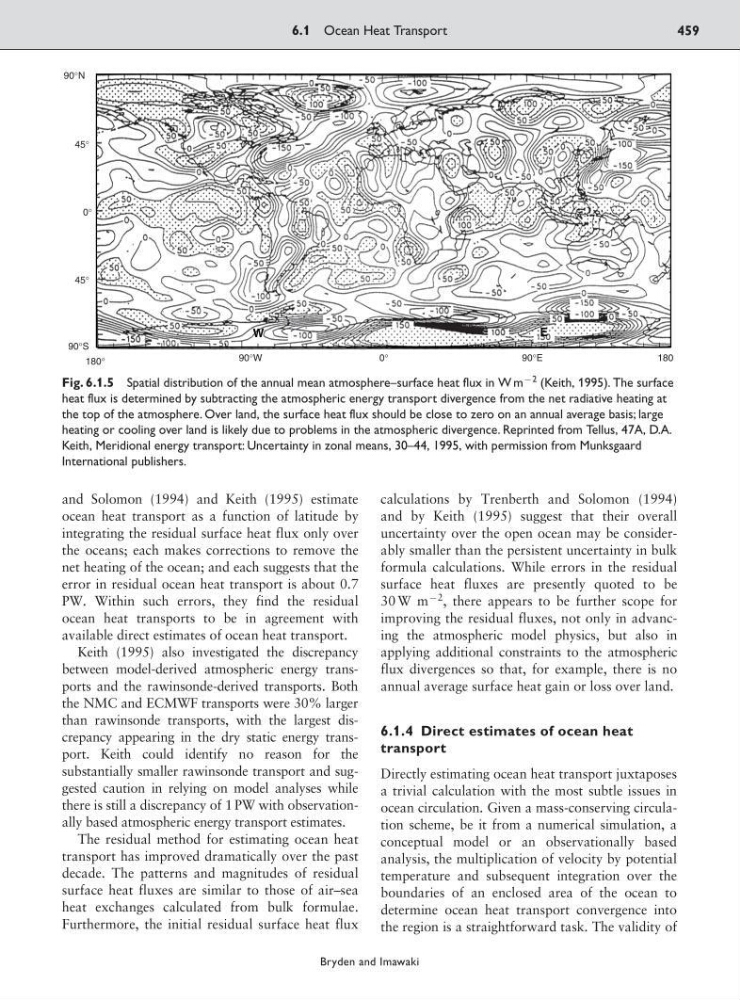
Fig. 6.1.5 Spatial distribution of the annual mean atmosphere–surface heat flux in W m
92 (Keith, 1995). The surface
heat flux is determined by subtracting the atmospheric energy transport divergence from the net radiative heating at
the top of the atmosphere. Over land, the surface heat flux should be close to zero on an annual average basis; large
heating or cooling over land is likely due to problems in the atmospheric divergence. Reprinted from Tellus, 47A, D.A.
Keith, Meridional energy transport: Uncertainty in zonal means, 30–44, 1995, with permission from Munksgaard
International publishers.
ocean heat transport as a function of latitude by
integrating the residual surface heat flux only over
the oceans; each makes corrections to remove the
net heating of the ocean; and each suggests that the
error in residual ocean heat transport is about 0.7
PW. Within such errors, they find the residual
ocean heat transports to be in agreement with
available direct estimates of ocean heat transport.
Keith (1995) also investigated the discrepancy
between model-derived atmospheric energy transports and the rawinsonde-derived transports. Both
the NMC and ECMWF transports were 30% larger
than rawinsonde transports, with the largest discrepancy appearing in the dry static energy transport. Keith could identify no reason for the
substantially smaller rawinsonde transport and suggested caution in relying on model analyses while
there is still a discrepancy of 1 PW with observationally based atmospheric energy transport estimates.
The residual method for estimating ocean heat
transport has improved dramatically over the past
decade. The patterns and magnitudes of residual
surface heat fluxes are similar to those of air–sea
heat exchanges calculated from bulk formulae.
Furthermore, the initial residual surface heat flux
calculations by Trenberth and Solomon (1994)
and by Keith (1995) suggest that their overall
uncertainty over the open ocean may be considerably smaller than the persistent uncertainty in bulk
formula calculations. While errors in the residual
surface heat fluxes are presently quoted to be
30 W m
92
, there appears to be further scope for
improving the residual fluxes, not only in advancing the atmospheric model physics, but also in
applying additional constraints to the atmospheric
flux divergences so that, for example, there is no
annual average surface heat gain or loss over land.
6.1.4 Direct estimates of ocean heat
transport
Directly estimating ocean heat transport juxtaposes
a trivial calculation with the most subtle issues in
ocean circulation. Given a mass-conserving circulation scheme, be it from a numerical simulation, a
conceptual model or an observationally based
analysis, the multiplication of velocity by potential
temperature and subsequent integration over the
boundaries of an enclosed area of the ocean to
determine ocean heat transport convergence into
the region is a straightforward task. The validity of
6.1 Ocean Heat Transport
459
Bryden and Imawaki
90°N
90°S
45°
45°
0°
0°
180°
180
90°W
9 0 °E
W
E
Fig. 6.1.5 Spatial distribution of the annual mean atmosphere–surface heat flux in W m
92 (Keith, 1995). The surface
heat flux is determined by subtracting the atmospheric energy transport divergence from the net radiative heating at
the top of the atmosphere. Over land, the surface heat flux should be close to zero on an annual average basis; large
heating or cooling over land is likely due to problems in the atmospheric divergence. Reprinted from Tellus, 47A, D.A.
Keith, Meridional energy transport: Uncertainty in zonal means, 30–44, 1995, with permission from Munksgaard
International publishers.