

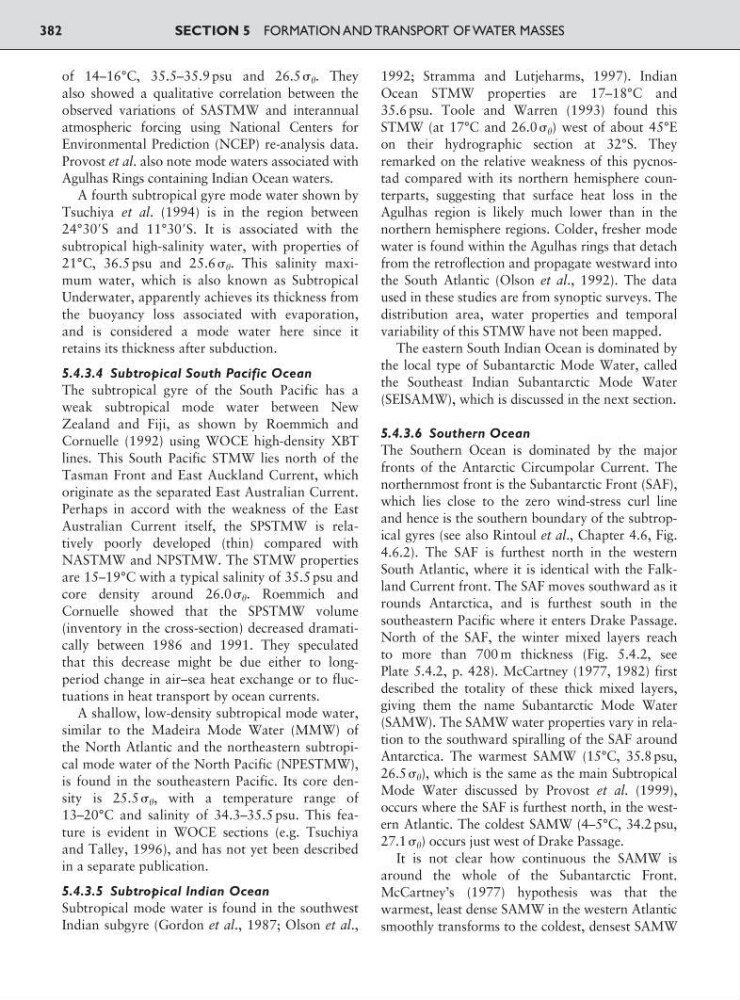
of 14–16°C, 35.5–35.9 psu and 26.5 . They
also showed a qualitative correlation between the
observed variations of SASTMW and interannual
atmospheric forcing using National Centers for
Environmental Prediction (NCEP) re-analysis data.
Provost et al. also note mode waters associated with
Agulhas Rings containing Indian Ocean waters.
A fourth subtropical gyre mode water shown by
Tsuchiya et al. (1994) is in the region between
24°30ЈS and 11°30ЈS. It is associated with the
subtropical high-salinity water, with properties of
21°C, 36.5 psu and 25.6 . This salinity maximum water, which is also known as Subtropical
Underwater, apparently achieves its thickness from
the buoyancy loss associated with evaporation,
and is considered a mode water here since it
retains its thickness after subduction.
5.4.3.4 Subtropical South Pacific Ocean
The subtropical gyre of the South Pacific has a
weak subtropical mode water between New
Zealand and Fiji, as shown by Roemmich and
Cornuelle (1992) using WOCE high-density XBT
lines. This South Pacific STMW lies north of the
Tasman Front and East Auckland Current, which
originate as the separated East Australian Current.
Perhaps in accord with the weakness of the East
Australian Current itself, the SPSTMW is relatively poorly developed (thin) compared with
NASTMW and NPSTMW. The STMW properties
are 15–19°C with a typical salinity of 35.5 psu and
core density around 26.0 . Roemmich and
Cornuelle showed that the SPSTMW volume
(inventory in the cross-section) decreased dramatically between 1986 and 1991. They speculated
that this decrease might be due either to longperiod change in air–sea heat exchange or to fluctuations in heat transport by ocean currents.
A shallow, low-density subtropical mode water,
similar to the Madeira Mode Water (MMW) of
the North Atlantic and the northeastern subtropical mode water of the North Pacific (NPESTMW),
is found in the southeastern Pacific. Its core density is 25.5 , with a temperature range of
13–20°C and salinity of 34.3–35.5 psu. This feature is evident in WOCE sections (e.g. Tsuchiya
and Talley, 1996), and has not yet been described
in a separate publication.
5.4.3.5 Subtropical Indian Ocean
Subtropical mode water is found in the southwest
Indian subgyre (Gordon et al., 1987; Olson et al.,
1992; Stramma and Lutjeharms, 1997). Indian
Ocean STMW properties are 17–18°C and
35.6 psu. Toole and Warren (1993) found this
STMW (at 17°C and 26.0 ) west of about 45°E
on their hydrographic section at 32°S. They
remarked on the relative weakness of this pycnostad compared with its northern hemisphere counterparts, suggesting that surface heat loss in the
Agulhas region is likely much lower than in the
northern hemisphere regions. Colder, fresher mode
water is found within the Agulhas rings that detach
from the retroflection and propagate westward into
the South Atlantic (Olson et al., 1992). The data
used in these studies are from synoptic surveys. The
distribution area, water properties and temporal
variability of this STMW have not been mapped.
The eastern South Indian Ocean is dominated by
the local type of Subantarctic Mode Water, called
the Southeast Indian Subantarctic Mode Water
(SEISAMW), which is discussed in the next section.
5.4.3.6 Southern Ocean
The Southern Ocean is dominated by the major
fronts of the Antarctic Circumpolar Current. The
northernmost front is the Subantarctic Front (SAF),
which lies close to the zero wind-stress curl line
and hence is the southern boundary of the subtropical gyres (see also Rintoul et al., Chapter 4.6, Fig.
4.6.2). The SAF is furthest north in the western
South Atlantic, where it is identical with the Falkland Current front. The SAF moves southward as it
rounds Antarctica, and is furthest south in the
southeastern Pacific where it enters Drake Passage.
North of the SAF, the winter mixed layers reach
to more than 700 m thickness (Fig. 5.4.2, see
Plate 5.4.2, p. 428). McCartney (1977, 1982) first
described the totality of these thick mixed layers,
giving them the name Subantarctic Mode Water
(SAMW). The SAMW water properties vary in relation to the southward spiralling of the SAF around
Antarctica. The warmest SAMW (15°C, 35.8 psu,
26.5 ), which is the same as the main Subtropical
Mode Water discussed by Provost et al. (1999),
occurs where the SAF is furthest north, in the western Atlantic. The coldest SAMW (4–5°C, 34.2 psu,
27.1 ) occurs just west of Drake Passage.
It is not clear how continuous the SAMW is
around the whole of the Subantarctic Front.
McCartney’s (1977) hypothesis was that the
warmest, least dense SAMW in the western Atlantic
smoothly transforms to the coldest, densest SAMW
SECTION 5 FORMATION AND TRANSPORT OF WATER MASSES
382
also showed a qualitative correlation between the
observed variations of SASTMW and interannual
atmospheric forcing using National Centers for
Environmental Prediction (NCEP) re-analysis data.
Provost et al. also note mode waters associated with
Agulhas Rings containing Indian Ocean waters.
A fourth subtropical gyre mode water shown by
Tsuchiya et al. (1994) is in the region between
24°30ЈS and 11°30ЈS. It is associated with the
subtropical high-salinity water, with properties of
21°C, 36.5 psu and 25.6 . This salinity maximum water, which is also known as Subtropical
Underwater, apparently achieves its thickness from
the buoyancy loss associated with evaporation,
and is considered a mode water here since it
retains its thickness after subduction.
5.4.3.4 Subtropical South Pacific Ocean
The subtropical gyre of the South Pacific has a
weak subtropical mode water between New
Zealand and Fiji, as shown by Roemmich and
Cornuelle (1992) using WOCE high-density XBT
lines. This South Pacific STMW lies north of the
Tasman Front and East Auckland Current, which
originate as the separated East Australian Current.
Perhaps in accord with the weakness of the East
Australian Current itself, the SPSTMW is relatively poorly developed (thin) compared with
NASTMW and NPSTMW. The STMW properties
are 15–19°C with a typical salinity of 35.5 psu and
core density around 26.0 . Roemmich and
Cornuelle showed that the SPSTMW volume
(inventory in the cross-section) decreased dramatically between 1986 and 1991. They speculated
that this decrease might be due either to longperiod change in air–sea heat exchange or to fluctuations in heat transport by ocean currents.
A shallow, low-density subtropical mode water,
similar to the Madeira Mode Water (MMW) of
the North Atlantic and the northeastern subtropical mode water of the North Pacific (NPESTMW),
is found in the southeastern Pacific. Its core density is 25.5 , with a temperature range of
13–20°C and salinity of 34.3–35.5 psu. This feature is evident in WOCE sections (e.g. Tsuchiya
and Talley, 1996), and has not yet been described
in a separate publication.
5.4.3.5 Subtropical Indian Ocean
Subtropical mode water is found in the southwest
Indian subgyre (Gordon et al., 1987; Olson et al.,
1992; Stramma and Lutjeharms, 1997). Indian
Ocean STMW properties are 17–18°C and
35.6 psu. Toole and Warren (1993) found this
STMW (at 17°C and 26.0 ) west of about 45°E
on their hydrographic section at 32°S. They
remarked on the relative weakness of this pycnostad compared with its northern hemisphere counterparts, suggesting that surface heat loss in the
Agulhas region is likely much lower than in the
northern hemisphere regions. Colder, fresher mode
water is found within the Agulhas rings that detach
from the retroflection and propagate westward into
the South Atlantic (Olson et al., 1992). The data
used in these studies are from synoptic surveys. The
distribution area, water properties and temporal
variability of this STMW have not been mapped.
The eastern South Indian Ocean is dominated by
the local type of Subantarctic Mode Water, called
the Southeast Indian Subantarctic Mode Water
(SEISAMW), which is discussed in the next section.
5.4.3.6 Southern Ocean
The Southern Ocean is dominated by the major
fronts of the Antarctic Circumpolar Current. The
northernmost front is the Subantarctic Front (SAF),
which lies close to the zero wind-stress curl line
and hence is the southern boundary of the subtropical gyres (see also Rintoul et al., Chapter 4.6, Fig.
4.6.2). The SAF is furthest north in the western
South Atlantic, where it is identical with the Falkland Current front. The SAF moves southward as it
rounds Antarctica, and is furthest south in the
southeastern Pacific where it enters Drake Passage.
North of the SAF, the winter mixed layers reach
to more than 700 m thickness (Fig. 5.4.2, see
Plate 5.4.2, p. 428). McCartney (1977, 1982) first
described the totality of these thick mixed layers,
giving them the name Subantarctic Mode Water
(SAMW). The SAMW water properties vary in relation to the southward spiralling of the SAF around
Antarctica. The warmest SAMW (15°C, 35.8 psu,
26.5 ), which is the same as the main Subtropical
Mode Water discussed by Provost et al. (1999),
occurs where the SAF is furthest north, in the western Atlantic. The coldest SAMW (4–5°C, 34.2 psu,
27.1 ) occurs just west of Drake Passage.
It is not clear how continuous the SAMW is
around the whole of the Subantarctic Front.
McCartney’s (1977) hypothesis was that the
warmest, least dense SAMW in the western Atlantic
smoothly transforms to the coldest, densest SAMW
SECTION 5 FORMATION AND TRANSPORT OF WATER MASSES
382