

properties centred at 18°C, 36.5 psu and 26.5
(this form will be used in the present chapter to
indicate characteristic temperatures, salinities and
densities). It is found throughout the northwestern
part of the subtropical gyre. Its formation area is
just south of the Gulf Stream Extension, most
likely associated with the wall and meanders of the
current (Talley and Raymer, 1982), and in an
area of very high surface heat loss to the atmosphere. In winter the mixed layer where Eighteen
Degree Water is formed is as deep as 350 to 400 m
(Worthington, 1959). The temperature of the core
is lower to the east, suggesting that advection and
cooling along the Gulf Stream are part of the formation process. The Eighteen Degree Water is
advected southward out of the Gulf Stream Extension region, filling the western subtropical gyre
(Worthington, 1976).
The stability of Eighteen Degree Water properties was demonstrated by Schroeder et al. (1959)
SECTION 5 FORMATION AND TRANSPORT OF WATER MASSES
378
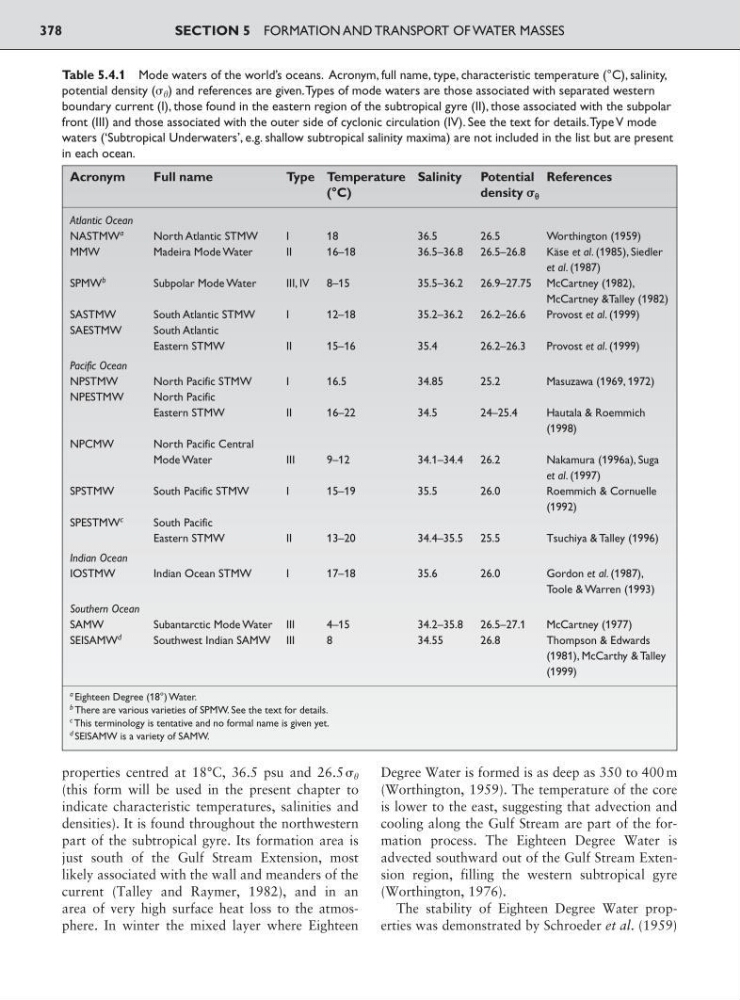
Table 5.4.1 Mode waters of the world’s oceans. Acronym, full name, type, characteristic temperature (°C), salinity,
potential density ( ) and references are given.Types of mode waters are those associated with separated western
boundary current (I), those found in the eastern region of the subtropical gyre (II), those associated with the subpolar
front (III) and those associated with the outer side of cyclonic circulation (IV). See the text for details.Type V mode
waters (‘Subtropical Underwaters’, e.g. shallow subtropical salinity maxima) are not included in the list but are present
in each ocean.
Acronym
Full name
Type Temperature Salinity Potential References
(°C)
density
Atlantic Ocean
NASTMW
a
North Atlantic STMW
I
18
36.5
2 6 .5
Worthington (1959)
MMW
Madeira Mode Water
II
16–18
36.5–36.8 26.5–26.8
Käse et al. (1985), Siedler
et al. (1987)
SPMW
b
Subpolar Mode Water
III, IV 8–15
35.5–36.2 26.9–27.75 McCartney (1982),
McCartney &Talley (1982)
SASTMW
South Atlantic STMW
I
12–18
35.2–36.2 26.2–26.6
Provost et al. (1999)
SAESTMW
South Atlantic
Eastern STMW
II
15–16
35.4
2 6 .2–26.3
Provost et al. (1999)
Pacific Ocean
NPSTMW
North Pacific STMW
I
16.5
3 4 .85
25.2
Masuzawa (1969, 1972)
NPESTMW
North Pacific
Eastern STMW
II
16–22
34.5
2 4 –25.4
Hautala & Roemmich
(1998)
NPCMW
North Pacific Central
Mode Water
III
9–12
34.1–34.4 26.2
Nakamura (1996a), Suga
et al. (1997)
SPSTMW
South Pacific STMW
I
15–19
35.5
2 6 .0
Roemmich & Cornuelle
(1992)
SPESTMW
c
South Pacific
Eastern STMW
II
13–20
34.4–35.5 25.5
Tsuchiya & Talley (1996)
Indian Ocean
IOSTMW
Indian Ocean STMW
I
17–18
35.6
2 6 .0
Gordon et al. (1987),
Toole & Warren (1993)
Southern Ocean
SAMW
Subantarctic Mode Water III
4–15
34.2–35.8 26.5–27.1
McCartney (1977)
SEISAMW
d
Southwest Indian SAMW III
8
3 4 .55
26.8
Thompson & Edwards
(1981), McCarthy & Talley
(1999)
a Eighteen Degree (18°) Water.
b There are various varieties of SPMW. See the text for details.
c This terminology is tentative and no formal name is given yet.
d SEISAMW is a variety of SAMW.
(this form will be used in the present chapter to
indicate characteristic temperatures, salinities and
densities). It is found throughout the northwestern
part of the subtropical gyre. Its formation area is
just south of the Gulf Stream Extension, most
likely associated with the wall and meanders of the
current (Talley and Raymer, 1982), and in an
area of very high surface heat loss to the atmosphere. In winter the mixed layer where Eighteen
Degree Water is formed is as deep as 350 to 400 m
(Worthington, 1959). The temperature of the core
is lower to the east, suggesting that advection and
cooling along the Gulf Stream are part of the formation process. The Eighteen Degree Water is
advected southward out of the Gulf Stream Extension region, filling the western subtropical gyre
(Worthington, 1976).
The stability of Eighteen Degree Water properties was demonstrated by Schroeder et al. (1959)
SECTION 5 FORMATION AND TRANSPORT OF WATER MASSES
378
Table 5.4.1 Mode waters of the world’s oceans. Acronym, full name, type, characteristic temperature (°C), salinity,
potential density ( ) and references are given.Types of mode waters are those associated with separated western
boundary current (I), those found in the eastern region of the subtropical gyre (II), those associated with the subpolar
front (III) and those associated with the outer side of cyclonic circulation (IV). See the text for details.Type V mode
waters (‘Subtropical Underwaters’, e.g. shallow subtropical salinity maxima) are not included in the list but are present
in each ocean.
Acronym
Full name
Type Temperature Salinity Potential References
(°C)
density
Atlantic Ocean
NASTMW
a
North Atlantic STMW
I
18
36.5
2 6 .5
Worthington (1959)
MMW
Madeira Mode Water
II
16–18
36.5–36.8 26.5–26.8
Käse et al. (1985), Siedler
et al. (1987)
SPMW
b
Subpolar Mode Water
III, IV 8–15
35.5–36.2 26.9–27.75 McCartney (1982),
McCartney &Talley (1982)
SASTMW
South Atlantic STMW
I
12–18
35.2–36.2 26.2–26.6
Provost et al. (1999)
SAESTMW
South Atlantic
Eastern STMW
II
15–16
35.4
2 6 .2–26.3
Provost et al. (1999)
Pacific Ocean
NPSTMW
North Pacific STMW
I
16.5
3 4 .85
25.2
Masuzawa (1969, 1972)
NPESTMW
North Pacific
Eastern STMW
II
16–22
34.5
2 4 –25.4
Hautala & Roemmich
(1998)
NPCMW
North Pacific Central
Mode Water
III
9–12
34.1–34.4 26.2
Nakamura (1996a), Suga
et al. (1997)
SPSTMW
South Pacific STMW
I
15–19
35.5
2 6 .0
Roemmich & Cornuelle
(1992)
SPESTMW
c
South Pacific
Eastern STMW
II
13–20
34.4–35.5 25.5
Tsuchiya & Talley (1996)
Indian Ocean
IOSTMW
Indian Ocean STMW
I
17–18
35.6
2 6 .0
Gordon et al. (1987),
Toole & Warren (1993)
Southern Ocean
SAMW
Subantarctic Mode Water III
4–15
34.2–35.8 26.5–27.1
McCartney (1977)
SEISAMW
d
Southwest Indian SAMW III
8
3 4 .55
26.8
Thompson & Edwards
(1981), McCarthy & Talley
(1999)
a Eighteen Degree (18°) Water.
b There are various varieties of SPMW. See the text for details.
c This terminology is tentative and no formal name is given yet.
d SEISAMW is a variety of SAMW.