

dynamically conserved property. Potential vorticity
depends on the Coriolis parameter (planetary component), the vertical density gradient (stretching
component) and local vorticity of the flow (relative
vorticity). The last is demonstrably small compared
with the stretching component in most regions, and
is also difficult to compute from hydrographic
data. When relative vorticity is ignored, the potential vorticity quantity (PV) is
PV:
(5.4.1)
where f is the Coriolis parameter and is the
potential density. This is sometimes referred to as
isopycnic potential vorticity.
Temperature profiles are more abundant than
profiles that include salinity, particularly for studies of variability of mode waters in the North
Pacific. Since both salinity and temperature are
relatively homogeneous in mode water, vertical
temperature gradients are sometimes used instead
of potential vorticity or the vertical gradient of
potential density to identify the core of the mode
water.
The specific values of potential vorticity or temperature gradient that have been used to define the
boundaries of a given mode water are empirical.
Values that have been used to trace NPSTMW in
space and time are potential vorticity less than
2.010
910 m
91 s
91 (Suga et al., 1989) or temperature gradient less than 1.5°C (100 m)
91 (Hanawa
et al., 1988a).
Mode waters have been mapped on isopycnal
or core layer surfaces. A core layer is the locus of
a vertical extremum of a property (Wüst, 1935).
For mode waters, the core layer is the vertical
Ѩ
ᎏ
Ѩz
f
ᎏ
5.4 Mode Waters
375
Hanawa and Talley
Potential vorticity (×10 –10 m –1 s –1 ) -broken line
Temperature gradient (°C (100 m) –1 )-thick line
Brunt– Väisälä Frequency (×10 –5 s –1 )-thin line
Potential density (σ θ ) -broken line
Salinity (psu)-thin line
Temperature (˚C)-thick line
(a)
(b)
Depth (m)
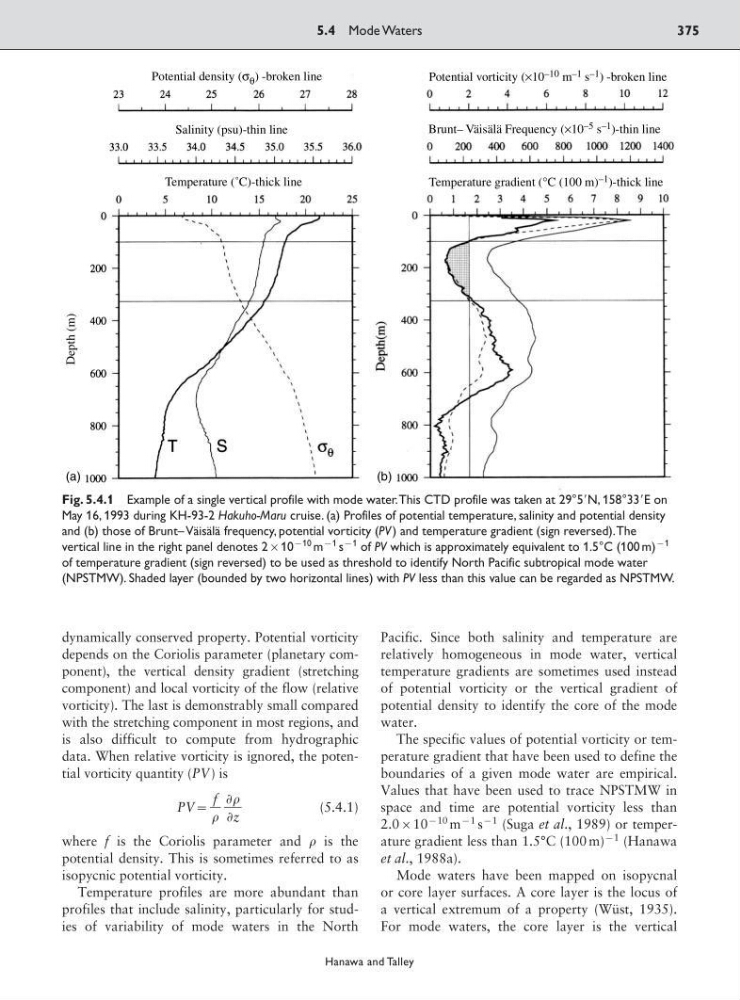
Fig. 5.4.1 Example of a single vertical profile with mode water.This CTD profile was taken at 29°5ЈN, 158°33ЈE on
May 16, 1993 during KH-93-2 Hakuho-Maru cruise. (a) Profiles of potential temperature, salinity and potential density
and (b) those of Brunt– Väisälä frequency, potential vorticity (PV) and temperature gradient (sign reversed).The
vertical line in the right panel denotes 210
910 m
91 s
91 of PV which is approximately equivalent to 1.5°C (100 m)
91
of temperature gradient (sign reversed) to be used as threshold to identify North Pacific subtropical mode water
(NPSTMW). Shaded layer (bounded by two horizontal lines) with PV less than this value can be regarded as NPSTMW.
depends on the Coriolis parameter (planetary component), the vertical density gradient (stretching
component) and local vorticity of the flow (relative
vorticity). The last is demonstrably small compared
with the stretching component in most regions, and
is also difficult to compute from hydrographic
data. When relative vorticity is ignored, the potential vorticity quantity (PV) is
PV:
(5.4.1)
where f is the Coriolis parameter and is the
potential density. This is sometimes referred to as
isopycnic potential vorticity.
Temperature profiles are more abundant than
profiles that include salinity, particularly for studies of variability of mode waters in the North
Pacific. Since both salinity and temperature are
relatively homogeneous in mode water, vertical
temperature gradients are sometimes used instead
of potential vorticity or the vertical gradient of
potential density to identify the core of the mode
water.
The specific values of potential vorticity or temperature gradient that have been used to define the
boundaries of a given mode water are empirical.
Values that have been used to trace NPSTMW in
space and time are potential vorticity less than
2.010
910 m
91 s
91 (Suga et al., 1989) or temperature gradient less than 1.5°C (100 m)
91 (Hanawa
et al., 1988a).
Mode waters have been mapped on isopycnal
or core layer surfaces. A core layer is the locus of
a vertical extremum of a property (Wüst, 1935).
For mode waters, the core layer is the vertical
Ѩ
ᎏ
Ѩz
f
ᎏ
5.4 Mode Waters
375
Hanawa and Talley
Potential vorticity (×10 –10 m –1 s –1 ) -broken line
Temperature gradient (°C (100 m) –1 )-thick line
Brunt– Väisälä Frequency (×10 –5 s –1 )-thin line
Potential density (σ θ ) -broken line
Salinity (psu)-thin line
Temperature (˚C)-thick line
(a)
(b)
Depth (m)
Fig. 5.4.1 Example of a single vertical profile with mode water.This CTD profile was taken at 29°5ЈN, 158°33ЈE on
May 16, 1993 during KH-93-2 Hakuho-Maru cruise. (a) Profiles of potential temperature, salinity and potential density
and (b) those of Brunt– Väisälä frequency, potential vorticity (PV) and temperature gradient (sign reversed).The
vertical line in the right panel denotes 210
910 m
91 s
91 of PV which is approximately equivalent to 1.5°C (100 m)
91
of temperature gradient (sign reversed) to be used as threshold to identify North Pacific subtropical mode water
(NPSTMW). Shaded layer (bounded by two horizontal lines) with PV less than this value can be regarded as NPSTMW.