

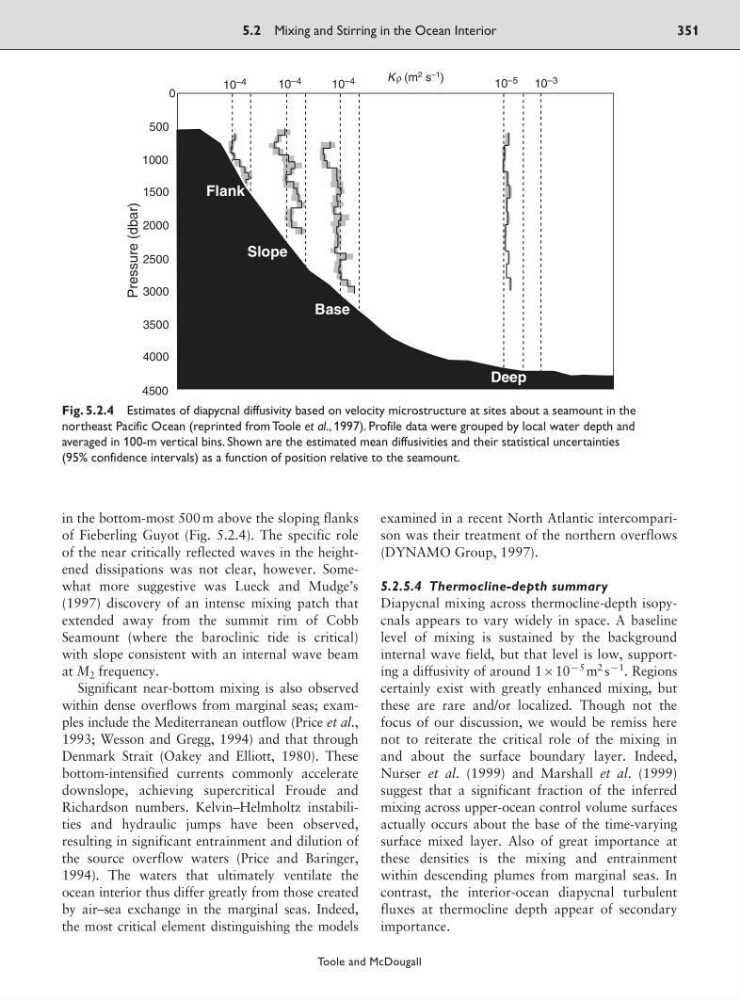
in the bottom-most 500 m above the sloping flanks
of Fieberling Guyot (Fig. 5.2.4). The specific role
of the near critically reflected waves in the heightened dissipations was not clear, however. Somewhat more suggestive was Lueck and Mudge’s
(1997) discovery of an intense mixing patch that
extended away from the summit rim of Cobb
Seamount (where the baroclinic tide is critical)
with slope consistent with an internal wave beam
at M 2 frequency.
Significant near-bottom mixing is also observed
within dense overflows from marginal seas; examples include the Mediterranean outflow (Price et al.,
1993; Wesson and Gregg, 1994) and that through
Denmark Strait (Oakey and Elliott, 1980). These
bottom-intensified currents commonly accelerate
downslope, achieving supercritical Froude and
Richardson numbers. Kelvin–Helmholtz instabilities and hydraulic jumps have been observed,
resulting in significant entrainment and dilution of
the source overflow waters (Price and Baringer,
1994). The waters that ultimately ventilate the
ocean interior thus differ greatly from those created
by air–sea exchange in the marginal seas. Indeed,
the most critical element distinguishing the models
examined in a recent North Atlantic intercomparison was their treatment of the northern overflows
(DYNAMO Group, 1997).
5.2.5.4 Thermocline-depth summary
Diapycnal mixing across thermocline-depth isopycnals appears to vary widely in space. A baseline
level of mixing is sustained by the background
internal wave field, but that level is low, supporting a diffusivity of around 110
95 m
2 s
91
. Regions
certainly exist with greatly enhanced mixing, but
these are rare and/or localized. Though not the
focus of our discussion, we would be remiss here
not to reiterate the critical role of the mixing in
and about the surface boundary layer. Indeed,
Nurser et al. (1999) and Marshall et al. (1999)
suggest that a significant fraction of the inferred
mixing across upper-ocean control volume surfaces
actually occurs about the base of the time-varying
surface mixed layer. Also of great importance at
these densities is the mixing and entrainment
within descending plumes from marginal seas. In
contrast, the interior-ocean diapycnal turbulent
fluxes at thermocline depth appear of secondary
importance.
5.2 Mixing and Stirring in the Ocean Interior
351
Toole and McDougall
0
500
1000
1500
2000
2500
3000
3500
4000
4500
Pressure (dbar)
10 –4
10 –4
10 –4
10 –5 10 –3
Kρ (m
2 s
–1 )
Flank
Slope
Base
Deep
Fig. 5.2.4 Estimates of diapycnal diffusivity based on velocity microstructure at sites about a seamount in the
northeast Pacific Ocean (reprinted from Toole et al., 1997). Profile data were grouped by local water depth and
averaged in 100-m vertical bins. Shown are the estimated mean diffusivities and their statistical uncertainties
(95% confidence intervals) as a function of position relative to the seamount.
of Fieberling Guyot (Fig. 5.2.4). The specific role
of the near critically reflected waves in the heightened dissipations was not clear, however. Somewhat more suggestive was Lueck and Mudge’s
(1997) discovery of an intense mixing patch that
extended away from the summit rim of Cobb
Seamount (where the baroclinic tide is critical)
with slope consistent with an internal wave beam
at M 2 frequency.
Significant near-bottom mixing is also observed
within dense overflows from marginal seas; examples include the Mediterranean outflow (Price et al.,
1993; Wesson and Gregg, 1994) and that through
Denmark Strait (Oakey and Elliott, 1980). These
bottom-intensified currents commonly accelerate
downslope, achieving supercritical Froude and
Richardson numbers. Kelvin–Helmholtz instabilities and hydraulic jumps have been observed,
resulting in significant entrainment and dilution of
the source overflow waters (Price and Baringer,
1994). The waters that ultimately ventilate the
ocean interior thus differ greatly from those created
by air–sea exchange in the marginal seas. Indeed,
the most critical element distinguishing the models
examined in a recent North Atlantic intercomparison was their treatment of the northern overflows
(DYNAMO Group, 1997).
5.2.5.4 Thermocline-depth summary
Diapycnal mixing across thermocline-depth isopycnals appears to vary widely in space. A baseline
level of mixing is sustained by the background
internal wave field, but that level is low, supporting a diffusivity of around 110
95 m
2 s
91
. Regions
certainly exist with greatly enhanced mixing, but
these are rare and/or localized. Though not the
focus of our discussion, we would be remiss here
not to reiterate the critical role of the mixing in
and about the surface boundary layer. Indeed,
Nurser et al. (1999) and Marshall et al. (1999)
suggest that a significant fraction of the inferred
mixing across upper-ocean control volume surfaces
actually occurs about the base of the time-varying
surface mixed layer. Also of great importance at
these densities is the mixing and entrainment
within descending plumes from marginal seas. In
contrast, the interior-ocean diapycnal turbulent
fluxes at thermocline depth appear of secondary
importance.
5.2 Mixing and Stirring in the Ocean Interior
351
Toole and McDougall
0
500
1000
1500
2000
2500
3000
3500
4000
4500
Pressure (dbar)
10 –4
10 –4
10 –4
10 –5 10 –3
Kρ (m
2 s
–1 )
Flank
Slope
Base
Deep
Fig. 5.2.4 Estimates of diapycnal diffusivity based on velocity microstructure at sites about a seamount in the
northeast Pacific Ocean (reprinted from Toole et al., 1997). Profile data were grouped by local water depth and
averaged in 100-m vertical bins. Shown are the estimated mean diffusivities and their statistical uncertainties
(95% confidence intervals) as a function of position relative to the seamount.