

cooling, suggests that both Sandström and Jeffreys
were right. When the heating source lies above the
cooling source, an overturning circulation is still
possible because of mixing; but when that mixing
is solely the result of molecular diffusion (as would
virtually be the case in a careful laboratory experiment), the flow is very slow (and so difficult to
observe.)
Scaling arguments by Welander (1971), Bryan
(1987) and others for the steady overturning circulation in a simplified ocean basin (e.g. pie-shaped,
single-hemisphere) also imply a strong dependence
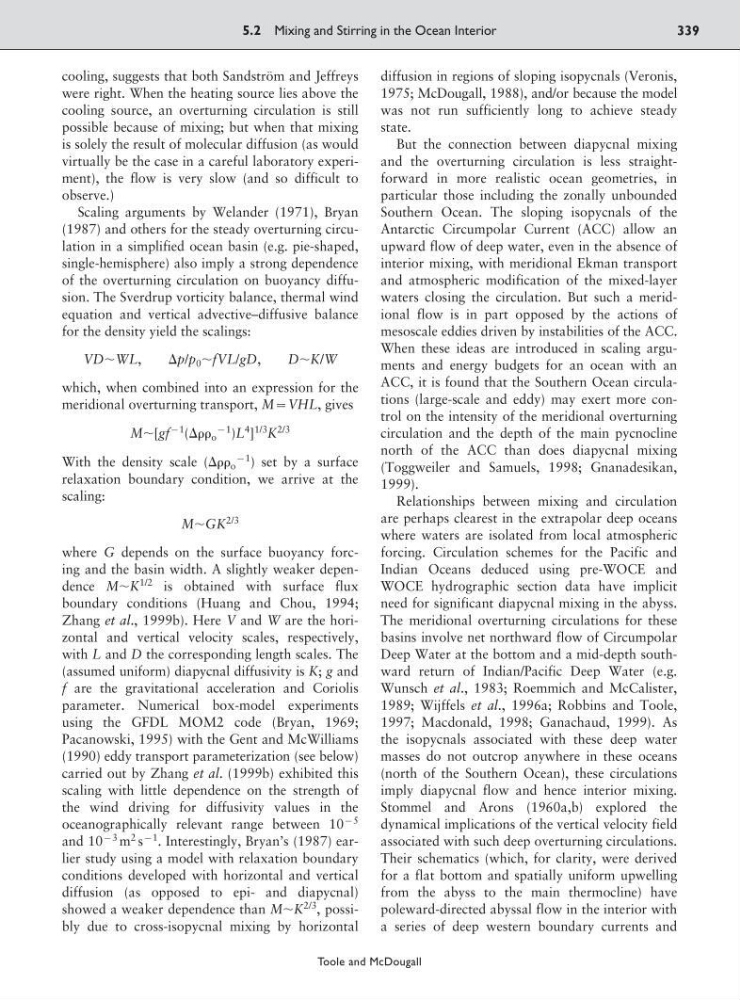
of the overturning circulation on buoyancy diffusion. The Sverdrup vorticity balance, thermal wind
equation and vertical advective–diffusive balance
for the density yield the scalings:
VDϳWL,
⌬p/p 0 ϳfVL/gD,
DϳK/W
which, when combined into an expression for the
meridional overturning transport, M:VHL, gives
Mϳ[gf
91 (⌬ o
91 )L
4 ]
1/3 K
2/3
With the density scale (⌬ o
91
) set by a surface
relaxation boundary condition, we arrive at the
scaling:
MϳGK
2/3
where G depends on the surface buoyancy forcing and the basin width. A slightly weaker dependence MϳK
1/2 is obtained with surface flux
boundary conditions (Huang and Chou, 1994;
Zhang et al., 1999b). Here V and W are the horizontal and vertical velocity scales, respectively,
with L and D the corresponding length scales. The
(assumed uniform) diapycnal diffusivity is K; g and
f are the gravitational acceleration and Coriolis
parameter. Numerical box-model experiments
using the GFDL MOM2 code (Bryan, 1969;
Pacanowski, 1995) with the Gent and McWilliams
(1990) eddy transport parameterization (see below)
carried out by Zhang et al. (1999b) exhibited this
scaling with little dependence on the strength of
the wind driving for diffusivity values in the
oceanographically relevant range between 10
95
and 10
93 m
2 s
91 . Interestingly, Bryan’s (1987) earlier study using a model with relaxation boundary
conditions developed with horizontal and vertical
diffusion (as opposed to epi- and diapycnal)
showed a weaker dependence than MϳK
2/3 , possibly due to cross-isopycnal mixing by horizontal
diffusion in regions of sloping isopycnals (Veronis,
1975; McDougall, 1988), and/or because the model
was not run sufficiently long to achieve steady
state.
But the connection between diapycnal mixing
and the overturning circulation is less straightforward in more realistic ocean geometries, in
particular those including the zonally unbounded
Southern Ocean. The sloping isopycnals of the
Antarctic Circumpolar Current (ACC) allow an
upward flow of deep water, even in the absence of
interior mixing, with meridional Ekman transport
and atmospheric modification of the mixed-layer
waters closing the circulation. But such a meridional flow is in part opposed by the actions of
mesoscale eddies driven by instabilities of the ACC.
When these ideas are introduced in scaling arguments and energy budgets for an ocean with an
ACC, it is found that the Southern Ocean circulations (large-scale and eddy) may exert more control on the intensity of the meridional overturning
circulation and the depth of the main pycnocline
north of the ACC than does diapycnal mixing
(Toggweiler and Samuels, 1998; Gnanadesikan,
1999).
Relationships between mixing and circulation
are perhaps clearest in the extrapolar deep oceans
where waters are isolated from local atmospheric
forcing. Circulation schemes for the Pacific and
Indian Oceans deduced using pre-WOCE and
WOCE hydrographic section data have implicit
need for significant diapycnal mixing in the abyss.
The meridional overturning circulations for these
basins involve net northward flow of Circumpolar
Deep Water at the bottom and a mid-depth southward return of Indian/Pacific Deep Water (e.g.
Wunsch et al., 1983; Roemmich and McCalister,
1989; Wijffels et al., 1996a; Robbins and Toole,
1997; Macdonald, 1998; Ganachaud, 1999). As
the isopycnals associated with these deep water
masses do not outcrop anywhere in these oceans
(north of the Southern Ocean), these circulations
imply diapycnal flow and hence interior mixing.
Stommel and Arons (1960a,b) explored the
dynamical implications of the vertical velocity field
associated with such deep overturning circulations.
Their schematics (which, for clarity, were derived
for a flat bottom and spatially uniform upwelling
from the abyss to the main thermocline) have
poleward-directed abyssal flow in the interior with
a series of deep western boundary currents and
5.2 Mixing and Stirring in the Ocean Interior
339
Toole and McDougall
were right. When the heating source lies above the
cooling source, an overturning circulation is still
possible because of mixing; but when that mixing
is solely the result of molecular diffusion (as would
virtually be the case in a careful laboratory experiment), the flow is very slow (and so difficult to
observe.)
Scaling arguments by Welander (1971), Bryan
(1987) and others for the steady overturning circulation in a simplified ocean basin (e.g. pie-shaped,
single-hemisphere) also imply a strong dependence
of the overturning circulation on buoyancy diffusion. The Sverdrup vorticity balance, thermal wind
equation and vertical advective–diffusive balance
for the density yield the scalings:
VDϳWL,
⌬p/p 0 ϳfVL/gD,
DϳK/W
which, when combined into an expression for the
meridional overturning transport, M:VHL, gives
Mϳ[gf
91 (⌬ o
91 )L
4 ]
1/3 K
2/3
With the density scale (⌬ o
91
) set by a surface
relaxation boundary condition, we arrive at the
scaling:
MϳGK
2/3
where G depends on the surface buoyancy forcing and the basin width. A slightly weaker dependence MϳK
1/2 is obtained with surface flux
boundary conditions (Huang and Chou, 1994;
Zhang et al., 1999b). Here V and W are the horizontal and vertical velocity scales, respectively,
with L and D the corresponding length scales. The
(assumed uniform) diapycnal diffusivity is K; g and
f are the gravitational acceleration and Coriolis
parameter. Numerical box-model experiments
using the GFDL MOM2 code (Bryan, 1969;
Pacanowski, 1995) with the Gent and McWilliams
(1990) eddy transport parameterization (see below)
carried out by Zhang et al. (1999b) exhibited this
scaling with little dependence on the strength of
the wind driving for diffusivity values in the
oceanographically relevant range between 10
95
and 10
93 m
2 s
91 . Interestingly, Bryan’s (1987) earlier study using a model with relaxation boundary
conditions developed with horizontal and vertical
diffusion (as opposed to epi- and diapycnal)
showed a weaker dependence than MϳK
2/3 , possibly due to cross-isopycnal mixing by horizontal
diffusion in regions of sloping isopycnals (Veronis,
1975; McDougall, 1988), and/or because the model
was not run sufficiently long to achieve steady
state.
But the connection between diapycnal mixing
and the overturning circulation is less straightforward in more realistic ocean geometries, in
particular those including the zonally unbounded
Southern Ocean. The sloping isopycnals of the
Antarctic Circumpolar Current (ACC) allow an
upward flow of deep water, even in the absence of
interior mixing, with meridional Ekman transport
and atmospheric modification of the mixed-layer
waters closing the circulation. But such a meridional flow is in part opposed by the actions of
mesoscale eddies driven by instabilities of the ACC.
When these ideas are introduced in scaling arguments and energy budgets for an ocean with an
ACC, it is found that the Southern Ocean circulations (large-scale and eddy) may exert more control on the intensity of the meridional overturning
circulation and the depth of the main pycnocline
north of the ACC than does diapycnal mixing
(Toggweiler and Samuels, 1998; Gnanadesikan,
1999).
Relationships between mixing and circulation
are perhaps clearest in the extrapolar deep oceans
where waters are isolated from local atmospheric
forcing. Circulation schemes for the Pacific and
Indian Oceans deduced using pre-WOCE and
WOCE hydrographic section data have implicit
need for significant diapycnal mixing in the abyss.
The meridional overturning circulations for these
basins involve net northward flow of Circumpolar
Deep Water at the bottom and a mid-depth southward return of Indian/Pacific Deep Water (e.g.
Wunsch et al., 1983; Roemmich and McCalister,
1989; Wijffels et al., 1996a; Robbins and Toole,
1997; Macdonald, 1998; Ganachaud, 1999). As
the isopycnals associated with these deep water
masses do not outcrop anywhere in these oceans
(north of the Southern Ocean), these circulations
imply diapycnal flow and hence interior mixing.
Stommel and Arons (1960a,b) explored the
dynamical implications of the vertical velocity field
associated with such deep overturning circulations.
Their schematics (which, for clarity, were derived
for a flat bottom and spatially uniform upwelling
from the abyss to the main thermocline) have
poleward-directed abyssal flow in the interior with
a series of deep western boundary currents and
5.2 Mixing and Stirring in the Ocean Interior
339
Toole and McDougall