

AAIW from the Southern Ocean is small (:5 Sv),
the gross exchange is large (about < 80 Sv). The
inflow of ‘new’ SAMW/AAIW to the subtropical gyres is roughly balanced by an outflow of
‘old’ SAMW/AAIW, whose properties have been
modified by mixing during their transit of the
gyres. Part of the returning SAMW/AAIW is
then converted to denser UCDW by diapycnal
mixing.
Because the SAMW and AAIW are renewed by
air–sea interaction on decadal time scales, they
provide a good place to look for evidence of
changes in forcing over such time scales. Several
recent studies have identified decadal changes in
the SAMW and AAIW layers in the south Indian
and Pacific oceans (e.g. Bindoff and Church, 1992;
Johnson and Orsi, 1997; Bindoff and McDougall,
2000). Wong et al. (1999) have shown that these
patterns are generally coherent throughout the
Pacific. These changes are consistent with warming and freshening at the surface outcrops of these
layers, as predicted to occur in coupled climate
models forced by increasing greenhouse gas concentrations (Bindoff and McDougall, 1994).
4.6.4.2 Circumpolar Deep Water
Two prominent core layers underly the salinity
minimum of the Antarctic Intermediate Water
throughout the Southern Ocean. An oxygen minimum layer (Fig. 4.6.3c) is used to define the Upper
Circumpolar Deep Water (UCDW) (Callahan,
1972). At slightly greater depth (and density) lies
the salinity maximum of the Lower Circumpolar
Deep Water (LCDW) (Fig. 4.6.3b). The LCDW
layer is supplied by saline North Atlantic Deep
Water (NADW) exported from the Atlantic. The
addition of ‘new’ NADW in the South Atlantic
produces an oxygen and salinity maximum
between the UCDW and LCDW entering the basin
through Drake Passage (Reid et al., 1977). The
high-salinity signature of the NADW/LCDW can
be traced to low latitudes of the abyssal Indian
and Pacific basins (Reid and Lynn, 1971). LCDW
enters the low-latitude basins primarily in a series
of deep western boundary currents (see Hogg,
Chapter 4.5). Within the subtropical basins, the
LCDW is slowly modified by mixing with surrounding fresher water, and the oxygen concentrations are reduced by biological consumption. The
return of the slightly less dense, low-oxygen water
from the Indian and Pacific basins supplies the
oxygen minimum of the UCDW (Callahan, 1972).
Both types of CDW spread poleward and upward
across the Southern Ocean, ultimately outcropping
at the sea surface south of the ACC. As described
in the previous section and in more detail in
Section 4.6.5, the outcropping of CDW and the
resulting water mass transformation by air–sea
fluxes provides the main connection between the
lower and upper limbs of the global overturning
circulation.
4.6.4.3 Antarctic Bottom Water
The WOCE decade has seen substantial progress in
our understanding of where, how and at what rate
AABW is formed in the Southern Ocean. In the
SECTION 4 THE GLOBAL FLOW FIELD
294
0°
0°
60°S
30°
60°S
60°S
60°W
6 0 °E
30°S
31
{
25
10
2
12
39
28 42
14
22
8
2
2
4
3
11
26
8
18
8
8
➪
➪
➪
➪
➪
10
➪
➪
➪
➪
3
10
➪
Diapycnal
fluxes
-4.3
+18.1
-13.8
120°
180°
120°W
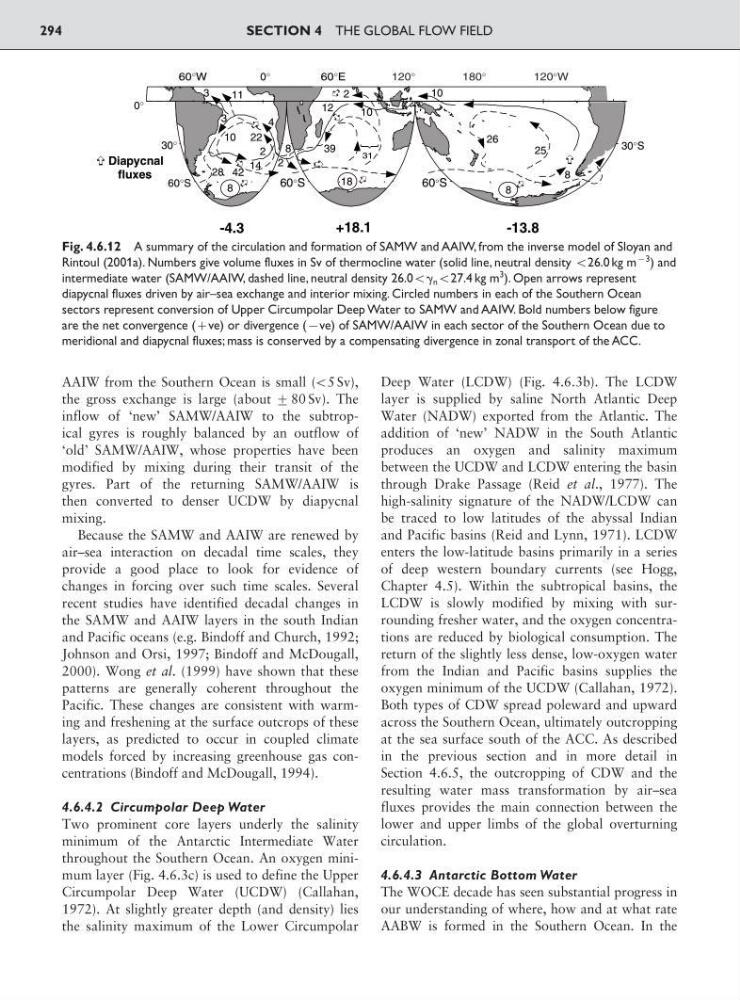
Fig. 4.6.12 A summary of the circulation and formation of SAMW and AAIW, from the inverse model of Sloyan and
Rintoul (2001a). Numbers give volume fluxes in Sv of thermocline water (solid line, neutral density :26.0 kg m
93
) and
intermediate water (SAMW/AAIW, dashed line, neutral density 26.0:␥ n :27.4 kg m
3 ). Open arrows represent
diapycnal fluxes driven by air–sea exchange and interior mixing. Circled numbers in each of the Southern Ocean
sectors represent conversion of Upper Circumpolar Deep Water to SAMW and AAIW. Bold numbers below figure
are the net convergence (;ve) or divergence (9ve) of SAMW/AAIW in each sector of the Southern Ocean due to
meridional and diapycnal fluxes; mass is conserved by a compensating divergence in zonal transport of the ACC.
the gross exchange is large (about < 80 Sv). The
inflow of ‘new’ SAMW/AAIW to the subtropical gyres is roughly balanced by an outflow of
‘old’ SAMW/AAIW, whose properties have been
modified by mixing during their transit of the
gyres. Part of the returning SAMW/AAIW is
then converted to denser UCDW by diapycnal
mixing.
Because the SAMW and AAIW are renewed by
air–sea interaction on decadal time scales, they
provide a good place to look for evidence of
changes in forcing over such time scales. Several
recent studies have identified decadal changes in
the SAMW and AAIW layers in the south Indian
and Pacific oceans (e.g. Bindoff and Church, 1992;
Johnson and Orsi, 1997; Bindoff and McDougall,
2000). Wong et al. (1999) have shown that these
patterns are generally coherent throughout the
Pacific. These changes are consistent with warming and freshening at the surface outcrops of these
layers, as predicted to occur in coupled climate
models forced by increasing greenhouse gas concentrations (Bindoff and McDougall, 1994).
4.6.4.2 Circumpolar Deep Water
Two prominent core layers underly the salinity
minimum of the Antarctic Intermediate Water
throughout the Southern Ocean. An oxygen minimum layer (Fig. 4.6.3c) is used to define the Upper
Circumpolar Deep Water (UCDW) (Callahan,
1972). At slightly greater depth (and density) lies
the salinity maximum of the Lower Circumpolar
Deep Water (LCDW) (Fig. 4.6.3b). The LCDW
layer is supplied by saline North Atlantic Deep
Water (NADW) exported from the Atlantic. The
addition of ‘new’ NADW in the South Atlantic
produces an oxygen and salinity maximum
between the UCDW and LCDW entering the basin
through Drake Passage (Reid et al., 1977). The
high-salinity signature of the NADW/LCDW can
be traced to low latitudes of the abyssal Indian
and Pacific basins (Reid and Lynn, 1971). LCDW
enters the low-latitude basins primarily in a series
of deep western boundary currents (see Hogg,
Chapter 4.5). Within the subtropical basins, the
LCDW is slowly modified by mixing with surrounding fresher water, and the oxygen concentrations are reduced by biological consumption. The
return of the slightly less dense, low-oxygen water
from the Indian and Pacific basins supplies the
oxygen minimum of the UCDW (Callahan, 1972).
Both types of CDW spread poleward and upward
across the Southern Ocean, ultimately outcropping
at the sea surface south of the ACC. As described
in the previous section and in more detail in
Section 4.6.5, the outcropping of CDW and the
resulting water mass transformation by air–sea
fluxes provides the main connection between the
lower and upper limbs of the global overturning
circulation.
4.6.4.3 Antarctic Bottom Water
The WOCE decade has seen substantial progress in
our understanding of where, how and at what rate
AABW is formed in the Southern Ocean. In the
SECTION 4 THE GLOBAL FLOW FIELD
294
0°
0°
60°S
30°
60°S
60°S
60°W
6 0 °E
30°S
31
{
25
10
2
12
39
28 42
14
22
8
2
2
4
3
11
26
8
18
8
8
➪
➪
➪
➪
➪
10
➪
➪
➪
➪
3
10
➪
Diapycnal
fluxes
-4.3
+18.1
-13.8
120°
180°
120°W
Fig. 4.6.12 A summary of the circulation and formation of SAMW and AAIW, from the inverse model of Sloyan and
Rintoul (2001a). Numbers give volume fluxes in Sv of thermocline water (solid line, neutral density :26.0 kg m
93
) and
intermediate water (SAMW/AAIW, dashed line, neutral density 26.0:␥ n :27.4 kg m
3 ). Open arrows represent
diapycnal fluxes driven by air–sea exchange and interior mixing. Circled numbers in each of the Southern Ocean
sectors represent conversion of Upper Circumpolar Deep Water to SAMW and AAIW. Bold numbers below figure
are the net convergence (;ve) or divergence (9ve) of SAMW/AAIW in each sector of the Southern Ocean due to
meridional and diapycnal fluxes; mass is conserved by a compensating divergence in zonal transport of the ACC.