

4.6.4.1 Subantarctic Mode Water and
Antarctic Intermediate Water
Subantarctic Mode Water (SAMW) is formed by
deep winter convection on the equatorward side
of the ACC (Hanawa and Talley, Chapter 5.4;
McCartney, 1977). The deep convection imprints
the SAMW with its characteristic properties: a vertically well-mixed (hence low potential vorticity)
layer that is rich in oxygen (Fig. 4.6.3). These
tracers allow the SAMWs to be tracked from
their formation regions to the southern hemisphere
subtropical gyres, where they renew the waters of
the lower thermocline (McCartney, 1982).
The Antarctic Intermediate Water (AAIW) is
identified by a salinity minimum layer that
descends near the Subantarctic Front (Fig. 4.6.3b;
Hanawa and Talley, Chapter 5.4). Early authors
traced the salinity minimum core layer poleward
to where it outcropped in the cold, fresh Antarctic
Surface Water, and inferred that circumpolar sinking along this layer renewed the AAIW tongue.
The apparent spreading was thought to be driven
SECTION 4 THE GLOBAL FLOW FIELD
292
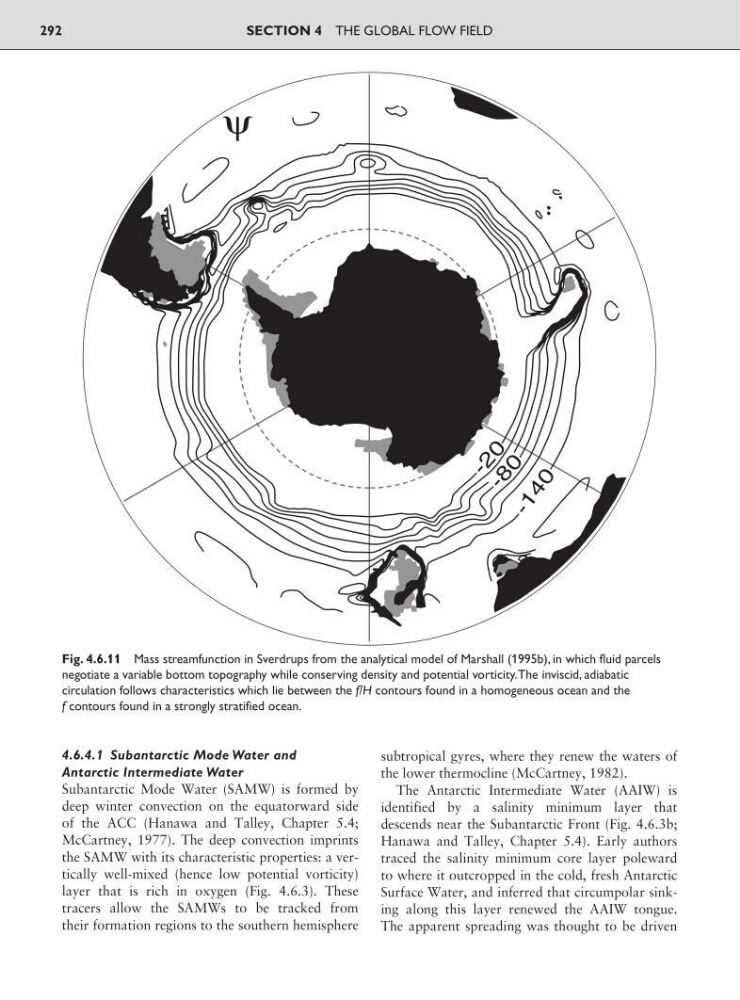
Fig. 4.6.11 Mass streamfunction in Sverdrups from the analytical model of Marshall (1995b), in which fluid parcels
negotiate a variable bottom topography while conserving density and potential vorticity.The inviscid, adiabatic
circulation follows characteristics which lie between the f/H contours found in a homogeneous ocean and the
f contours found in a strongly stratified ocean.
Antarctic Intermediate Water
Subantarctic Mode Water (SAMW) is formed by
deep winter convection on the equatorward side
of the ACC (Hanawa and Talley, Chapter 5.4;
McCartney, 1977). The deep convection imprints
the SAMW with its characteristic properties: a vertically well-mixed (hence low potential vorticity)
layer that is rich in oxygen (Fig. 4.6.3). These
tracers allow the SAMWs to be tracked from
their formation regions to the southern hemisphere
subtropical gyres, where they renew the waters of
the lower thermocline (McCartney, 1982).
The Antarctic Intermediate Water (AAIW) is
identified by a salinity minimum layer that
descends near the Subantarctic Front (Fig. 4.6.3b;
Hanawa and Talley, Chapter 5.4). Early authors
traced the salinity minimum core layer poleward
to where it outcropped in the cold, fresh Antarctic
Surface Water, and inferred that circumpolar sinking along this layer renewed the AAIW tongue.
The apparent spreading was thought to be driven
SECTION 4 THE GLOBAL FLOW FIELD
292
Fig. 4.6.11 Mass streamfunction in Sverdrups from the analytical model of Marshall (1995b), in which fluid parcels
negotiate a variable bottom topography while conserving density and potential vorticity.The inviscid, adiabatic
circulation follows characteristics which lie between the f/H contours found in a homogeneous ocean and the
f contours found in a strongly stratified ocean.