

Although the various circulation schemes that
have been assembled from hydrographic data are
generally in qualitative disagreement with the float
data, there is some consistency to be found there.
For example, we show in Fig. 4.5.8 (see Plate
4.5.8, p. 300) the oxygen distribution on six potential density surfaces within the NADW from a
section along 25°W (from Talley and Johnson,
1994) along with the mean zonal flows calculated
from the float and current meter data sets in the
Brazil Basin (selected to be away from the western
boundary). There is rough agreement between the
source direction implied by the oxygen and the
directly observed mean flows: the interior flow is
almost Wüstian in the sense that it appears to flow
down property tongues. Rüth et al. (2000) have
recently reported that the Mid-Atlantic Ridge is a
source of primordial helium to the NADW layer
of the South Atlantic. Sections of terrigenic
3 He at
11°S and 30°S show plumes extending westward
from the ridge crest. The first of these is coincident
with generally eastward flow and oxygen-rich
water (Fig. 4.5.8) while at 19°S the
3
He does not
spread far from the ridge. Whether these findings
are in contradiction or reflect the probably complex, zonally banded, time-varying, circulation has
yet to be determined.
There is a broad band of eastward flow
between 20°S and 25°S within the NADW that
appears to originate in the DWBC. This could well
supply the ‘Namib Col Current’ (Warren and
Speer, 1991; Speer et al., 1995b), which is believed
to extend across the whole of the South Atlantic to
the Namib Col, a break in the Walvis Ridge near
22°S. This is also the band of latitudes in the
South Atlantic at which the minimum depth of
the Mid-Atlantic Ridge is the deepest, reaching
2500 m on average versus 2000 m to the north
(Vanicek, 1998).
4.5.3.3 Time variations
In designing the DBE an assumption was made that
time scales, beyond the mesoscale, would be long
enough that a quasi-steady hypothesis could be
made. Indeed, the estimates of diffusion rates from
bulk balances depend on this. However, this has
not proven to be the case. For example, a line of
floats set along 19°W between the equator and 20°S
at 4000 m (Fig. 4.5.7b, see Plate 4.5.7b, p. 300) all
move to the west, more or less steadily. Another
line of floats set about a year later move in the
opposite direction. Low-frequency motions of interannual time scale are the most likely explanation.
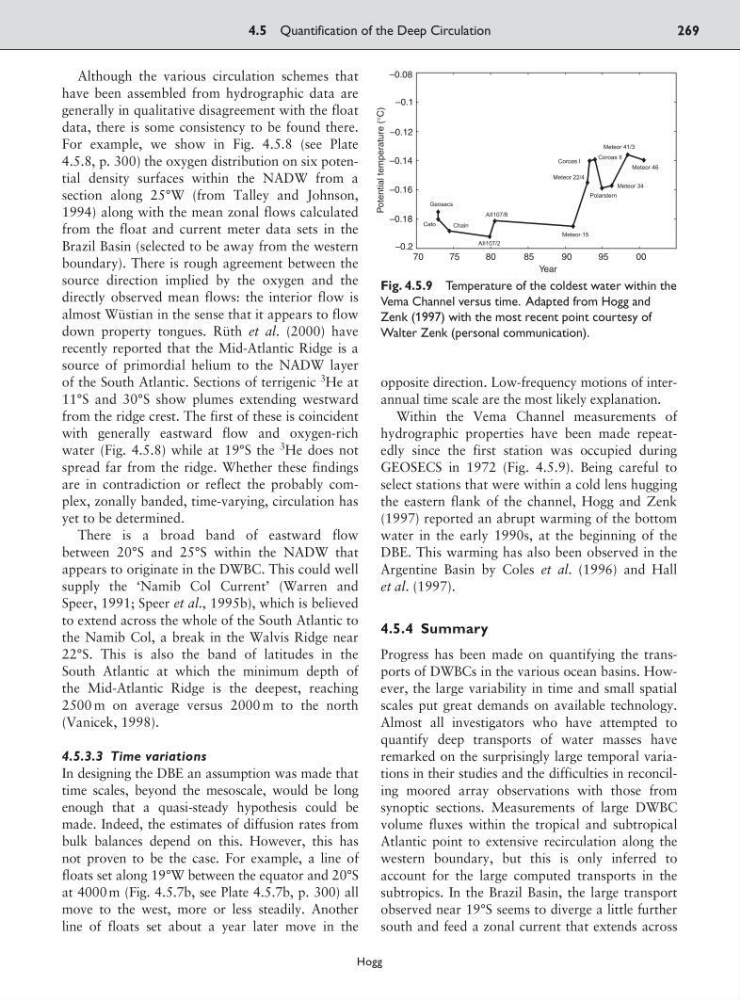
Within the Vema Channel measurements of
hydrographic properties have been made repeatedly since the first station was occupied during
GEOSECS in 1972 (Fig. 4.5.9). Being careful to
select stations that were within a cold lens hugging
the eastern flank of the channel, Hogg and Zenk
(1997) reported an abrupt warming of the bottom
water in the early 1990s, at the beginning of the
DBE. This warming has also been observed in the
Argentine Basin by Coles et al. (1996) and Hall
et al. (1997).
4.5.4 Summary
Progress has been made on quantifying the transports of DWBCs in the various ocean basins. However, the large variability in time and small spatial
scales put great demands on available technology.
Almost all investigators who have attempted to
quantify deep transports of water masses have
remarked on the surprisingly large temporal variations in their studies and the difficulties in reconciling moored array observations with those from
synoptic sections. Measurements of large DWBC
volume fluxes within the tropical and subtropical
Atlantic point to extensive recirculation along the
western boundary, but this is only inferred to
account for the large computed transports in the
subtropics. In the Brazil Basin, the large transport
observed near 19°S seems to diverge a little further
south and feed a zonal current that extends across
4.5 Quantification of the Deep Circulation
269
Hogg
Potential temperature (°C)
–0.08
–0.1
–0.12
–0.14
–0.16
–0.18
–0.2
70
75
80
85
90
95
Year
00
Fig. 4.5.9 Temperature of the coldest water within the
Vema Channel versus time. Adapted from Hogg and
Zenk (1997) with the most recent point courtesy of
Walter Zenk (personal communication).
have been assembled from hydrographic data are
generally in qualitative disagreement with the float
data, there is some consistency to be found there.
For example, we show in Fig. 4.5.8 (see Plate
4.5.8, p. 300) the oxygen distribution on six potential density surfaces within the NADW from a
section along 25°W (from Talley and Johnson,
1994) along with the mean zonal flows calculated
from the float and current meter data sets in the
Brazil Basin (selected to be away from the western
boundary). There is rough agreement between the
source direction implied by the oxygen and the
directly observed mean flows: the interior flow is
almost Wüstian in the sense that it appears to flow
down property tongues. Rüth et al. (2000) have
recently reported that the Mid-Atlantic Ridge is a
source of primordial helium to the NADW layer
of the South Atlantic. Sections of terrigenic
3 He at
11°S and 30°S show plumes extending westward
from the ridge crest. The first of these is coincident
with generally eastward flow and oxygen-rich
water (Fig. 4.5.8) while at 19°S the
3
He does not
spread far from the ridge. Whether these findings
are in contradiction or reflect the probably complex, zonally banded, time-varying, circulation has
yet to be determined.
There is a broad band of eastward flow
between 20°S and 25°S within the NADW that
appears to originate in the DWBC. This could well
supply the ‘Namib Col Current’ (Warren and
Speer, 1991; Speer et al., 1995b), which is believed
to extend across the whole of the South Atlantic to
the Namib Col, a break in the Walvis Ridge near
22°S. This is also the band of latitudes in the
South Atlantic at which the minimum depth of
the Mid-Atlantic Ridge is the deepest, reaching
2500 m on average versus 2000 m to the north
(Vanicek, 1998).
4.5.3.3 Time variations
In designing the DBE an assumption was made that
time scales, beyond the mesoscale, would be long
enough that a quasi-steady hypothesis could be
made. Indeed, the estimates of diffusion rates from
bulk balances depend on this. However, this has
not proven to be the case. For example, a line of
floats set along 19°W between the equator and 20°S
at 4000 m (Fig. 4.5.7b, see Plate 4.5.7b, p. 300) all
move to the west, more or less steadily. Another
line of floats set about a year later move in the
opposite direction. Low-frequency motions of interannual time scale are the most likely explanation.
Within the Vema Channel measurements of
hydrographic properties have been made repeatedly since the first station was occupied during
GEOSECS in 1972 (Fig. 4.5.9). Being careful to
select stations that were within a cold lens hugging
the eastern flank of the channel, Hogg and Zenk
(1997) reported an abrupt warming of the bottom
water in the early 1990s, at the beginning of the
DBE. This warming has also been observed in the
Argentine Basin by Coles et al. (1996) and Hall
et al. (1997).
4.5.4 Summary
Progress has been made on quantifying the transports of DWBCs in the various ocean basins. However, the large variability in time and small spatial
scales put great demands on available technology.
Almost all investigators who have attempted to
quantify deep transports of water masses have
remarked on the surprisingly large temporal variations in their studies and the difficulties in reconciling moored array observations with those from
synoptic sections. Measurements of large DWBC
volume fluxes within the tropical and subtropical
Atlantic point to extensive recirculation along the
western boundary, but this is only inferred to
account for the large computed transports in the
subtropics. In the Brazil Basin, the large transport
observed near 19°S seems to diverge a little further
south and feed a zonal current that extends across
4.5 Quantification of the Deep Circulation
269
Hogg
Potential temperature (°C)
–0.08
–0.1
–0.12
–0.14
–0.16
–0.18
–0.2
70
75
80
85
90
95
Year
00
Fig. 4.5.9 Temperature of the coldest water within the
Vema Channel versus time. Adapted from Hogg and
Zenk (1997) with the most recent point courtesy of
Walter Zenk (personal communication).