

results in the literature. Beal and Bryden (1997)
have identified a deep countercurrent beneath the
Agulhas at 30°S (no. 14, Fig. 4.5.2) using a lowered acoustic Doppler profiler. This current transports approximately 6 Sv of Red Sea Water and
AntArctic Intermediate Water (AAIW) toward
the northeast. Read and Pollard (1997) have
studied the deep flow into the Mozambique Basin
(no. 17, Fig. 4.5.2). Based on sparse direct current
measurements and two hydrographic sections
there appears to be 1 Sv of WSDW entering below
4000 m.
4.5.2.4 Inferences for mixing
A number of the measurements described above
were made in passages that constrain the flow from
one basin to another. Downstream of these passages the deeper isopycnals and isotherms can be
contained entirely within the basin, or may connect
to other basins through narrow passages where the
transport has been measured. Using simple heat
and mass balances for these surfaces Whitehead
and Worthington (1982) and Hogg et al. (1982)
were able to infer basin-averaged ‘vertical’ (i.e. perpendicular to the property surface) mixing rates of
a few square centimetres per second, well above the
direct estimates made in the thermocline (see Toole
and McDougall, Chapter 5.2). With the many
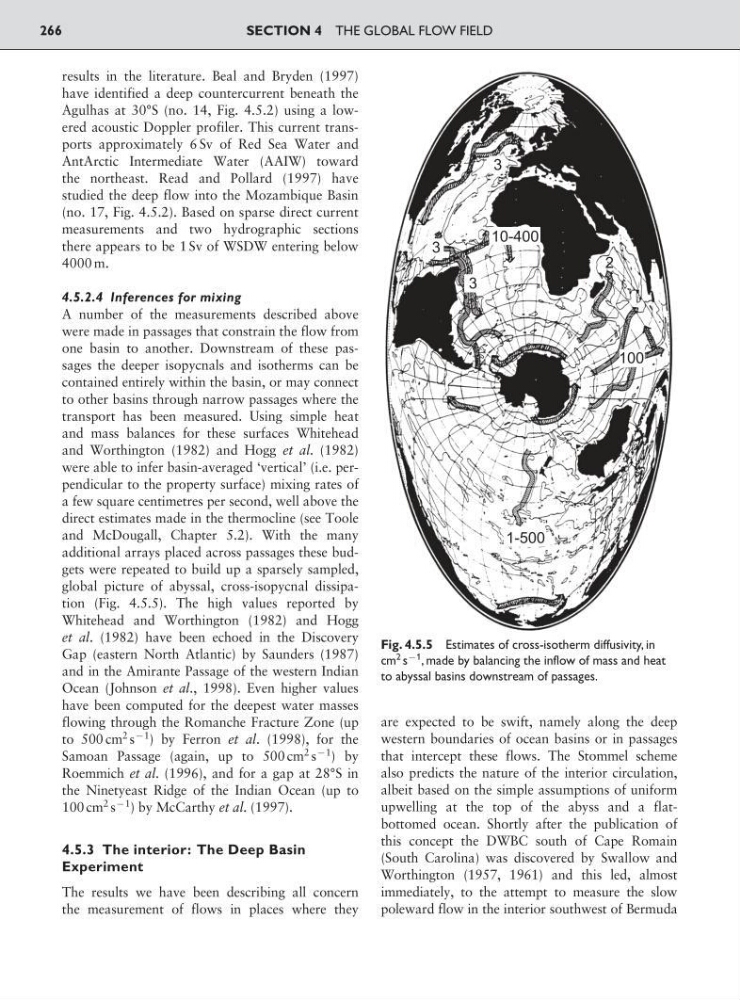
additional arrays placed across passages these budgets were repeated to build up a sparsely sampled,
global picture of abyssal, cross-isopycnal dissipation (Fig. 4.5.5). The high values reported by
Whitehead and Worthington (1982) and Hogg
et al. (1982) have been echoed in the Discovery
Gap (eastern North Atlantic) by Saunders (1987)
and in the Amirante Passage of the western Indian
Ocean (Johnson et al., 1998). Even higher values
have been computed for the deepest water masses
flowing through the Romanche Fracture Zone (up
to 500 cm
2 s
91
) by Ferron et al. (1998), for the
Samoan Passage (again, up to 500 cm
2 s
91
) by
Roemmich et al. (1996), and for a gap at 28°S in
the Ninetyeast Ridge of the Indian Ocean (up to
100 cm
2 s
91
) by McCarthy et al. (1997).
4.5.3 The interior: The Deep Basin
Experiment
The results we have been describing all concern
the measurement of flows in places where they
are expected to be swift, namely along the deep
western boundaries of ocean basins or in passages
that intercept these flows. The Stommel scheme
also predicts the nature of the interior circulation,
albeit based on the simple assumptions of uniform
upwelling at the top of the abyss and a flatbottomed ocean. Shortly after the publication of
this concept the DWBC south of Cape Romain
(South Carolina) was discovered by Swallow and
Worthington (1957, 1961) and this led, almost
immediately, to the attempt to measure the slow
poleward flow in the interior southwest of Bermuda
SECTION 4 THE GLOBAL FLOW FIELD
266
Fig. 4.5.5 Estimates of cross-isotherm diffusivity, in
cm
2 s
91
, made by balancing the inflow of mass and heat
to abyssal basins downstream of passages.
have identified a deep countercurrent beneath the
Agulhas at 30°S (no. 14, Fig. 4.5.2) using a lowered acoustic Doppler profiler. This current transports approximately 6 Sv of Red Sea Water and
AntArctic Intermediate Water (AAIW) toward
the northeast. Read and Pollard (1997) have
studied the deep flow into the Mozambique Basin
(no. 17, Fig. 4.5.2). Based on sparse direct current
measurements and two hydrographic sections
there appears to be 1 Sv of WSDW entering below
4000 m.
4.5.2.4 Inferences for mixing
A number of the measurements described above
were made in passages that constrain the flow from
one basin to another. Downstream of these passages the deeper isopycnals and isotherms can be
contained entirely within the basin, or may connect
to other basins through narrow passages where the
transport has been measured. Using simple heat
and mass balances for these surfaces Whitehead
and Worthington (1982) and Hogg et al. (1982)
were able to infer basin-averaged ‘vertical’ (i.e. perpendicular to the property surface) mixing rates of
a few square centimetres per second, well above the
direct estimates made in the thermocline (see Toole
and McDougall, Chapter 5.2). With the many
additional arrays placed across passages these budgets were repeated to build up a sparsely sampled,
global picture of abyssal, cross-isopycnal dissipation (Fig. 4.5.5). The high values reported by
Whitehead and Worthington (1982) and Hogg
et al. (1982) have been echoed in the Discovery
Gap (eastern North Atlantic) by Saunders (1987)
and in the Amirante Passage of the western Indian
Ocean (Johnson et al., 1998). Even higher values
have been computed for the deepest water masses
flowing through the Romanche Fracture Zone (up
to 500 cm
2 s
91
) by Ferron et al. (1998), for the
Samoan Passage (again, up to 500 cm
2 s
91
) by
Roemmich et al. (1996), and for a gap at 28°S in
the Ninetyeast Ridge of the Indian Ocean (up to
100 cm
2 s
91
) by McCarthy et al. (1997).
4.5.3 The interior: The Deep Basin
Experiment
The results we have been describing all concern
the measurement of flows in places where they
are expected to be swift, namely along the deep
western boundaries of ocean basins or in passages
that intercept these flows. The Stommel scheme
also predicts the nature of the interior circulation,
albeit based on the simple assumptions of uniform
upwelling at the top of the abyss and a flatbottomed ocean. Shortly after the publication of
this concept the DWBC south of Cape Romain
(South Carolina) was discovered by Swallow and
Worthington (1957, 1961) and this led, almost
immediately, to the attempt to measure the slow
poleward flow in the interior southwest of Bermuda
SECTION 4 THE GLOBAL FLOW FIELD
266
Fig. 4.5.5 Estimates of cross-isotherm diffusivity, in
cm
2 s
91
, made by balancing the inflow of mass and heat
to abyssal basins downstream of passages.