

earlier is (Ѩ
(x)
/Ѩy)/. In the models, the Ekman
transport augments the counterflow a few tens
of metres below the surface downwind flow
(Wacongne and Pacanowski, 1996; Garternicht
and Schott, 1997). Some qualitative support for
the idea that a Wacongne–Pacanowski cell may
exist in the real ocean comes from work of Hastenrath and Greischar (1989), who obtain divergences
from the Cutler and Swallow (1984) ship-drift currents. They show surprisingly consistent patterns.
In the transition seasons, there is equatorial divergence in the western Indian Ocean and convergence in the eastern, consistent with Wyrtki
(1973b); but in June to September, there is convergence in 0–5°N, divergence in 0–5°S, more or less
uniformly across the Indian Ocean. The inverse of
this pattern is seen in January–March. Thus the
summer and winter surface divergence patterns are
consistent with what one might expect, if the seasonal cycle of surface transport across the equator
were zero, or the inverse of the higher-latitude
Ekman flows. Hastenrath and Greischar find typical convergence magnitudes of <10
97 s
91
, possibly
suggesting that over the 3 months of summer or
winter mixed-layer depths should roughly double
(or halve) on either side of the equator. However,
this is not observed. Alternatively, water may flow
from the surface convergence to the divergence,
just below the surface, consistent with the existence of a Wacongne–Pacanowski cell. There is
SECTION 4 THE GLOBAL FLOW FIELD
238
20 N
10
0
10
20 S
20 N
10
0
10
20 S
20 N
10
0
10
20 S
Jan
Feb
Mar
Apr
May
Jun
Jul
Aug
Oct
Nov
Dec
Sep
1987
1988
CLIMATOLOGY
-4
-3.5
3.5
-3
3
-2.5
2.5
-2
2
-1.5
1.5
-1
1
-0.5
0
Heat Transport (PW)
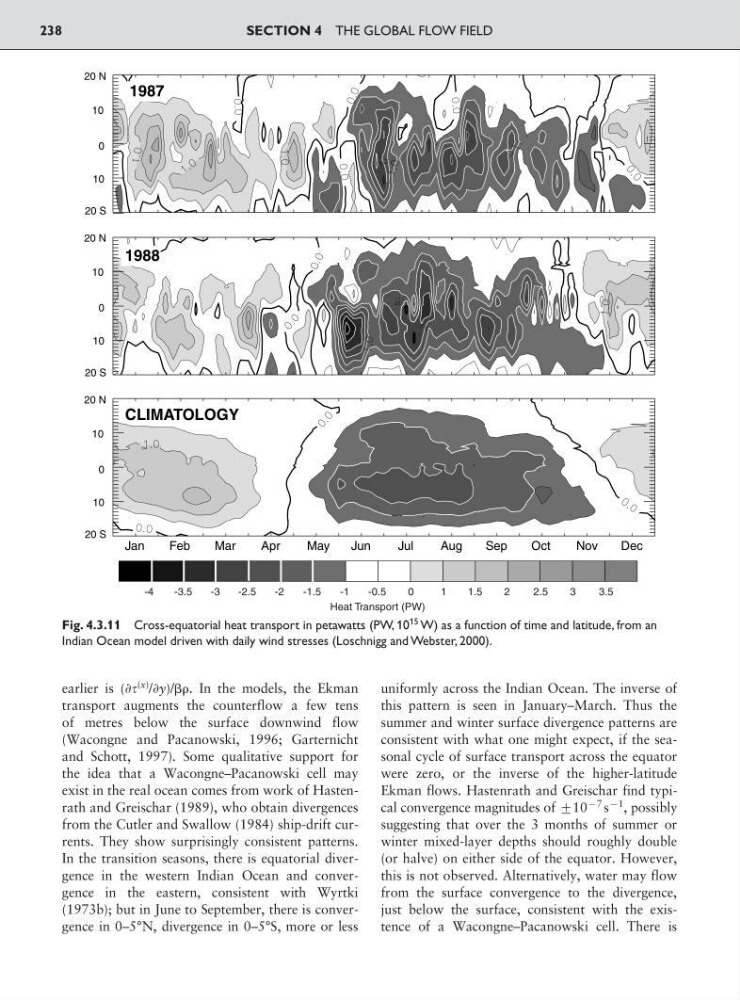
Fig. 4.3.11 Cross-equatorial heat transport in petawatts (PW, 10
15 W) as a function of time and latitude, from an
Indian Ocean model driven with daily wind stresses (Loschnigg and Webster, 2000).
(x)
/Ѩy)/. In the models, the Ekman
transport augments the counterflow a few tens
of metres below the surface downwind flow
(Wacongne and Pacanowski, 1996; Garternicht
and Schott, 1997). Some qualitative support for
the idea that a Wacongne–Pacanowski cell may
exist in the real ocean comes from work of Hastenrath and Greischar (1989), who obtain divergences
from the Cutler and Swallow (1984) ship-drift currents. They show surprisingly consistent patterns.
In the transition seasons, there is equatorial divergence in the western Indian Ocean and convergence in the eastern, consistent with Wyrtki
(1973b); but in June to September, there is convergence in 0–5°N, divergence in 0–5°S, more or less
uniformly across the Indian Ocean. The inverse of
this pattern is seen in January–March. Thus the
summer and winter surface divergence patterns are
consistent with what one might expect, if the seasonal cycle of surface transport across the equator
were zero, or the inverse of the higher-latitude
Ekman flows. Hastenrath and Greischar find typical convergence magnitudes of <10
97 s
91
, possibly
suggesting that over the 3 months of summer or
winter mixed-layer depths should roughly double
(or halve) on either side of the equator. However,
this is not observed. Alternatively, water may flow
from the surface convergence to the divergence,
just below the surface, consistent with the existence of a Wacongne–Pacanowski cell. There is
SECTION 4 THE GLOBAL FLOW FIELD
238
20 N
10
0
10
20 S
20 N
10
0
10
20 S
20 N
10
0
10
20 S
Jan
Feb
Mar
Apr
May
Jun
Jul
Aug
Oct
Nov
Dec
Sep
1987
1988
CLIMATOLOGY
-4
-3.5
3.5
-3
3
-2.5
2.5
-2
2
-1.5
1.5
-1
1
-0.5
0
Heat Transport (PW)
Fig. 4.3.11 Cross-equatorial heat transport in petawatts (PW, 10
15 W) as a function of time and latitude, from an
Indian Ocean model driven with daily wind stresses (Loschnigg and Webster, 2000).