

allowing for inefficiencies in the mixing process,
they are more than enough to provide the extra
vertical mixing that we require.
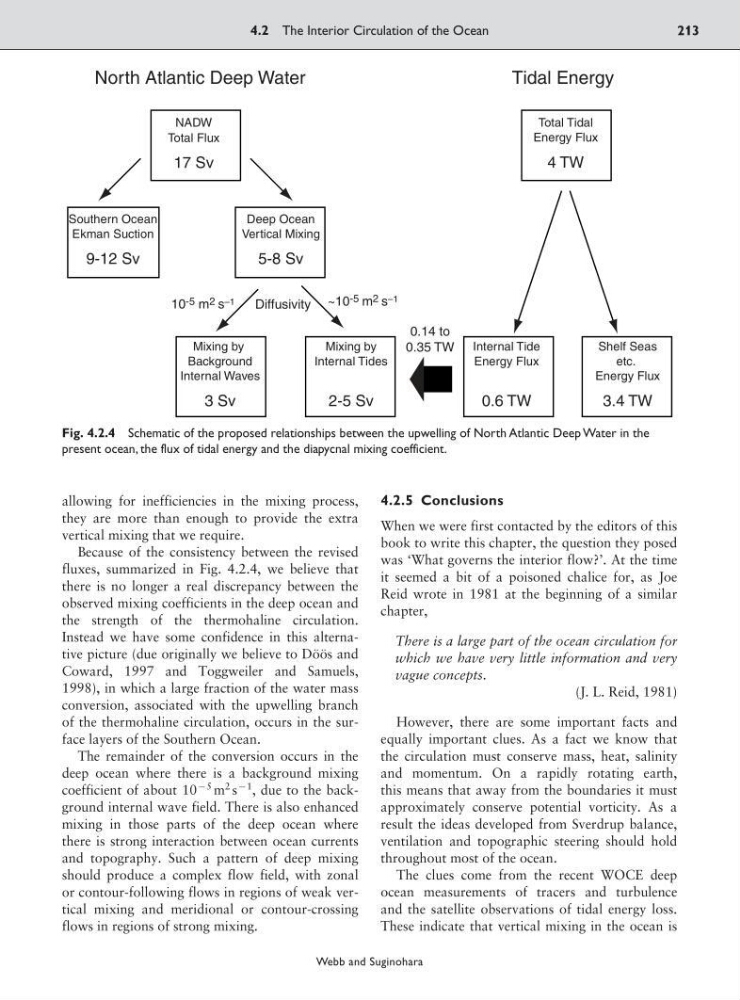
Because of the consistency between the revised
fluxes, summarized in Fig. 4.2.4, we believe that
there is no longer a real discrepancy between the
observed mixing coefficients in the deep ocean and
the strength of the thermohaline circulation.
Instead we have some confidence in this alternative picture (due originally we believe to Döös and
Coward, 1997 and Toggweiler and Samuels,
1998), in which a large fraction of the water mass
conversion, associated with the upwelling branch
of the thermohaline circulation, occurs in the surface layers of the Southern Ocean.
The remainder of the conversion occurs in the
deep ocean where there is a background mixing
coefficient of about 10
95 m
2 s
91
, due to the background internal wave field. There is also enhanced
mixing in those parts of the deep ocean where
there is strong interaction between ocean currents
and topography. Such a pattern of deep mixing
should produce a complex flow field, with zonal
or contour-following flows in regions of weak vertical mixing and meridional or contour-crossing
flows in regions of strong mixing.
4.2.5 Conclusions
When we were first contacted by the editors of this
book to write this chapter, the question they posed
was ‘What governs the interior flow?’. At the time
it seemed a bit of a poisoned chalice for, as Joe
Reid wrote in 1981 at the beginning of a similar
chapter,
There is a large part of the ocean circulation for
which we have very little information and very
vague concepts.
(J. L. Reid, 1981)
However, there are some important facts and
equally important clues. As a fact we know that
the circulation must conserve mass, heat, salinity
and momentum. On a rapidly rotating earth,
this means that away from the boundaries it must
approximately conserve potential vorticity. As a
result the ideas developed from Sverdrup balance,
ventilation and topographic steering should hold
throughout most of the ocean.
The clues come from the recent WOCE deep
ocean measurements of tracers and turbulence
and the satellite observations of tidal energy loss.
These indicate that vertical mixing in the ocean is
4.2 The Interior Circulation of the Ocean
213
Webb and Suginohara
NADW
Total Flux
17 Sv
Total Tidal
Energy Flux
4 TW
Southern Ocean
Ekman Suction
9-12 Sv
Deep Ocean
Vertical Mixing
5-8 Sv
Mixing by
Background
Internal Waves
3 Sv
Mixing by
Internal Tides
2-5 Sv
Internal Tide
Energy Flux
0.6 TW
Shelf Seas
etc.
Energy Flux
3.4 TW
North Atlantic Deep Water
Tidal Energy
0.14 to
0.35 TW
~10 -5 m 2 s –1
10 -5 m 2 s –1
Diffusivity
Fig. 4.2.4 Schematic of the proposed relationships between the upwelling of North Atlantic Deep Water in the
present ocean, the flux of tidal energy and the diapycnal mixing coefficient.
they are more than enough to provide the extra
vertical mixing that we require.
Because of the consistency between the revised
fluxes, summarized in Fig. 4.2.4, we believe that
there is no longer a real discrepancy between the
observed mixing coefficients in the deep ocean and
the strength of the thermohaline circulation.
Instead we have some confidence in this alternative picture (due originally we believe to Döös and
Coward, 1997 and Toggweiler and Samuels,
1998), in which a large fraction of the water mass
conversion, associated with the upwelling branch
of the thermohaline circulation, occurs in the surface layers of the Southern Ocean.
The remainder of the conversion occurs in the
deep ocean where there is a background mixing
coefficient of about 10
95 m
2 s
91
, due to the background internal wave field. There is also enhanced
mixing in those parts of the deep ocean where
there is strong interaction between ocean currents
and topography. Such a pattern of deep mixing
should produce a complex flow field, with zonal
or contour-following flows in regions of weak vertical mixing and meridional or contour-crossing
flows in regions of strong mixing.
4.2.5 Conclusions
When we were first contacted by the editors of this
book to write this chapter, the question they posed
was ‘What governs the interior flow?’. At the time
it seemed a bit of a poisoned chalice for, as Joe
Reid wrote in 1981 at the beginning of a similar
chapter,
There is a large part of the ocean circulation for
which we have very little information and very
vague concepts.
(J. L. Reid, 1981)
However, there are some important facts and
equally important clues. As a fact we know that
the circulation must conserve mass, heat, salinity
and momentum. On a rapidly rotating earth,
this means that away from the boundaries it must
approximately conserve potential vorticity. As a
result the ideas developed from Sverdrup balance,
ventilation and topographic steering should hold
throughout most of the ocean.
The clues come from the recent WOCE deep
ocean measurements of tracers and turbulence
and the satellite observations of tidal energy loss.
These indicate that vertical mixing in the ocean is
4.2 The Interior Circulation of the Ocean
213
Webb and Suginohara
NADW
Total Flux
17 Sv
Total Tidal
Energy Flux
4 TW
Southern Ocean
Ekman Suction
9-12 Sv
Deep Ocean
Vertical Mixing
5-8 Sv
Mixing by
Background
Internal Waves
3 Sv
Mixing by
Internal Tides
2-5 Sv
Internal Tide
Energy Flux
0.6 TW
Shelf Seas
etc.
Energy Flux
3.4 TW
North Atlantic Deep Water
Tidal Energy
0.14 to
0.35 TW
~10 -5 m 2 s –1
10 -5 m 2 s –1
Diffusivity
Fig. 4.2.4 Schematic of the proposed relationships between the upwelling of North Atlantic Deep Water in the
present ocean, the flux of tidal energy and the diapycnal mixing coefficient.