

3.5 Developing the WOCE Global Data System
185
Lindstrom and Legler
products of great utility to the community should
be produced on the basis of proposals for specific
data (or model) products. DACs were eventually
charged with tracking such product generation initiatives and to broaden their scope to accommodate
their own involvement in these activities.
Technology developments impacted the WOCE
Data System in a number of ways. Observational
technologies developed during the experiment,
necessitating new responsibilities (e.g. profile capability on floats, lowered ADCPs) for data assembly
and quality control. Perhaps most profound was
the change resulting from the advent of the World
Wide Web and browser software. The web capability brought the disparate functional elements
together virtually and stimulated online access to
many heretofore hidden resources.
Providing for easy access to the data sets for
WOCE and other investigators is also a necessary
function of the WOCE Data System. Online access
has been emphasized wherever possible. The
widespread use of the World Wide Web and
public Internet sites for data files has revolutionized online data distribution in just the past few
years. Likewise, inexpensive CD-ROM technology
has allowed mass distribution of data for immediate local accessibility. Data availability for
WOCE has changed dramatically as a result of
these developments.
The concept of a single WOCE Data Resource
One aim of WOCE data facilities and WOCE Data
Products Committee is to provide better and more
comprehensive access to WOCE data of all kinds.
One concept that is assisting in this direction is that
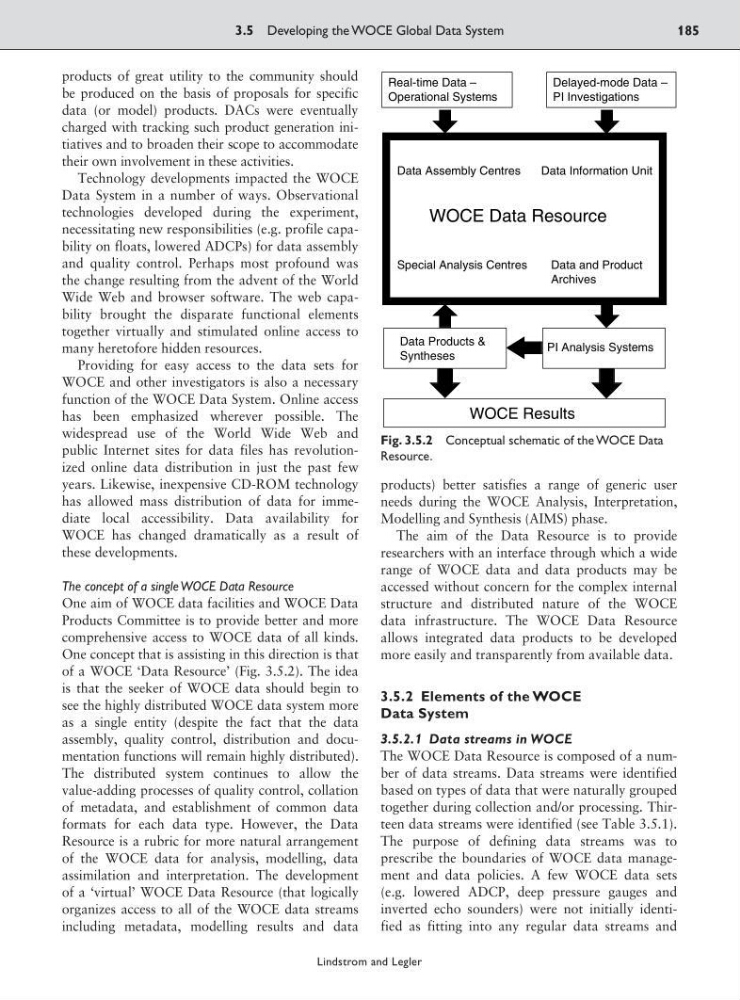
of a WOCE ‘Data Resource’ (Fig. 3.5.2). The idea
is that the seeker of WOCE data should begin to
see the highly distributed WOCE data system more
as a single entity (despite the fact that the data
assembly, quality control, distribution and documentation functions will remain highly distributed).
The distributed system continues to allow the
value-adding processes of quality control, collation
of metadata, and establishment of common data
formats for each data type. However, the Data
Resource is a rubric for more natural arrangement
of the WOCE data for analysis, modelling, data
assimilation and interpretation. The development
of a ‘virtual’ WOCE Data Resource (that logically
organizes access to all of the WOCE data streams
including metadata, modelling results and data
products) better satisfies a range of generic user
needs during the WOCE Analysis, Interpretation,
Modelling and Synthesis (AIMS) phase.
The aim of the Data Resource is to provide
researchers with an interface through which a wide
range of WOCE data and data products may be
accessed without concern for the complex internal
structure and distributed nature of the WOCE
data infrastructure. The WOCE Data Resource
allows integrated data products to be developed
more easily and transparently from available data.
3.5.2 Elements of the WOCE
Data System
3.5.2.1 Data streams in WOCE
The WOCE Data Resource is composed of a number of data streams. Data streams were identified
based on types of data that were naturally grouped
together during collection and/or processing. Thirteen data streams were identified (see Table 3.5.1).
The purpose of defining data streams was to
prescribe the boundaries of WOCE data management and data policies. A few WOCE data sets
(e.g. lowered ADCP, deep pressure gauges and
inverted echo sounders) were not initially identified as fitting into any regular data streams and
Real-time Data –
Operational Systems
Delayed-mode Data –
PI Investigations
WOCE Data Resource
Data Assembly Centres
Special Analysis Centres
Data and Product
Archives
Data Information Unit
PI Analysis Systems
Data Products &
Syntheses
WOCE Results
Fig. 3.5.2 Conceptual schematic of the WOCE Data
Resource.
185
Lindstrom and Legler
products of great utility to the community should
be produced on the basis of proposals for specific
data (or model) products. DACs were eventually
charged with tracking such product generation initiatives and to broaden their scope to accommodate
their own involvement in these activities.
Technology developments impacted the WOCE
Data System in a number of ways. Observational
technologies developed during the experiment,
necessitating new responsibilities (e.g. profile capability on floats, lowered ADCPs) for data assembly
and quality control. Perhaps most profound was
the change resulting from the advent of the World
Wide Web and browser software. The web capability brought the disparate functional elements
together virtually and stimulated online access to
many heretofore hidden resources.
Providing for easy access to the data sets for
WOCE and other investigators is also a necessary
function of the WOCE Data System. Online access
has been emphasized wherever possible. The
widespread use of the World Wide Web and
public Internet sites for data files has revolutionized online data distribution in just the past few
years. Likewise, inexpensive CD-ROM technology
has allowed mass distribution of data for immediate local accessibility. Data availability for
WOCE has changed dramatically as a result of
these developments.
The concept of a single WOCE Data Resource
One aim of WOCE data facilities and WOCE Data
Products Committee is to provide better and more
comprehensive access to WOCE data of all kinds.
One concept that is assisting in this direction is that
of a WOCE ‘Data Resource’ (Fig. 3.5.2). The idea
is that the seeker of WOCE data should begin to
see the highly distributed WOCE data system more
as a single entity (despite the fact that the data
assembly, quality control, distribution and documentation functions will remain highly distributed).
The distributed system continues to allow the
value-adding processes of quality control, collation
of metadata, and establishment of common data
formats for each data type. However, the Data
Resource is a rubric for more natural arrangement
of the WOCE data for analysis, modelling, data
assimilation and interpretation. The development
of a ‘virtual’ WOCE Data Resource (that logically
organizes access to all of the WOCE data streams
including metadata, modelling results and data
products) better satisfies a range of generic user
needs during the WOCE Analysis, Interpretation,
Modelling and Synthesis (AIMS) phase.
The aim of the Data Resource is to provide
researchers with an interface through which a wide
range of WOCE data and data products may be
accessed without concern for the complex internal
structure and distributed nature of the WOCE
data infrastructure. The WOCE Data Resource
allows integrated data products to be developed
more easily and transparently from available data.
3.5.2 Elements of the WOCE
Data System
3.5.2.1 Data streams in WOCE
The WOCE Data Resource is composed of a number of data streams. Data streams were identified
based on types of data that were naturally grouped
together during collection and/or processing. Thirteen data streams were identified (see Table 3.5.1).
The purpose of defining data streams was to
prescribe the boundaries of WOCE data management and data policies. A few WOCE data sets
(e.g. lowered ADCP, deep pressure gauges and
inverted echo sounders) were not initially identified as fitting into any regular data streams and
Real-time Data –
Operational Systems
Delayed-mode Data –
PI Investigations
WOCE Data Resource
Data Assembly Centres
Special Analysis Centres
Data and Product
Archives
Data Information Unit
PI Analysis Systems
Data Products &
Syntheses
WOCE Results
Fig. 3.5.2 Conceptual schematic of the WOCE Data
Resource.