

Chelton and Schlax (1996) conducted a global
analysis of the properties of Rossby waves detected
by T/P. They also showed evidence of the refraction: after leaving the eastern boundary, wavefronts travel faster at low latitudes than at high
latitudes due to the latitudinal dependence of ,
creating an arc of wavefront with the leading edge
at low latitudes and the trailing edge at high latitudes. The waves are apparently amplified when
passing over mid-ocean topographic features. The
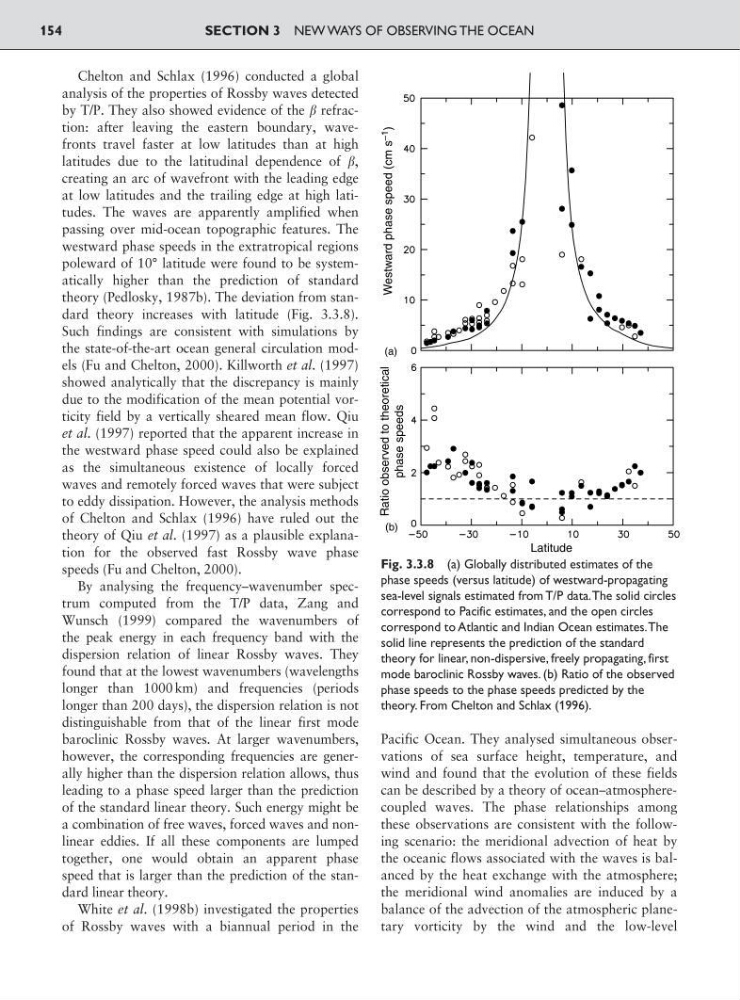
westward phase speeds in the extratropical regions
poleward of 10° latitude were found to be systematically higher than the prediction of standard
theory (Pedlosky, 1987b). The deviation from standard theory increases with latitude (Fig. 3.3.8).
Such findings are consistent with simulations by
the state-of-the-art ocean general circulation models (Fu and Chelton, 2000). Killworth et al. (1997)
showed analytically that the discrepancy is mainly
due to the modification of the mean potential vorticity field by a vertically sheared mean flow. Qiu
et al. (1997) reported that the apparent increase in
the westward phase speed could also be explained
as the simultaneous existence of locally forced
waves and remotely forced waves that were subject
to eddy dissipation. However, the analysis methods
of Chelton and Schlax (1996) have ruled out the
theory of Qiu et al. (1997) as a plausible explanation for the observed fast Rossby wave phase
speeds (Fu and Chelton, 2000).
By analysing the frequency–wavenumber spectrum computed from the T/P data, Zang and
Wunsch (1999) compared the wavenumbers of
the peak energy in each frequency band with the
dispersion relation of linear Rossby waves. They
found that at the lowest wavenumbers (wavelengths
longer than 1000 km) and frequencies (periods
longer than 200 days), the dispersion relation is not
distinguishable from that of the linear first mode
baroclinic Rossby waves. At larger wavenumbers,
however, the corresponding frequencies are generally higher than the dispersion relation allows, thus
leading to a phase speed larger than the prediction
of the standard linear theory. Such energy might be
a combination of free waves, forced waves and nonlinear eddies. If all these components are lumped
together, one would obtain an apparent phase
speed that is larger than the prediction of the standard linear theory.
White et al. (1998b) investigated the properties
of Rossby waves with a biannual period in the
Pacific Ocean. They analysed simultaneous observations of sea surface height, temperature, and
wind and found that the evolution of these fields
can be described by a theory of ocean–atmospherecoupled waves. The phase relationships among
these observations are consistent with the following scenario: the meridional advection of heat by
the oceanic flows associated with the waves is balanced by the heat exchange with the atmosphere;
the meridional wind anomalies are induced by a
balance of the advection of the atmospheric planetary vorticity by the wind and the low-level
SECTION 3 NEW WAYS OF OBSERVING THE OCEAN
154
Westward phase speed (cm s –1
)
Latitude
Ratio observed to theoretical
phase speeds
(a)
(b)
Fig. 3.3.8 (a) Globally distributed estimates of the
phase speeds (versus latitude) of westward-propagating
sea-level signals estimated from T/P data.The solid circles
correspond to Pacific estimates, and the open circles
correspond to Atlantic and Indian Ocean estimates.The
solid line represents the prediction of the standard
theory for linear, non-dispersive, freely propagating, first
mode baroclinic Rossby waves. (b) Ratio of the observed
phase speeds to the phase speeds predicted by the
theory. From Chelton and Schlax (1996).
analysis of the properties of Rossby waves detected
by T/P. They also showed evidence of the refraction: after leaving the eastern boundary, wavefronts travel faster at low latitudes than at high
latitudes due to the latitudinal dependence of ,
creating an arc of wavefront with the leading edge
at low latitudes and the trailing edge at high latitudes. The waves are apparently amplified when
passing over mid-ocean topographic features. The
westward phase speeds in the extratropical regions
poleward of 10° latitude were found to be systematically higher than the prediction of standard
theory (Pedlosky, 1987b). The deviation from standard theory increases with latitude (Fig. 3.3.8).
Such findings are consistent with simulations by
the state-of-the-art ocean general circulation models (Fu and Chelton, 2000). Killworth et al. (1997)
showed analytically that the discrepancy is mainly
due to the modification of the mean potential vorticity field by a vertically sheared mean flow. Qiu
et al. (1997) reported that the apparent increase in
the westward phase speed could also be explained
as the simultaneous existence of locally forced
waves and remotely forced waves that were subject
to eddy dissipation. However, the analysis methods
of Chelton and Schlax (1996) have ruled out the
theory of Qiu et al. (1997) as a plausible explanation for the observed fast Rossby wave phase
speeds (Fu and Chelton, 2000).
By analysing the frequency–wavenumber spectrum computed from the T/P data, Zang and
Wunsch (1999) compared the wavenumbers of
the peak energy in each frequency band with the
dispersion relation of linear Rossby waves. They
found that at the lowest wavenumbers (wavelengths
longer than 1000 km) and frequencies (periods
longer than 200 days), the dispersion relation is not
distinguishable from that of the linear first mode
baroclinic Rossby waves. At larger wavenumbers,
however, the corresponding frequencies are generally higher than the dispersion relation allows, thus
leading to a phase speed larger than the prediction
of the standard linear theory. Such energy might be
a combination of free waves, forced waves and nonlinear eddies. If all these components are lumped
together, one would obtain an apparent phase
speed that is larger than the prediction of the standard linear theory.
White et al. (1998b) investigated the properties
of Rossby waves with a biannual period in the
Pacific Ocean. They analysed simultaneous observations of sea surface height, temperature, and
wind and found that the evolution of these fields
can be described by a theory of ocean–atmospherecoupled waves. The phase relationships among
these observations are consistent with the following scenario: the meridional advection of heat by
the oceanic flows associated with the waves is balanced by the heat exchange with the atmosphere;
the meridional wind anomalies are induced by a
balance of the advection of the atmospheric planetary vorticity by the wind and the low-level
SECTION 3 NEW WAYS OF OBSERVING THE OCEAN
154
Westward phase speed (cm s –1
)
Latitude
Ratio observed to theoretical
phase speeds
(a)
(b)
Fig. 3.3.8 (a) Globally distributed estimates of the
phase speeds (versus latitude) of westward-propagating
sea-level signals estimated from T/P data.The solid circles
correspond to Pacific estimates, and the open circles
correspond to Atlantic and Indian Ocean estimates.The
solid line represents the prediction of the standard
theory for linear, non-dispersive, freely propagating, first
mode baroclinic Rossby waves. (b) Ratio of the observed
phase speeds to the phase speeds predicted by the
theory. From Chelton and Schlax (1996).