

data for 12 197 repeat hydrography stations. Their
locations are shown in Fig. 3.1.6 (see Plate 3.1.6,
p. 172).
The repeat hydrography programme has had
some notable successes. The 48°N line in the
Atlantic was occupied six times from 1993 to
1999, including twice to the standards of a onetime survey with full tracer suite, and continues to
be occupied by Germany as part of a CLIVAR
programme. In the Southern Ocean, the chokepoints at Drake Passage and South of Australia
were occupied ten and six times, respectively, by
the combined efforts of several countries. Here,
too, repeat measurements triggered by WOCE will
continue as part of national CLIVAR plans.
However, much remains to be done in the
analysis and interpretation of the repeat hydrography before the variability is appropriately quantified and the knowledge used in the analysis and
interpretation of the one-time survey.
3.1.2.4 How the WHP defined standards for
data and methods of measurement
The measurement techniques required for WOCE
had been built up over a long period of time. But at
the start of WOCE there were many parameters for
which only a few groups in the world had the
expertise to measure them to the required standard.
Never before had a single coordinated hydrographic survey planned to draw on contributions
from so many different institutions, investigators
and countries. The question therefore arose of
how to ensure that data were of a uniformly high
standard, remembering that for many of the parameters the WHP Planning Committee deliberately
defined a standard that before WOCE was the best
achievable by an experienced investigator with
access to the best analytical equipment. The scale
of the WHP necessarily required a rapid growth
in the capacity of the community, which implied
many new investigators taking a leading role. The
ambition in WOCE was not only to provide a data
set of unprecedented coverage, but also of unprecedented quality.
The amounts of data and the international scope
of the experiment required the establishment of a
centre to coordinate the programme. The WHP
Office, initially located at the Woods Hole Oceanographic Institution and later at the Scripps Institution of Oceanography, was a central facility
established to oversee the global effort, to receive
and evaluate incoming data, to make provisional
and final data available to the WOCE community
in a uniform format as quickly as possible, and to
ensure a final archive was submitted to a World
Data Centre. The issue of what metadata (information describing the data) would be required was
addressed by a detailed description (WHPO, 1994b)
of information and data requirements, including a
timetable for data submission to the WHP Office.
SECTION 3 NEW WAYS OF OBSERVING THE OCEAN
106
Biological
Other Chemical Tracers
Carbon-14
Helium/Tritium
Carbon System
CFCs
Oxygen
Nutrients
Salinity
Percent of One Time Survey Sections
0
10
20
30
40
50
60
70
80
90
100
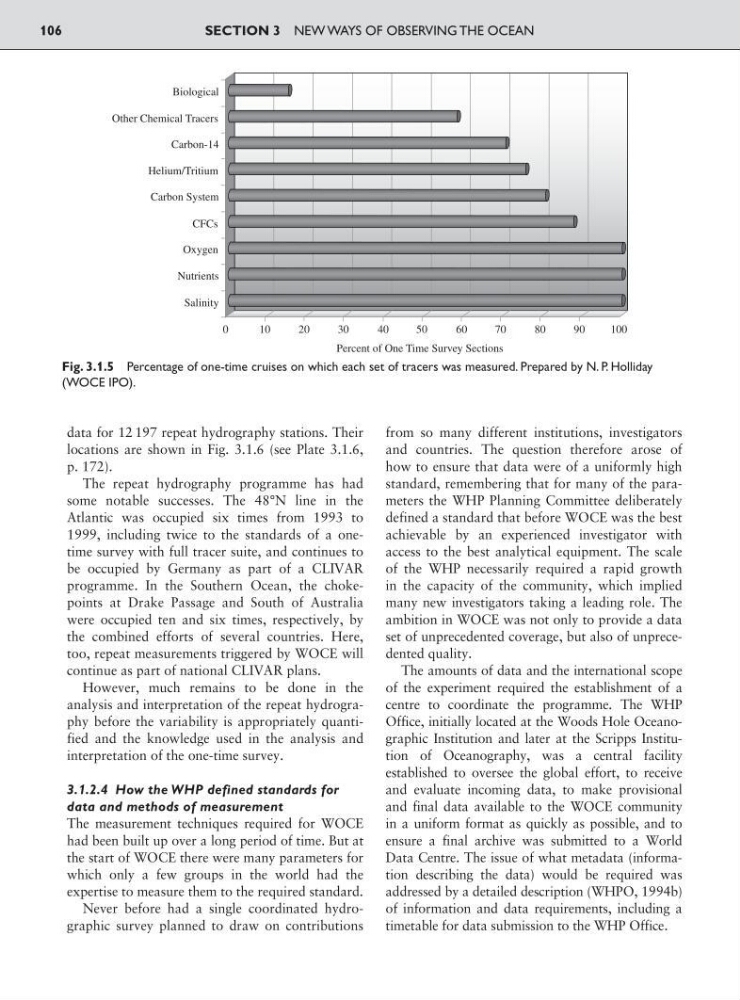
Fig. 3.1.5 Percentage of one-time cruises on which each set of tracers was measured. Prepared by N. P. Holliday
(WOCE IPO).
locations are shown in Fig. 3.1.6 (see Plate 3.1.6,
p. 172).
The repeat hydrography programme has had
some notable successes. The 48°N line in the
Atlantic was occupied six times from 1993 to
1999, including twice to the standards of a onetime survey with full tracer suite, and continues to
be occupied by Germany as part of a CLIVAR
programme. In the Southern Ocean, the chokepoints at Drake Passage and South of Australia
were occupied ten and six times, respectively, by
the combined efforts of several countries. Here,
too, repeat measurements triggered by WOCE will
continue as part of national CLIVAR plans.
However, much remains to be done in the
analysis and interpretation of the repeat hydrography before the variability is appropriately quantified and the knowledge used in the analysis and
interpretation of the one-time survey.
3.1.2.4 How the WHP defined standards for
data and methods of measurement
The measurement techniques required for WOCE
had been built up over a long period of time. But at
the start of WOCE there were many parameters for
which only a few groups in the world had the
expertise to measure them to the required standard.
Never before had a single coordinated hydrographic survey planned to draw on contributions
from so many different institutions, investigators
and countries. The question therefore arose of
how to ensure that data were of a uniformly high
standard, remembering that for many of the parameters the WHP Planning Committee deliberately
defined a standard that before WOCE was the best
achievable by an experienced investigator with
access to the best analytical equipment. The scale
of the WHP necessarily required a rapid growth
in the capacity of the community, which implied
many new investigators taking a leading role. The
ambition in WOCE was not only to provide a data
set of unprecedented coverage, but also of unprecedented quality.
The amounts of data and the international scope
of the experiment required the establishment of a
centre to coordinate the programme. The WHP
Office, initially located at the Woods Hole Oceanographic Institution and later at the Scripps Institution of Oceanography, was a central facility
established to oversee the global effort, to receive
and evaluate incoming data, to make provisional
and final data available to the WOCE community
in a uniform format as quickly as possible, and to
ensure a final archive was submitted to a World
Data Centre. The issue of what metadata (information describing the data) would be required was
addressed by a detailed description (WHPO, 1994b)
of information and data requirements, including a
timetable for data submission to the WHP Office.
SECTION 3 NEW WAYS OF OBSERVING THE OCEAN
106
Biological
Other Chemical Tracers
Carbon-14
Helium/Tritium
Carbon System
CFCs
Oxygen
Nutrients
Salinity
Percent of One Time Survey Sections
0
10
20
30
40
50
60
70
80
90
100
Fig. 3.1.5 Percentage of one-time cruises on which each set of tracers was measured. Prepared by N. P. Holliday
(WOCE IPO).