

the ocean interior; between the surface pressure
field and velocity measurements from drifters,
floats and current meters. The ocean temperature
and salinity fields are arguably the most fundamental of all ocean measurements.
3.1.1.2 The basis of support for the WHP
The number of different PIs who supported and
participated in the work of the WHP was surely
greater than for any other element of WOCE.
With each cruise requiring a wide range of physical and chemical measurements, literally hundreds
of PIs were involved in writing proposals, organizing cruises and cooperating in the exchange and
reporting of data.
The task of completing the WHP was beyond
any single nation. The programme could not have
achieved the success it did if it had not been
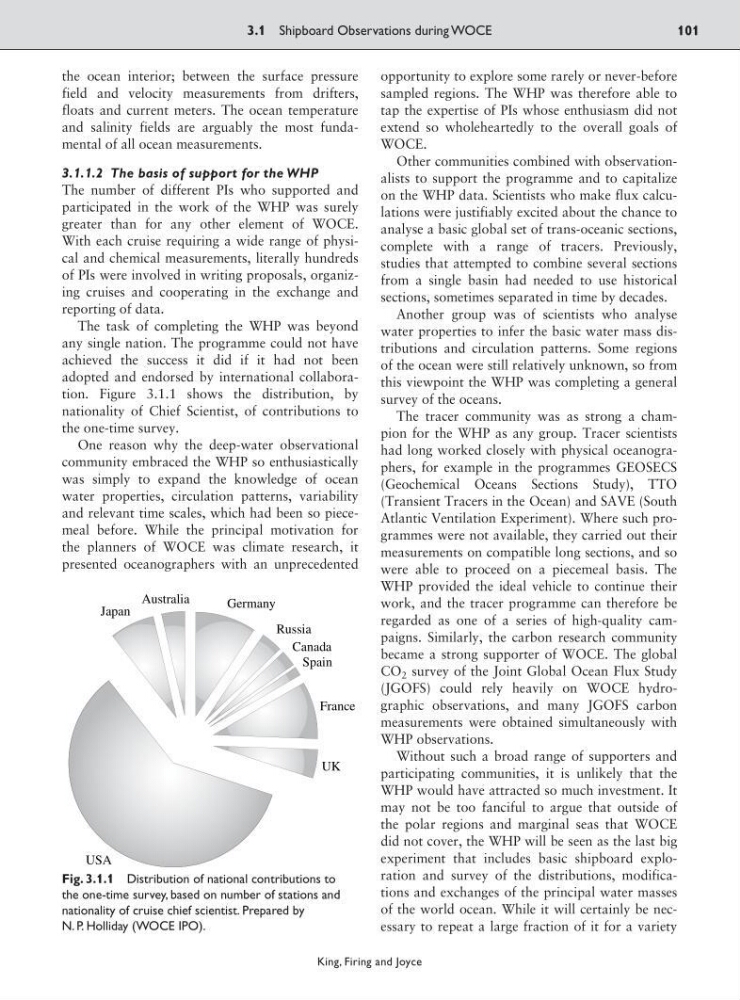
adopted and endorsed by international collaboration. Figure 3.1.1 shows the distribution, by
nationality of Chief Scientist, of contributions to
the one-time survey.
One reason why the deep-water observational
community embraced the WHP so enthusiastically
was simply to expand the knowledge of ocean
water properties, circulation patterns, variability
and relevant time scales, which had been so piecemeal before. While the principal motivation for
the planners of WOCE was climate research, it
presented oceanographers with an unprecedented
opportunity to explore some rarely or never-before
sampled regions. The WHP was therefore able to
tap the expertise of PIs whose enthusiasm did not
extend so wholeheartedly to the overall goals of
WOCE.
Other communities combined with observationalists to support the programme and to capitalize
on the WHP data. Scientists who make flux calculations were justifiably excited about the chance to
analyse a basic global set of trans-oceanic sections,
complete with a range of tracers. Previously,
studies that attempted to combine several sections
from a single basin had needed to use historical
sections, sometimes separated in time by decades.
Another group was of scientists who analyse
water properties to infer the basic water mass distributions and circulation patterns. Some regions
of the ocean were still relatively unknown, so from
this viewpoint the WHP was completing a general
survey of the oceans.
The tracer community was as strong a champion for the WHP as any group. Tracer scientists
had long worked closely with physical oceanographers, for example in the programmes GEOSECS
(Geochemical Oceans Sections Study), TTO
(Transient Tracers in the Ocean) and SAVE (South
Atlantic Ventilation Experiment). Where such programmes were not available, they carried out their
measurements on compatible long sections, and so
were able to proceed on a piecemeal basis. The
WHP provided the ideal vehicle to continue their
work, and the tracer programme can therefore be
regarded as one of a series of high-quality campaigns. Similarly, the carbon research community
became a strong supporter of WOCE. The global
CO 2 survey of the Joint Global Ocean Flux Study
(JGOFS) could rely heavily on WOCE hydrographic observations, and many JGOFS carbon
measurements were obtained simultaneously with
WHP observations.
Without such a broad range of supporters and
participating communities, it is unlikely that the
WHP would have attracted so much investment. It
may not be too fanciful to argue that outside of
the polar regions and marginal seas that WOCE
did not cover, the WHP will be seen as the last big
experiment that includes basic shipboard exploration and survey of the distributions, modifications and exchanges of the principal water masses
of the world ocean. While it will certainly be necessary to repeat a large fraction of it for a variety
3.1 Shipboard Observations during WOCE
101
King, Firing and Joyce
Germany
Russia
Canada
Spain
France
UK
USA
Japan
Australia
Fig. 3.1.1 Distribution of national contributions to
the one-time survey, based on number of stations and
nationality of cruise chief scientist. Prepared by
N. P. Holliday (WOCE IPO).
field and velocity measurements from drifters,
floats and current meters. The ocean temperature
and salinity fields are arguably the most fundamental of all ocean measurements.
3.1.1.2 The basis of support for the WHP
The number of different PIs who supported and
participated in the work of the WHP was surely
greater than for any other element of WOCE.
With each cruise requiring a wide range of physical and chemical measurements, literally hundreds
of PIs were involved in writing proposals, organizing cruises and cooperating in the exchange and
reporting of data.
The task of completing the WHP was beyond
any single nation. The programme could not have
achieved the success it did if it had not been
adopted and endorsed by international collaboration. Figure 3.1.1 shows the distribution, by
nationality of Chief Scientist, of contributions to
the one-time survey.
One reason why the deep-water observational
community embraced the WHP so enthusiastically
was simply to expand the knowledge of ocean
water properties, circulation patterns, variability
and relevant time scales, which had been so piecemeal before. While the principal motivation for
the planners of WOCE was climate research, it
presented oceanographers with an unprecedented
opportunity to explore some rarely or never-before
sampled regions. The WHP was therefore able to
tap the expertise of PIs whose enthusiasm did not
extend so wholeheartedly to the overall goals of
WOCE.
Other communities combined with observationalists to support the programme and to capitalize
on the WHP data. Scientists who make flux calculations were justifiably excited about the chance to
analyse a basic global set of trans-oceanic sections,
complete with a range of tracers. Previously,
studies that attempted to combine several sections
from a single basin had needed to use historical
sections, sometimes separated in time by decades.
Another group was of scientists who analyse
water properties to infer the basic water mass distributions and circulation patterns. Some regions
of the ocean were still relatively unknown, so from
this viewpoint the WHP was completing a general
survey of the oceans.
The tracer community was as strong a champion for the WHP as any group. Tracer scientists
had long worked closely with physical oceanographers, for example in the programmes GEOSECS
(Geochemical Oceans Sections Study), TTO
(Transient Tracers in the Ocean) and SAVE (South
Atlantic Ventilation Experiment). Where such programmes were not available, they carried out their
measurements on compatible long sections, and so
were able to proceed on a piecemeal basis. The
WHP provided the ideal vehicle to continue their
work, and the tracer programme can therefore be
regarded as one of a series of high-quality campaigns. Similarly, the carbon research community
became a strong supporter of WOCE. The global
CO 2 survey of the Joint Global Ocean Flux Study
(JGOFS) could rely heavily on WOCE hydrographic observations, and many JGOFS carbon
measurements were obtained simultaneously with
WHP observations.
Without such a broad range of supporters and
participating communities, it is unlikely that the
WHP would have attracted so much investment. It
may not be too fanciful to argue that outside of
the polar regions and marginal seas that WOCE
did not cover, the WHP will be seen as the last big
experiment that includes basic shipboard exploration and survey of the distributions, modifications and exchanges of the principal water masses
of the world ocean. While it will certainly be necessary to repeat a large fraction of it for a variety
3.1 Shipboard Observations during WOCE
101
King, Firing and Joyce
Germany
Russia
Canada
Spain
France
UK
USA
Japan
Australia
Fig. 3.1.1 Distribution of national contributions to
the one-time survey, based on number of stations and
nationality of cruise chief scientist. Prepared by
N. P. Holliday (WOCE IPO).