

the heat budget are described by Bryden and
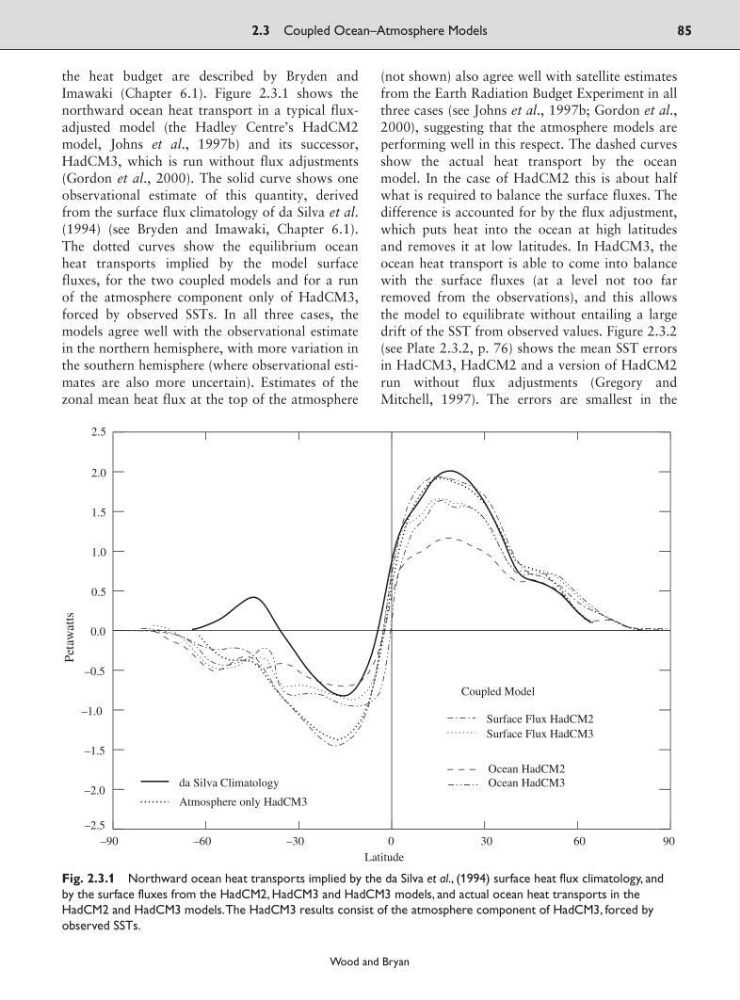
Imawaki (Chapter 6.1). Figure 2.3.1 shows the
northward ocean heat transport in a typical fluxadjusted model (the Hadley Centre’s HadCM2
model, Johns et al., 1997b) and its successor,
HadCM3, which is run without flux adjustments
(Gordon et al., 2000). The solid curve shows one
observational estimate of this quantity, derived
from the surface flux climatology of da Silva et al.
(1994) (see Bryden and Imawaki, Chapter 6.1).
The dotted curves show the equilibrium ocean
heat transports implied by the model surface
fluxes, for the two coupled models and for a run
of the atmosphere component only of HadCM3,
forced by observed SSTs. In all three cases, the
models agree well with the observational estimate
in the northern hemisphere, with more variation in
the southern hemisphere (where observational estimates are also more uncertain). Estimates of the
zonal mean heat flux at the top of the atmosphere
(not shown) also agree well with satellite estimates
from the Earth Radiation Budget Experiment in all
three cases (see Johns et al., 1997b; Gordon et al.,
2000), suggesting that the atmosphere models are
performing well in this respect. The dashed curves
show the actual heat transport by the ocean
model. In the case of HadCM2 this is about half
what is required to balance the surface fluxes. The
difference is accounted for by the flux adjustment,
which puts heat into the ocean at high latitudes
and removes it at low latitudes. In HadCM3, the
ocean heat transport is able to come into balance
with the surface fluxes (at a level not too far
removed from the observations), and this allows
the model to equilibrate without entailing a large
drift of the SST from observed values. Figure 2.3.2
(see Plate 2.3.2, p. 76) shows the mean SST errors
in HadCM3, HadCM2 and a version of HadCM2
run without flux adjustments (Gregory and
Mitchell, 1997). The errors are smallest in the
2.3 Coupled Ocean–Atmosphere Models
85
Wood and Bryan
–90
–60
–30
0
30
60
90
Latitude
–2.5
–2.0
–1.5
–1.0
–0.5
0.0
0.5
1.0
1.5
2.0
2.5
Petawatts
Coupled Model
da Silva Climatology
Atmosphere only HadCM3
Surface Flux HadCM2
Surface Flux HadCM3
Ocean HadCM2
Ocean HadCM3
Fig. 2.3.1 Northward ocean heat transports implied by the da Silva et al., (1994) surface heat flux climatology, and
by the surface fluxes from the HadCM2, HadCM3 and HadCM3 models, and actual ocean heat transports in the
HadCM2 and HadCM3 models.The HadCM3 results consist of the atmosphere component of HadCM3, forced by
observed SSTs.
Imawaki (Chapter 6.1). Figure 2.3.1 shows the
northward ocean heat transport in a typical fluxadjusted model (the Hadley Centre’s HadCM2
model, Johns et al., 1997b) and its successor,
HadCM3, which is run without flux adjustments
(Gordon et al., 2000). The solid curve shows one
observational estimate of this quantity, derived
from the surface flux climatology of da Silva et al.
(1994) (see Bryden and Imawaki, Chapter 6.1).
The dotted curves show the equilibrium ocean
heat transports implied by the model surface
fluxes, for the two coupled models and for a run
of the atmosphere component only of HadCM3,
forced by observed SSTs. In all three cases, the
models agree well with the observational estimate
in the northern hemisphere, with more variation in
the southern hemisphere (where observational estimates are also more uncertain). Estimates of the
zonal mean heat flux at the top of the atmosphere
(not shown) also agree well with satellite estimates
from the Earth Radiation Budget Experiment in all
three cases (see Johns et al., 1997b; Gordon et al.,
2000), suggesting that the atmosphere models are
performing well in this respect. The dashed curves
show the actual heat transport by the ocean
model. In the case of HadCM2 this is about half
what is required to balance the surface fluxes. The
difference is accounted for by the flux adjustment,
which puts heat into the ocean at high latitudes
and removes it at low latitudes. In HadCM3, the
ocean heat transport is able to come into balance
with the surface fluxes (at a level not too far
removed from the observations), and this allows
the model to equilibrate without entailing a large
drift of the SST from observed values. Figure 2.3.2
(see Plate 2.3.2, p. 76) shows the mean SST errors
in HadCM3, HadCM2 and a version of HadCM2
run without flux adjustments (Gregory and
Mitchell, 1997). The errors are smallest in the
2.3 Coupled Ocean–Atmosphere Models
85
Wood and Bryan
–90
–60
–30
0
30
60
90
Latitude
–2.5
–2.0
–1.5
–1.0
–0.5
0.0
0.5
1.0
1.5
2.0
2.5
Petawatts
Coupled Model
da Silva Climatology
Atmosphere only HadCM3
Surface Flux HadCM2
Surface Flux HadCM3
Ocean HadCM2
Ocean HadCM3
Fig. 2.3.1 Northward ocean heat transports implied by the da Silva et al., (1994) surface heat flux climatology, and
by the surface fluxes from the HadCM2, HadCM3 and HadCM3 models, and actual ocean heat transports in the
HadCM2 and HadCM3 models.The HadCM3 results consist of the atmosphere component of HadCM3, forced by
observed SSTs.