

systems on the ridge flanks. The net amount of heat
transported and the total geographical extent of the
flanks is much larger than that of the axial parts of
the ridges, the division often being drawn at 1 My,
resulting in a partitioning of 70%:30% relative heat
loss. Hence, the relative chemical anomaly and volume of fluids expelled on the axis versus the flanks of
the ridge will determine which of these parts of the
midocean ridge hydrothermal system is most important for the cycles of individual chemical elements
and species. It has been difficult to acquire quantitative data on the fluids exiting from the flanks, one
of the reasons being that sites of flank fluid venting
are difficult to identify because water column plumes
are not present, nor are the distinctive animal communities (distinctive both for their animal types as
well as their white color on the black basalt) found at
the axial sites of venting. In the last several years
drilling by the Ocean Drilling Program on the flanks
of the Juan de Fuca Ridge has provided important
new information on the chemistry and hydrology of
these systems, as well as demonstrating a viable
method for further approaching the flank question.
Observed Fluid Compositions
Compositions of hydrothermal fluids not only vary
widely but also are almost always very different from
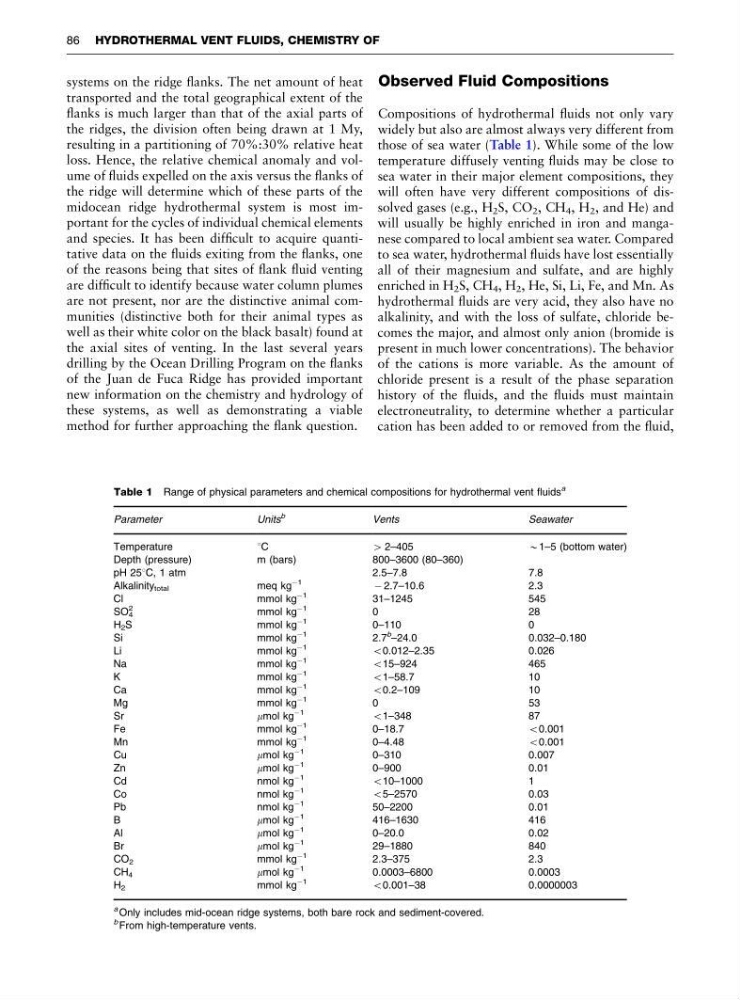
those of sea water (Table 1). While some of the low
temperature diffusely venting fluids may be close to
sea water in their major element compositions, they
will often have very different compositions of dissolved gases (e.g., H 2 S, CO 2 , CH 4 , H 2 , and He) and
will usually be highly enriched in iron and manganese compared to local ambient sea water. Compared
to sea water, hydrothermal fluids have lost essentially
all of their magnesium and sulfate, and are highly
enriched in H 2 S, CH 4 , H 2 , He, Si, Li, Fe, and Mn. As
hydrothermal fluids are very acid, they also have no
alkalinity, and with the loss of sulfate, chloride becomes the major, and almost only anion (bromide is
present in much lower concentrations). The behavior
of the cations is more variable. As the amount of
chloride present is a result of the phase separation
history of the fluids, and the fluids must maintain
electroneutrality, to determine whether a particular
cation has been added to or removed from the fluid,
Table 1 Range of physical parameters and chemical compositions for hydrothermal vent fluids
a
Parameter
Units
b
Vents
Seawater
Temperature
1C
4 2–405
B1–5 (bottom water)
Depth (pressure)
m (bars)
800–3600 (80–360)
pH 251C, 1 atm
2.5–7.8
7.8
Alkalinity total
meq kg
À1
À 2.7–10.6
2.3
Cl
mmol kg
À1
31–1245
545
SO 4
2
mmol kg
À1
0
2 8
H 2 S
mmol kg
À1
0–110
0
Si
mmol kg
À1
2.7
b –24.0
0.032–0.180
Li
mmol kg
À1
o0.012–2.35
0.026
Na
mmol kg
À1
o15–924
465
K
mmol kg
À1
o1–58.7
10
Ca
mmol kg
À1
o0.2–109
10
Mg
mmol kg
À1
0
5 3
Sr
mmol kg
À1
o1–348
87
Fe
mmol kg
À1
0–18.7
o0.001
Mn
mmol kg
À1
0–4.48
o0.001
Cu
mmol kg
À1
0–310
0.007
Zn
mmol kg
À1
0–900
0.01
Cd
nmol kg
À1
o10–1000
1
Co
nmol kg
À1
o5–2570
0.03
Pb
nmol kg
À1
50–2200
0.01
B
mmol kg
À1
416–1630
416
Al
mmol kg
À1
0–20.0
0.02
Br
mmol kg
À1
29–1880
840
CO 2
mmol kg
À1
2.3–375
2.3
CH 4
mmol kg
À1
0.0003–6800
0.0003
H 2
mmol kg
À1
o0.001–38
0.0000003
a Only includes mid-ocean ridge systems, both bare rock and sediment-covered.
b From high-temperature vents.
86 HYDROTHERMAL VENT FLUIDS, CHEMISTRY OF
transported and the total geographical extent of the
flanks is much larger than that of the axial parts of
the ridges, the division often being drawn at 1 My,
resulting in a partitioning of 70%:30% relative heat
loss. Hence, the relative chemical anomaly and volume of fluids expelled on the axis versus the flanks of
the ridge will determine which of these parts of the
midocean ridge hydrothermal system is most important for the cycles of individual chemical elements
and species. It has been difficult to acquire quantitative data on the fluids exiting from the flanks, one
of the reasons being that sites of flank fluid venting
are difficult to identify because water column plumes
are not present, nor are the distinctive animal communities (distinctive both for their animal types as
well as their white color on the black basalt) found at
the axial sites of venting. In the last several years
drilling by the Ocean Drilling Program on the flanks
of the Juan de Fuca Ridge has provided important
new information on the chemistry and hydrology of
these systems, as well as demonstrating a viable
method for further approaching the flank question.
Observed Fluid Compositions
Compositions of hydrothermal fluids not only vary
widely but also are almost always very different from
those of sea water (Table 1). While some of the low
temperature diffusely venting fluids may be close to
sea water in their major element compositions, they
will often have very different compositions of dissolved gases (e.g., H 2 S, CO 2 , CH 4 , H 2 , and He) and
will usually be highly enriched in iron and manganese compared to local ambient sea water. Compared
to sea water, hydrothermal fluids have lost essentially
all of their magnesium and sulfate, and are highly
enriched in H 2 S, CH 4 , H 2 , He, Si, Li, Fe, and Mn. As
hydrothermal fluids are very acid, they also have no
alkalinity, and with the loss of sulfate, chloride becomes the major, and almost only anion (bromide is
present in much lower concentrations). The behavior
of the cations is more variable. As the amount of
chloride present is a result of the phase separation
history of the fluids, and the fluids must maintain
electroneutrality, to determine whether a particular
cation has been added to or removed from the fluid,
Table 1 Range of physical parameters and chemical compositions for hydrothermal vent fluids
a
Parameter
Units
b
Vents
Seawater
Temperature
1C
4 2–405
B1–5 (bottom water)
Depth (pressure)
m (bars)
800–3600 (80–360)
pH 251C, 1 atm
2.5–7.8
7.8
Alkalinity total
meq kg
À1
À 2.7–10.6
2.3
Cl
mmol kg
À1
31–1245
545
SO 4
2
mmol kg
À1
0
2 8
H 2 S
mmol kg
À1
0–110
0
Si
mmol kg
À1
2.7
b –24.0
0.032–0.180
Li
mmol kg
À1
o0.012–2.35
0.026
Na
mmol kg
À1
o15–924
465
K
mmol kg
À1
o1–58.7
10
Ca
mmol kg
À1
o0.2–109
10
Mg
mmol kg
À1
0
5 3
Sr
mmol kg
À1
o1–348
87
Fe
mmol kg
À1
0–18.7
o0.001
Mn
mmol kg
À1
0–4.48
o0.001
Cu
mmol kg
À1
0–310
0.007
Zn
mmol kg
À1
0–900
0.01
Cd
nmol kg
À1
o10–1000
1
Co
nmol kg
À1
o5–2570
0.03
Pb
nmol kg
À1
50–2200
0.01
B
mmol kg
À1
416–1630
416
Al
mmol kg
À1
0–20.0
0.02
Br
mmol kg
À1
29–1880
840
CO 2
mmol kg
À1
2.3–375
2.3
CH 4
mmol kg
À1
0.0003–6800
0.0003
H 2
mmol kg
À1
o0.001–38
0.0000003
a Only includes mid-ocean ridge systems, both bare rock and sediment-covered.
b From high-temperature vents.
86 HYDROTHERMAL VENT FLUIDS, CHEMISTRY OF