

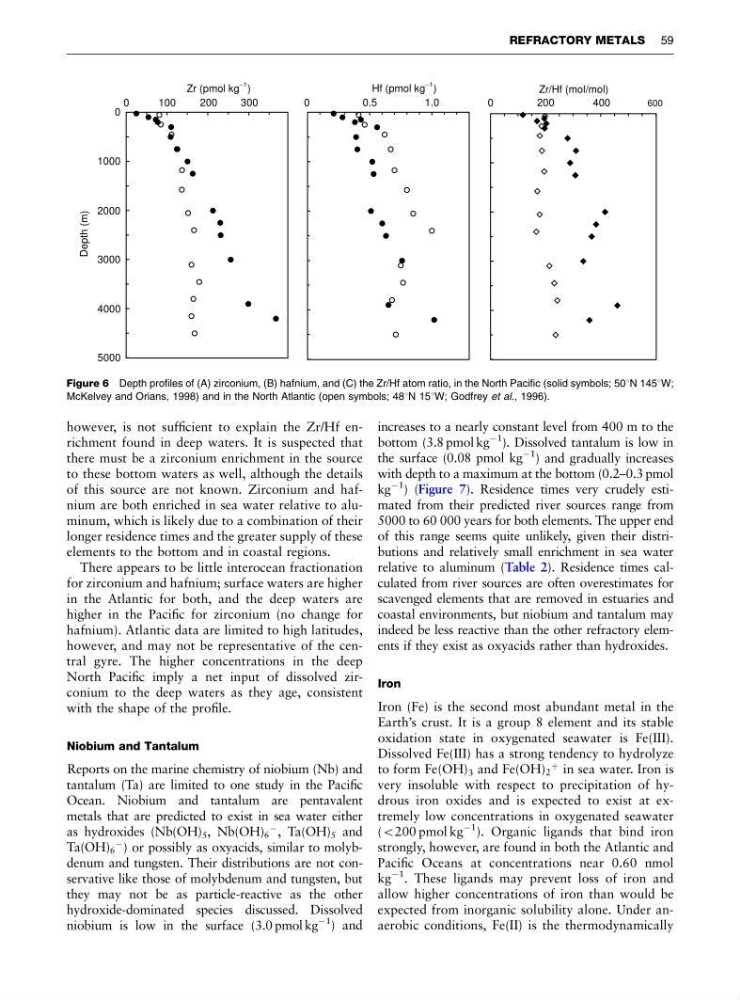
however, is not sufficient to explain the Zr/Hf enrichment found in deep waters. It is suspected that
there must be a zirconium enrichment in the source
to these bottom waters as well, although the details
of this source are not known. Zirconium and hafnium are both enriched in sea water relative to aluminum, which is likely due to a combination of their
longer residence times and the greater supply of these
elements to the bottom and in coastal regions.
There appears to be little interocean fractionation
for zirconium and hafnium; surface waters are higher
in the Atlantic for both, and the deep waters are
higher in the Pacific for zirconium (no change for
hafnium). Atlantic data are limited to high latitudes,
however, and may not be representative of the central gyre. The higher concentrations in the deep
North Pacific imply a net input of dissolved zirconium to the deep waters as they age, consistent
with the shape of the profile.
Niobium and Tantalum
Reports on the marine chemistry of niobium (Nb) and
tantalum (Ta) are limited to one study in the Pacific
Ocean. Niobium and tantalum are pentavalent
metals that are predicted to exist in sea water either
as hydroxides (Nb(OH) 5 , Nb(OH) 6
À , Ta(OH) 5 and
Ta(OH) 6
À ) or possibly as oxyacids, similar to molybdenum and tungsten. Their distributions are not conservative like those of molybdenum and tungsten, but
they may not be as particle-reactive as the other
hydroxide-dominated species discussed. Dissolved
niobium is low in the surface (3.0 pmol kg
À1
) and
increases to a nearly constant level from 400 m to the
bottom (3.8 pmol kg
À1
). Dissolved tantalum is low in
the surface (0.08 pmol kg
À1
) and gradually increases
with depth to a maximum at the bottom (0.2–0.3 pmol
kg
À1
) (Figure 7). Residence times very crudely estimated from their predicted river sources range from
5000 to 60 000 years for both elements. The upper end
of this range seems quite unlikely, given their distributions and relatively small enrichment in sea water
relative to aluminum (Table 2). Residence times calculated from river sources are often overestimates for
scavenged elements that are removed in estuaries and
coastal environments, but niobium and tantalum may
indeed be less reactive than the other refractory elements if they exist as oxyacids rather than hydroxides.
Iron
Iron (Fe) is the second most abundant metal in the
Earth’s crust. It is a group 8 element and its stable
oxidation state in oxygenated seawater is Fe(III).
Dissolved Fe(III) has a strong tendency to hydrolyze
to form Fe(OH) 3 and Fe(OH) 2
þ in sea water. Iron is
very insoluble with respect to precipitation of hydrous iron oxides and is expected to exist at extremely low concentrations in oxygenated seawater
(o200 pmol kg
À1
). Organic ligands that bind iron
strongly, however, are found in both the Atlantic and
Pacific Oceans at concentrations near 0.60 nmol
kg
À1
. These ligands may prevent loss of iron and
allow higher concentrations of iron than would be
expected from inorganic solubility alone. Under anaerobic conditions, Fe(II) is the thermodynamically
0
1000
2000
3000
4000
5000
0
100
200
300
Zr (pmol kg
_ 1 )
Depth (m)
0
0.5
1.0
Hf (pmol kg
_ 1 )
0
200
400
600
Zr/Hf (mol/mol)
Figure 6 Depth profiles of (A) zirconium, (B) hafnium, and (C) the Zr/Hf atom ratio, in the North Pacific (solid symbols; 501N 1451W;
McKelvey and Orians, 1998) and in the North Atlantic (open symbols; 481N 151W; Godfrey et al., 1996).
REFRACTORY METALS 59
there must be a zirconium enrichment in the source
to these bottom waters as well, although the details
of this source are not known. Zirconium and hafnium are both enriched in sea water relative to aluminum, which is likely due to a combination of their
longer residence times and the greater supply of these
elements to the bottom and in coastal regions.
There appears to be little interocean fractionation
for zirconium and hafnium; surface waters are higher
in the Atlantic for both, and the deep waters are
higher in the Pacific for zirconium (no change for
hafnium). Atlantic data are limited to high latitudes,
however, and may not be representative of the central gyre. The higher concentrations in the deep
North Pacific imply a net input of dissolved zirconium to the deep waters as they age, consistent
with the shape of the profile.
Niobium and Tantalum
Reports on the marine chemistry of niobium (Nb) and
tantalum (Ta) are limited to one study in the Pacific
Ocean. Niobium and tantalum are pentavalent
metals that are predicted to exist in sea water either
as hydroxides (Nb(OH) 5 , Nb(OH) 6
À , Ta(OH) 5 and
Ta(OH) 6
À ) or possibly as oxyacids, similar to molybdenum and tungsten. Their distributions are not conservative like those of molybdenum and tungsten, but
they may not be as particle-reactive as the other
hydroxide-dominated species discussed. Dissolved
niobium is low in the surface (3.0 pmol kg
À1
) and
increases to a nearly constant level from 400 m to the
bottom (3.8 pmol kg
À1
). Dissolved tantalum is low in
the surface (0.08 pmol kg
À1
) and gradually increases
with depth to a maximum at the bottom (0.2–0.3 pmol
kg
À1
) (Figure 7). Residence times very crudely estimated from their predicted river sources range from
5000 to 60 000 years for both elements. The upper end
of this range seems quite unlikely, given their distributions and relatively small enrichment in sea water
relative to aluminum (Table 2). Residence times calculated from river sources are often overestimates for
scavenged elements that are removed in estuaries and
coastal environments, but niobium and tantalum may
indeed be less reactive than the other refractory elements if they exist as oxyacids rather than hydroxides.
Iron
Iron (Fe) is the second most abundant metal in the
Earth’s crust. It is a group 8 element and its stable
oxidation state in oxygenated seawater is Fe(III).
Dissolved Fe(III) has a strong tendency to hydrolyze
to form Fe(OH) 3 and Fe(OH) 2
þ in sea water. Iron is
very insoluble with respect to precipitation of hydrous iron oxides and is expected to exist at extremely low concentrations in oxygenated seawater
(o200 pmol kg
À1
). Organic ligands that bind iron
strongly, however, are found in both the Atlantic and
Pacific Oceans at concentrations near 0.60 nmol
kg
À1
. These ligands may prevent loss of iron and
allow higher concentrations of iron than would be
expected from inorganic solubility alone. Under anaerobic conditions, Fe(II) is the thermodynamically
0
1000
2000
3000
4000
5000
0
100
200
300
Zr (pmol kg
_ 1 )
Depth (m)
0
0.5
1.0
Hf (pmol kg
_ 1 )
0
200
400
600
Zr/Hf (mol/mol)
Figure 6 Depth profiles of (A) zirconium, (B) hafnium, and (C) the Zr/Hf atom ratio, in the North Pacific (solid symbols; 501N 1451W;
McKelvey and Orians, 1998) and in the North Atlantic (open symbols; 481N 151W; Godfrey et al., 1996).
REFRACTORY METALS 59